
DC charger for electric vehicle: The Honest 2026 Buying Guide to Power Levels, CCS-2 Connectors, Real Indian Prices and the Site Checks Most Buyers Get Wrong Before They Install One
Power levels from 15 kW to 360 kW, CCS-2 connectors, listed prices in India and the grid checks to run before you buy a DC charger for an EV.
Quick answer
A DC charger for electric vehicle feeds the battery direct current and takes a car to 80 percent in about an hour, if the car accepts that power. Current listings run from 15 kW to 360 kW, but the connector and the grid supply matter as much as the kW figure.
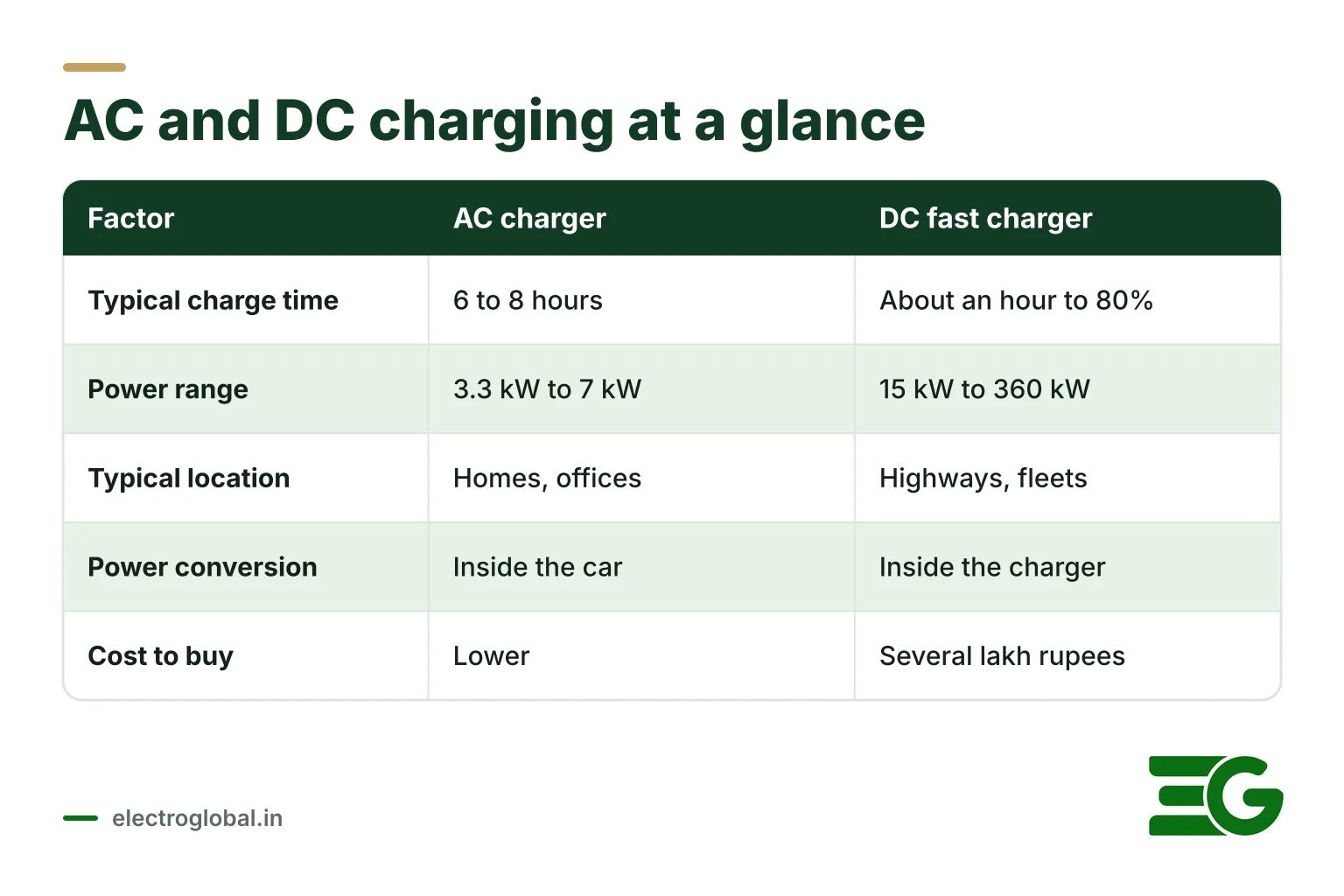
| Factor | AC charger | DC fast charger |
|---|---|---|
| Typical charge time | 6 to 8 hours | About an hour to 80% |
| Power range | 3.3 kW to 7 kW | 15 kW to 360 kW |
| Typical location | Homes, offices | Highways, fleets |
| Power conversion | Inside the car | Inside the charger |
| Cost to buy | Lower | Several lakh rupees |
Introduction
A DC charger for electric vehicle is the piece of charging hardware that changes the shape of a trip. An AC wall unit gives a car a full night's charge. A DC unit gives a highway stop enough range to finish the drive, which is why the site and the connection matter more than the brochure.
Most people start with the power rating. We'd start with the grid connection, the connector and the phase supply, because a 120 kW unit on a supply that cannot carry it is just an expensive cabinet. Get those three right and the kW number is the easy part.
Below we cover how the conversion works, what the power levels in current listings mean, AC against DC, connector standards, prices from the listings, common mistakes and the site checks we'd run before anyone signs a purchase order. Every price and rating comes from manufacturer listings, so get a written quote before you budget.
How a DC charger for electric vehicle works
The conversion happens in the cabinet
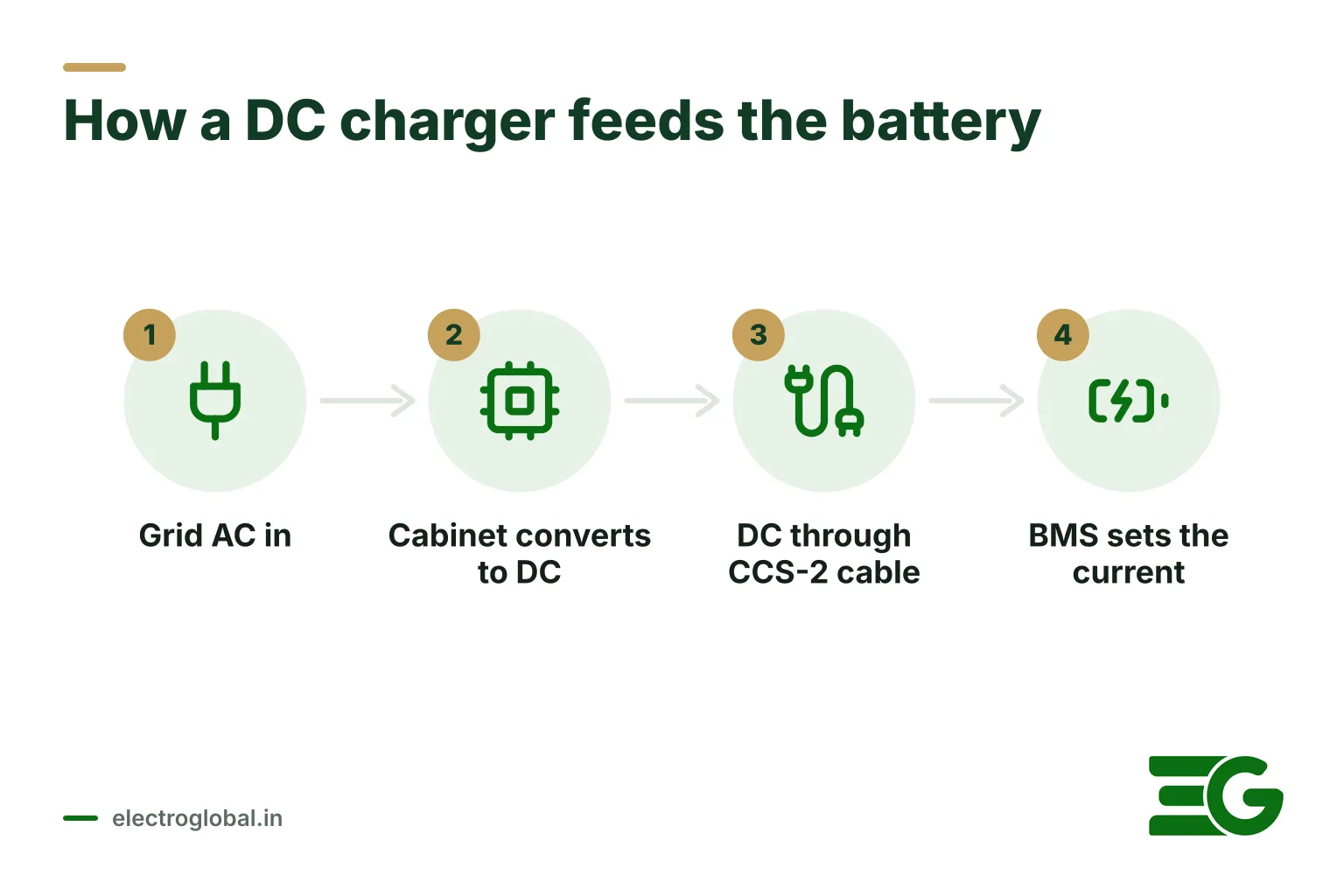
Homes and offices get single-phase 230 V, 50 Hz power. A car battery stores direct current, so the power has to be converted somewhere. In an AC charger the car does that job with its onboard charger. In a DC charger the conversion happens inside the cabinet, and the battery gets DC straight through the cable.
The charger also talks to the car. The battery management system tells the charger what voltage and current it can take, and the charger adjusts its output to match. That handshake is why a DC unit can stop itself when the battery is full, even though nobody is standing next to it.
Why a DC charger for electric vehicle is faster
An AC charger is limited by the car's onboard charger, which has to fit inside the car. Delta's AC listing puts a full charge at 6 to 8 hours. A DC unit skips that bottleneck. A charging vendor's explainer notes that many vehicles reach 80 percent in about an hour or less on current DC fast chargers, but only if the car accepts that power.
Power levels from 15 kW to 360 kW
What the ratings in current listings tell you
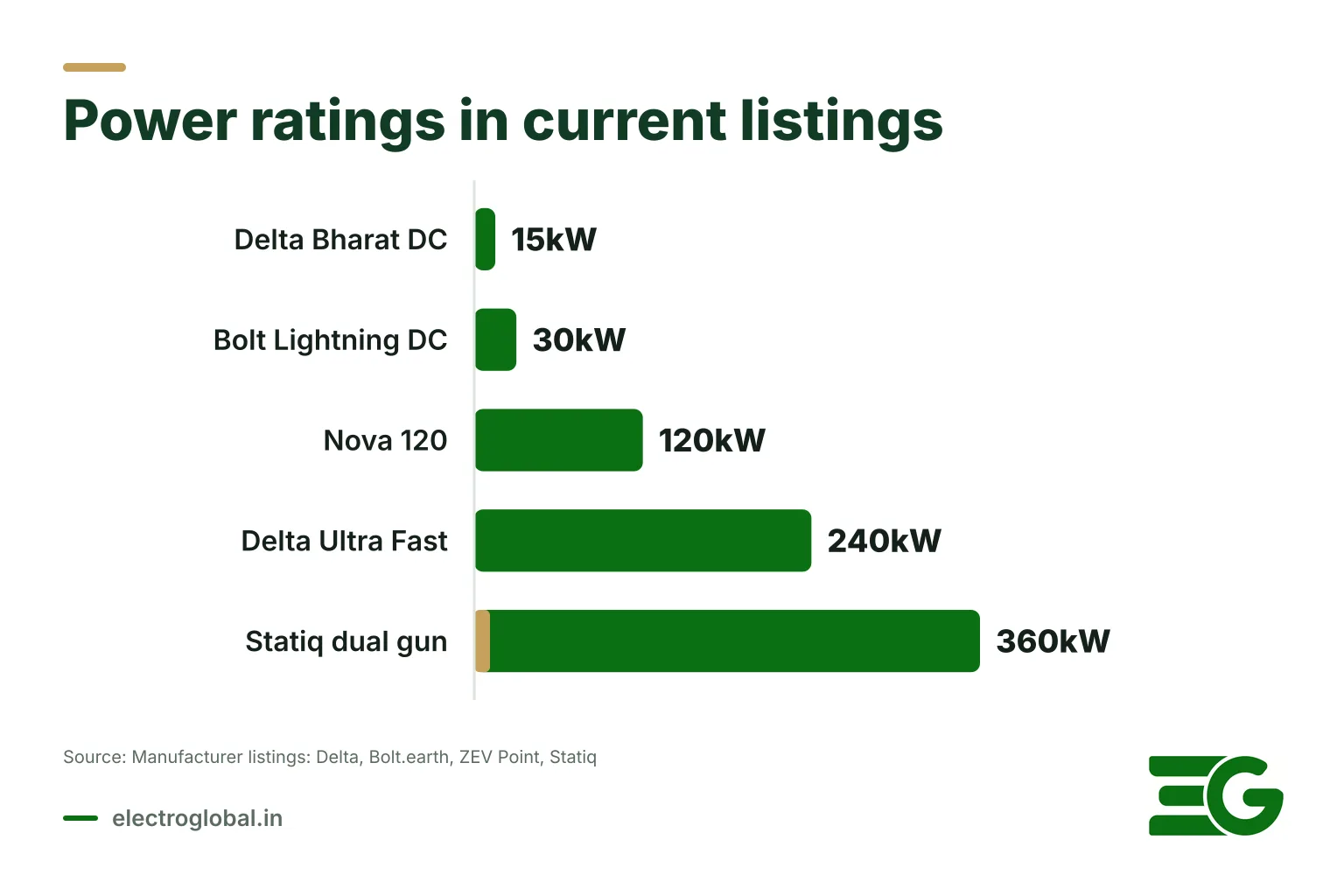
The power rating is the ceiling on the charger, not the speed you get. Delta's compact Bharat DC unit is listed at 15 kW with a single gun. Bolt.earth's Lightning DC starts at 30 kW for small businesses, and its 60 kW, 120 kW and 240 kW dual gun models target highways and busy depots. Delta's 240 kW Ultra Fast charger and Statiq's 360 kW dual gun output sit at the top of the range.
The car decides how much of that it takes. A car that accepts 50 kW will not charge faster on a 120 kW unit, so the number to match is the vehicle's maximum DC intake, not the highest rating on the page. Check the car maker's spec before you pay for a bigger cabinet.
Single gun or dual gun
A single-gun unit serves one car at a time. Dual gun models have two connectors, and Statiq's configurable line lets two vehicles charge at once, with power shared automatically between them. Statiq lists 360 kW as the maximum dual gun output, so each car gets less when both are plugged in.
For a site with two bays, we'd usually pick a dual gun unit. For a single car on a highway with no queue, one gun is enough, and you save the cost of the second connector and cable.
How the car and the charger share power
Think of the charger's kW as the water pressure in a pipe and the car's intake as the size of the bucket. The battery's state of charge also matters: most cars accept their highest current when the battery is low and slow down as it fills. That is why a car that starts a session at 80 kW may be taking far less by the time it reaches 80 percent.
AC or DC: which one you actually need
Most buyers do not need DC at home. A DC charger solves a speed problem, and if the car sits in the driveway overnight, AC does the job at much lower cost. The table shows where each one fits.
Charge time and where each one fits
An AC unit suits homes, private parking and workplaces where cars stay for hours. A DC unit suits highways, fleet depots and public stations, where a driver needs a top-up before the next leg of the trip.
Time at a DC site depends on the queue as much as the charger. A dual gun unit serving two cars shares its output, so each car charges more slowly than it would on a single gun, and that matters when every bay is busy. Count the bays and the stop time you expect before you size the unit, not just the kW.
Cost and installation differences
AC hardware costs much less. Servotech lists its 3.3 kW AC unit at Rs 12,899. A DC unit is a different class of spend. Installation also differs, because a DC site needs a much bigger grid connection and more space for the cabinet, so the hardware price is only the start.
Connectors: CCS-2, CHAdeMO and what your car needs
The connector is the first compatibility check, and it fails more often than the power rating does. A DC charger only works with a car that has a matching DC inlet.
CCS-2 is what the listings use
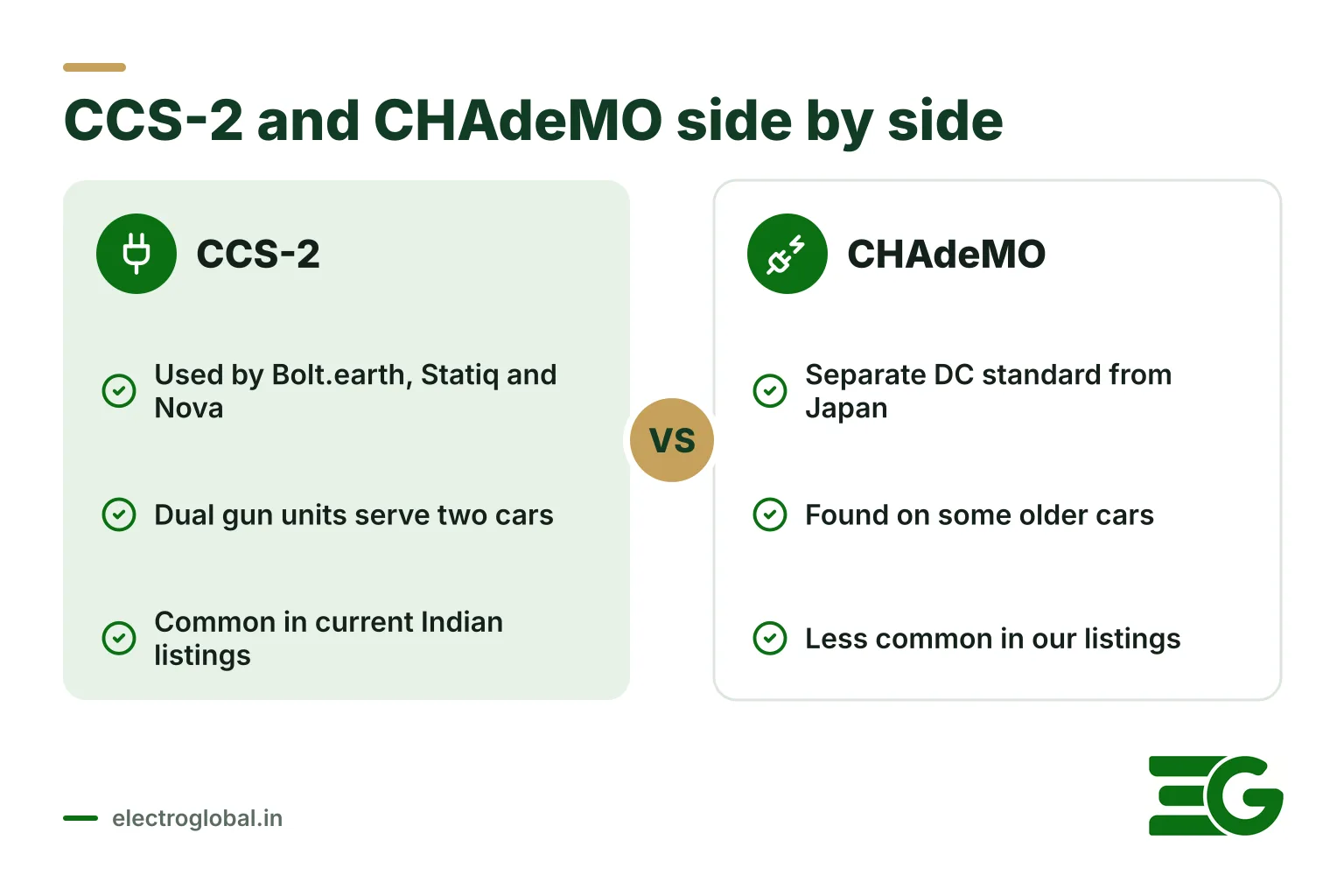
The DC units in our research that name a connector use CCS-2: Bolt.earth's Lightning DC, Statiq's configurable line, Servotech's 60 kW dual gun unit and ZEV Point's Nova 120 kW. CHAdeMO is the other DC standard. An explainer from a charger vendor lists it alongside CCS and Tesla's Supercharger in North America, and it is still found on some older cars.
Check the inlet before you buy
Look at the car's charging port, or the manufacturer's spec sheet, before you choose a unit. A CCS-2 unit will not fill a CHAdeMO car, and a car with no DC inlet cannot use DC power at all. In that case a DC charger is useless for that vehicle, however many kilowatts it has.
What a DC charger costs in India
Prices in the listings we checked
Listed prices are a starting point, and they change. Bolt.earth lists its 30 kW Lightning DC at ₹3,69,999. ZEV Point lists its 120 kW Nova at Rs 770,000 ex-factory, so freight and taxes come on top. Servotech lists a 360 kW dual gun unit at about Rs 24.84 lakh. Those three points show the spread: a few lakh rupees for a small unit, and well over twenty lakh for a highway-class unit.
Costs the listing does not show
The cabinet is the smaller bill. A DC site needs a grid connection sized for the load, civil work for the foundation and cable run, and the charger's network and payment set-up. Nova 120 kW lists OCPP 1.6, RFID and UPI or card payment, so budget for the back-end software and the payment gateway, not just the metal.
Ask the distribution company for the connection quote early. It is the item most likely to change the schedule, and nobody can estimate it from a product page.
Site checks we'd run before you buy
These are the checks we'd run on paper before anyone commits money. None of them takes long, and each one is cheap before the order and expensive after it.
Grid supply and phase
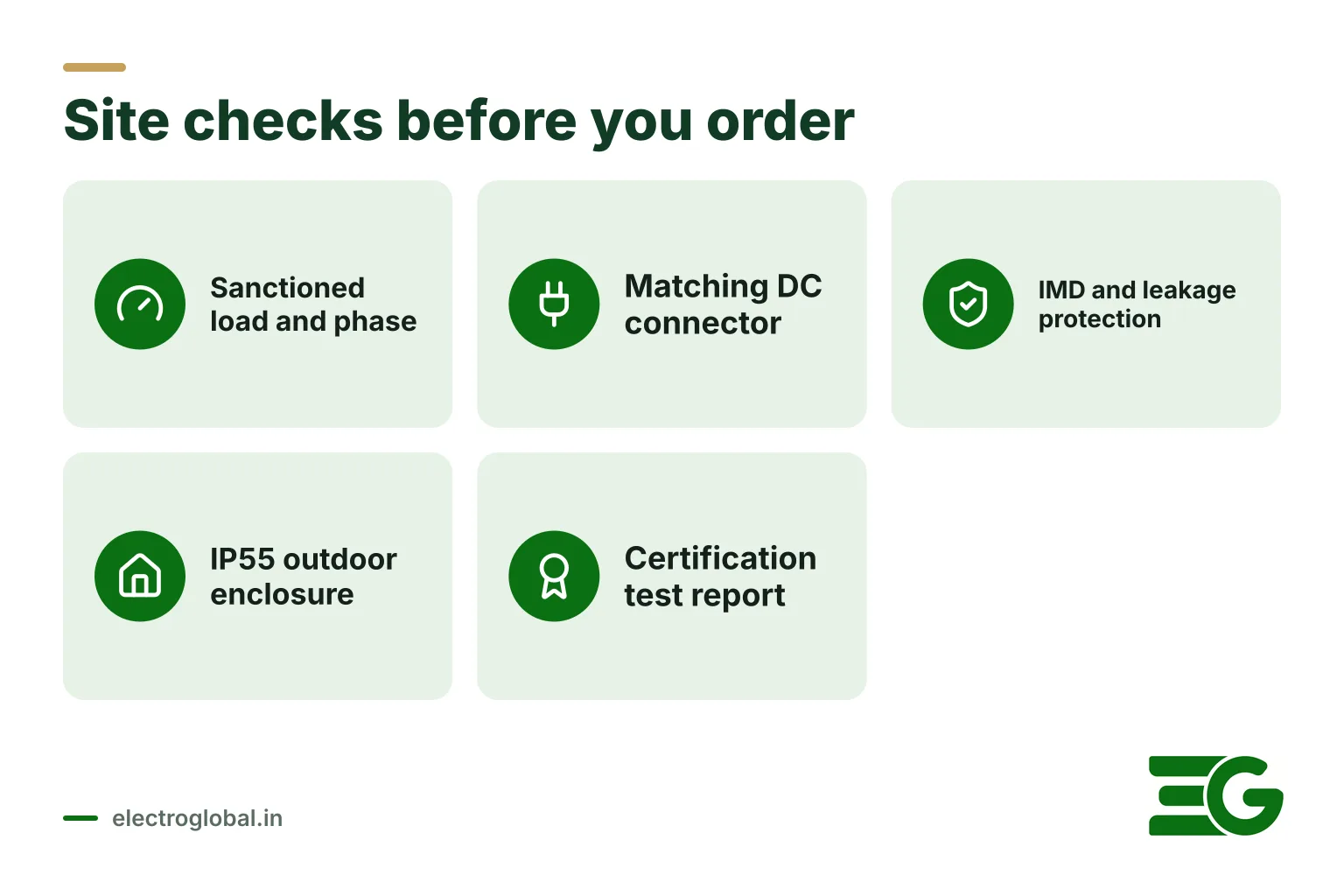
Start with the supply. Servotech lists its 60 kW DC unit as three-phase, so a single-phase 230 V connection is unlikely to be enough for that class. Confirm the available phase, the sanctioned load and the transformer capacity with the distribution company before you choose the kW rating.
Outdoor protection and safety
A public or fleet charger lives outside, through Jaipur summer heat and monsoon humidity. Statiq lists an IP55 and IK10 enclosure, and its unit includes insulation monitoring (IMD) and leakage protection. Those are the features to ask about. Also ask for the certification paperwork. Nova 120 kW is listed as ARAI-certified, and Delta lists ARAI/ICAT among its certifications. Request the test report, not just the logo.
Bench tip: Ask the vendor for the rated output at your site voltage, not the brochure number. Cable length and supply sag both cut the real power you get.
Advantages and limits of a DC fast charger
DC fast charging is the only option that keeps a car moving on a long drive. It also costs more to install, needs more grid capacity and puts a bigger load on the local network. Those trade-offs are the real decision.
- Fastest option for a driver who cannot wait overnight
- Dual gun units serve two cars from one cabinet
- Needs a large grid connection and more site space
- Higher hardware and installation cost than AC
Where DC makes sense
Highway corridors, fleet depots with a tight turnaround and public stations near busy roads all benefit. A driver who needs 80 percent in about an hour gets nothing from an AC unit in that window.
Where it does not
For a single car charged overnight at home, DC is overkill. Frequent fast charging also adds heat and wear over time. Occasional DC top-ups are fine for most batteries, but daily fast charging is a habit we'd avoid if the car will be kept for years. Check the car maker's warranty terms.
Common mistakes buyers make with DC chargers
Reddit threads about home DC charging keep returning to the same few mistakes. None of them is about the hardware being bad. They are about asking the wrong question first.
Expecting a large efficiency gain
People read that DC is more efficient than AC and assume the bill will fall. The gain is real but usually small. What you actually buy with DC is time, and the price of that time is the hardware and the grid connection.
Buying a home DC unit for a single car
The DC use cases that make sense are fleets and highways, where a car has to turn around fast. A single commuter with a home AC charger rarely needs one, and the extra cost will not come back as saved time.
Forgetting the cable and the rest of the site
A cabinet with the right kW rating still underperforms if the cable run is too long or the supply sags under load. Plan the cable route, the earthing and the metering with the installer before the unit arrives, not after.
Conclusion: which DC charger to shortlist first
Start with the car's DC inlet and the site's grid connection. Once those two are confirmed, pick the power level that matches the car's maximum intake, and pick a dual gun unit only if two cars will charge at the same time.
For the chargers and power parts we carry, browse our chargers category. If you are planning a battery system around a charger, our battery range and BMS boards are a good place to compare cell and protection options. Send us your load and supply details and we'll help you check the sizing before you order.
For the standards themselves, the Combined Charging System and CHAdeMO pages explain the two connector families in more detail.
Tagged