
Lithium Battery Cell Price in India: The Honest 2026 Guide to 18650, 21700 and 32140 Cells, Real Indian Prices and the Pack Math Most Buyers Skip Before Building a 12V Battery Bank
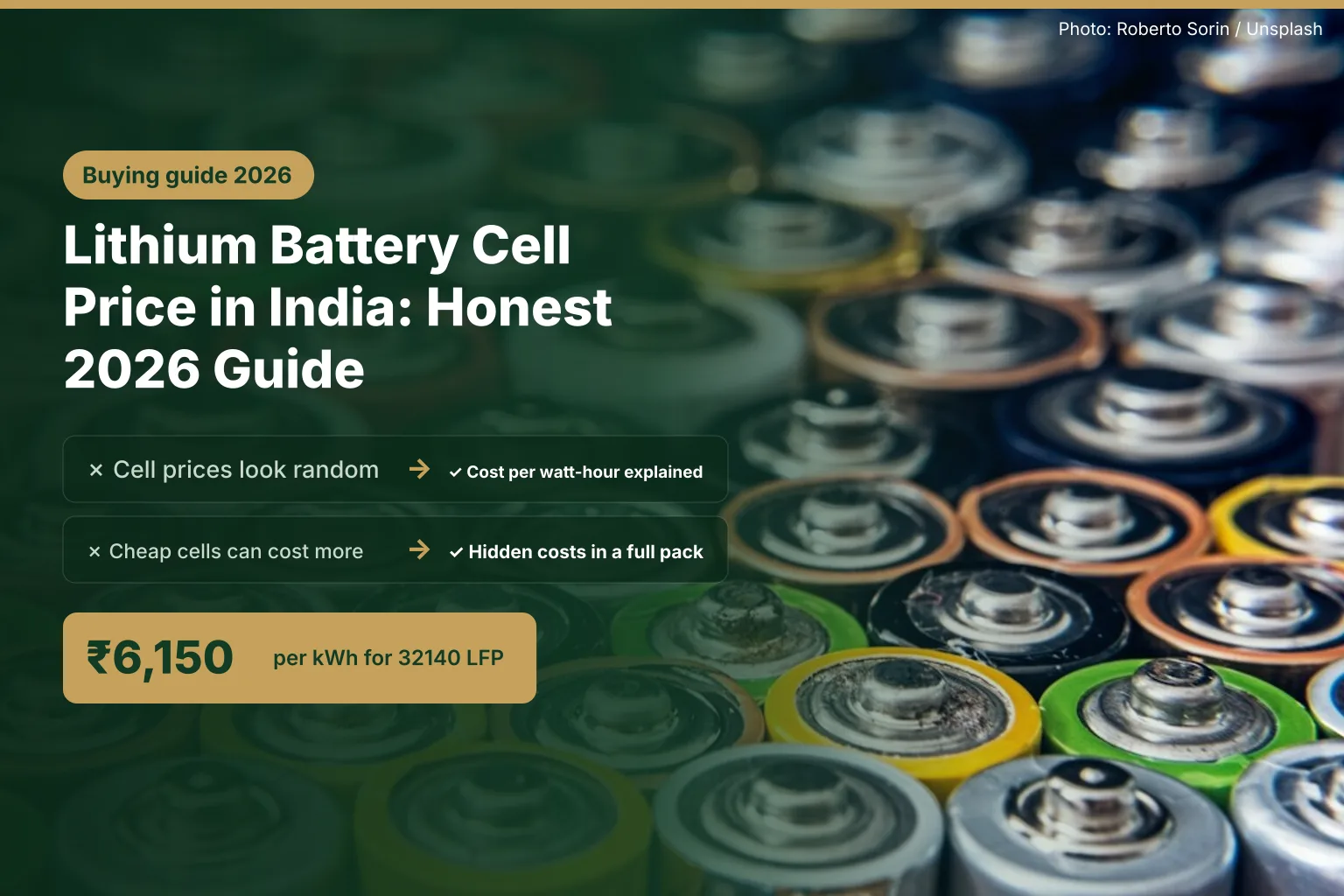
Lithium battery cell price in India looks cheap per piece, but the real number is cost per kWh. We compare 21700, 18650 and 32140 cells from Indian sellers.
Quick answer
Lithium battery cell price in India ranges from about ₹120 to ₹378 per cell for the LiFePO4 formats we checked. A 3.2 V, 15Ah 32140 cell sells for ₹295 to ₹378 with a 40-piece minimum, while a single 21700 Li-ion cell costs ₹219 but roughly twice as much per watt-hour.
- ✗ Cell prices look random → ✓ Cost per watt-hour explained
- ✗ Cheap cells can cost more → ✓ Hidden costs in a full pack
| Cell | Price (INR) | Minimum order |
|---|---|---|
| 21700 Li-ion 4500mAh | ₹219 each | Not listed |
| 32140 LiFePO4 15Ah (MIANYANG) | ₹295 each | 40 pieces |
| 32140 LiFePO4 15Ah (CBAK) | ₹340 each | 40 pieces |
| 32700 LiFePO4 6Ah (HX) | ₹120 each | 100 pieces |
Introduction
Lithium battery cell price in India depends on four things: the chemistry, the cell format, the grade and how many pieces you have to order. Get one of those wrong and the cheapest listing on the page can end up costing you more than a dearer cell.
Most buyers sort listings by price per piece, pick the lowest and then find the pack sags under load or the final bill is higher than planned. We have seen this on the bench more than once. A cell's sticker price tells you very little until you divide it by the energy the cell stores.
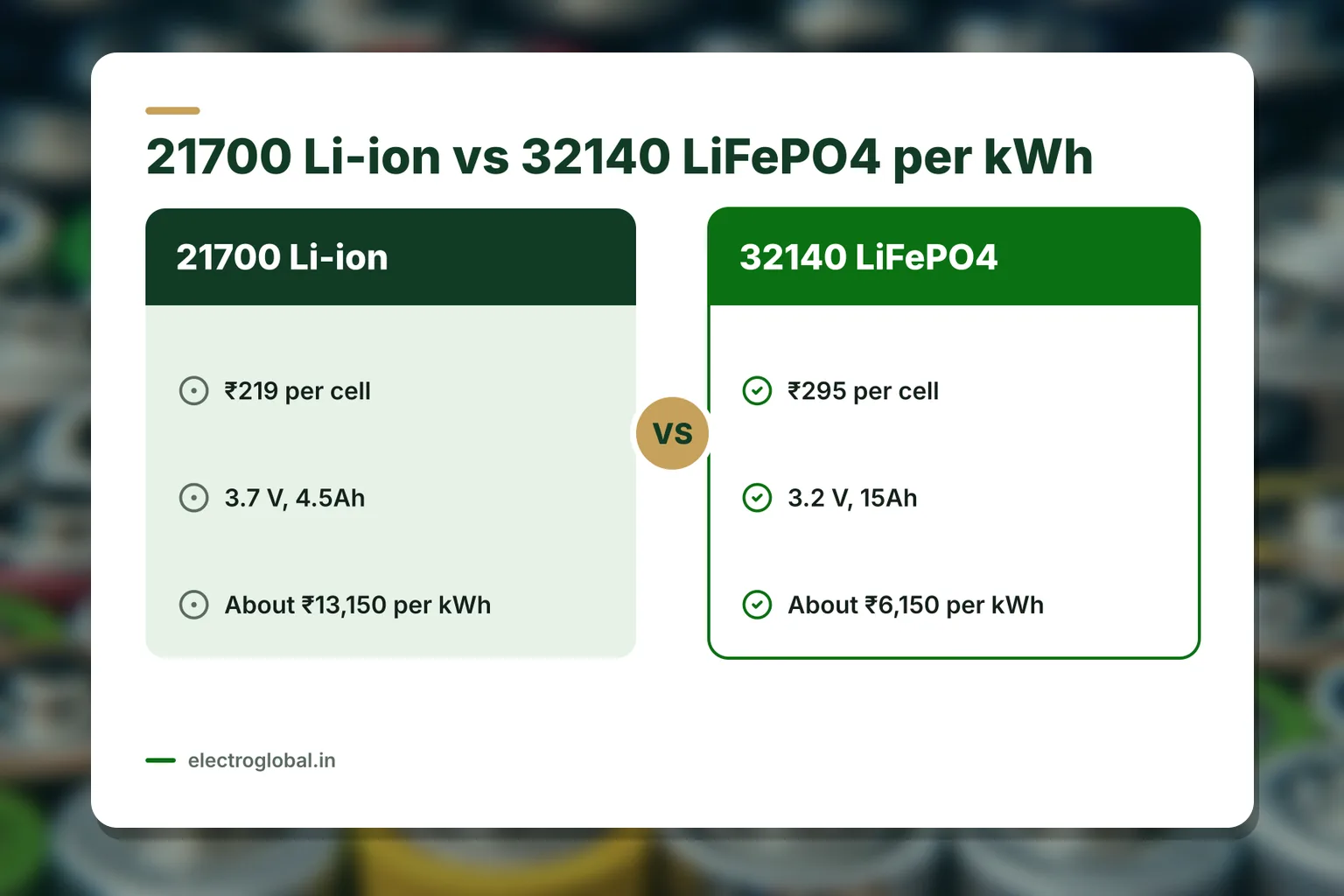
Our short answer: in the Indian listings we checked, the 32140 and 32700 LiFePO4 cells work out to about ₹6,150 to ₹7,870 per kWh, while a 21700 Li-ion cell works out to about ₹13,150 per kWh. The rest of this guide shows how we got those numbers and how you can check any cell yourself.
Lithium battery cell price: what drives the number
Four factors set what a cell costs you. Chemistry comes first, then the physical format, then the grade, then the order size. Each one changes both the price and the usable energy, so compare them together.
Chemistry: Li-ion or LiFePO4
Most 18650 and 21700 cells are lithium-ion battery chemistry with a nominal voltage of 3.6 to 3.7 V. The 32140 and 32700 cells in our search are LiFePO4 battery chemistry, rated at a nominal 3.2 V. LiFePO4 stores less energy per kilogram and needs more space for the same watt-hours, but it tolerates repeated deep discharge better and is more stable when it is damaged or overheated. For a 12V or 24V home battery bank, we would pick LiFePO4 nearly every time. For a small handheld device, Li-ion is usually the better fit.
Format and capacity
The numbers in a cell's name give its size. An 18650 cell is 18 mm across and 65 mm long. A 21700 is 21 mm by 70 mm, and a 32140 is 32 mm by 140 mm. Bigger cells hold more energy, but they also cost more per piece. The price per piece tells you nothing on its own. You need the capacity in amp-hours (Ah) and the nominal voltage, because together they give the watt-hours (Wh) you actually get. If you only need one cell to test a circuit, our single fast-charge lithium battery cell price listing is the quickest place to start.
Grade, order size and MOQ
Sellers label cells as EV grade, ESS grade or unsorted. EV and ESS grade cells are usually sorted more tightly on capacity and internal resistance, which matters when you wire several cells in parallel. Many Indian listings also set a minimum order quantity (MOQ). In our search, the 32140 and 32700 LiFePO4 cells came with MOQs of 40 to 100 pieces, which is a lot for a hobby build. Check the MOQ before you compare prices, or you will end up buying a box you did not plan for.
Cost per watt-hour: the number that matters
Cost per watt-hour puts every cell on the same scale. It is the only fair way to compare a 3.7 V cell with a 3.2 V cell, or a 15Ah cell with a 6Ah one.
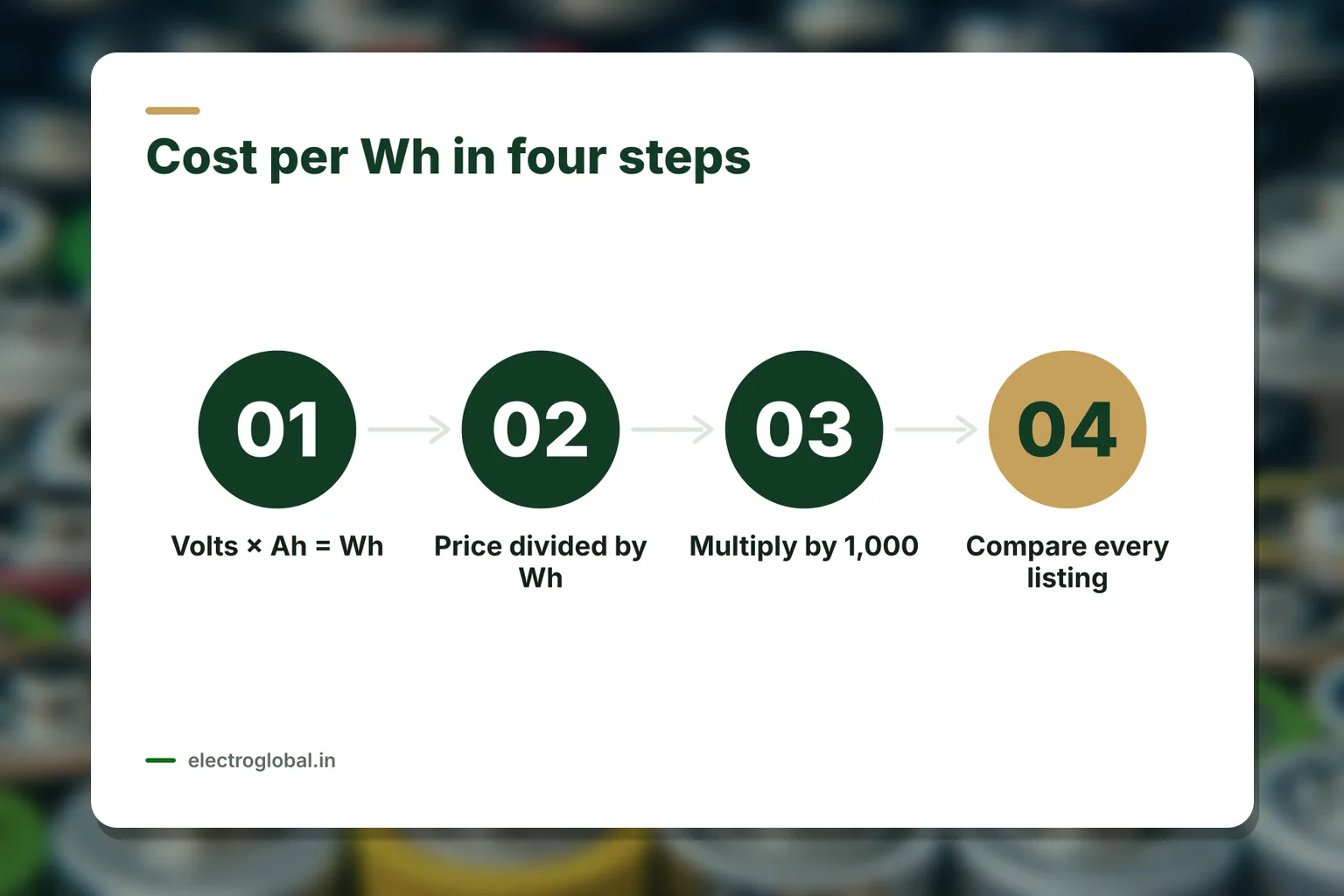
The formula in four steps
- Multiply the nominal voltage by the amp-hours to get watt-hours. For example, 3.2 V × 15 Ah = 48 Wh.
- Divide the price per piece by the watt-hours. For example, ₹295 ÷ 48 Wh = about ₹6.15 per Wh.
- Multiply by 1,000 to get the price per kWh. That gives about ₹6,150 per kWh.
- Repeat for every cell on your shortlist, always using the same unit.
What the formula shows
Run the numbers on the cells we found and the picture changes. A 21700 cell at ₹219 looks cheap, but its 4.5Ah at 3.7 V stores only about 16.7 Wh, which works out to near ₹13,150 per kWh. The 32140 cell at ₹295 stores 48 Wh, so it comes out near ₹6,150 per kWh. The bigger LiFePO4 cell is cheaper per unit of energy, though it is bulkier and takes more room in your enclosure. A cheap-looking cell that stores little energy is the most common trap we see.
Cell prices we found in Indian listings
We checked product pages from Indian sellers, including ARB Accessories, Aqueouss, MyInnovation and MakerBazar. Prices change often and some pages show old offers, so treat these figures as a snapshot, not a quote. GST and shipping are extra in most cases.
Li-ion 21700 and 18650 cells
The Norda ND Original 21700 cell, rated 3.7 V and 4500mAh, was listed at ₹219 each. The page showed a single-cell price with no minimum order, so it suits a prototype or a small repair. The 18650 listings we saw were mostly 2600mAh to 3000mAh cells, but the price was not clear on every page. Check the live listing before you build a budget around one.
LiFePO4 32140 and 32700 cells
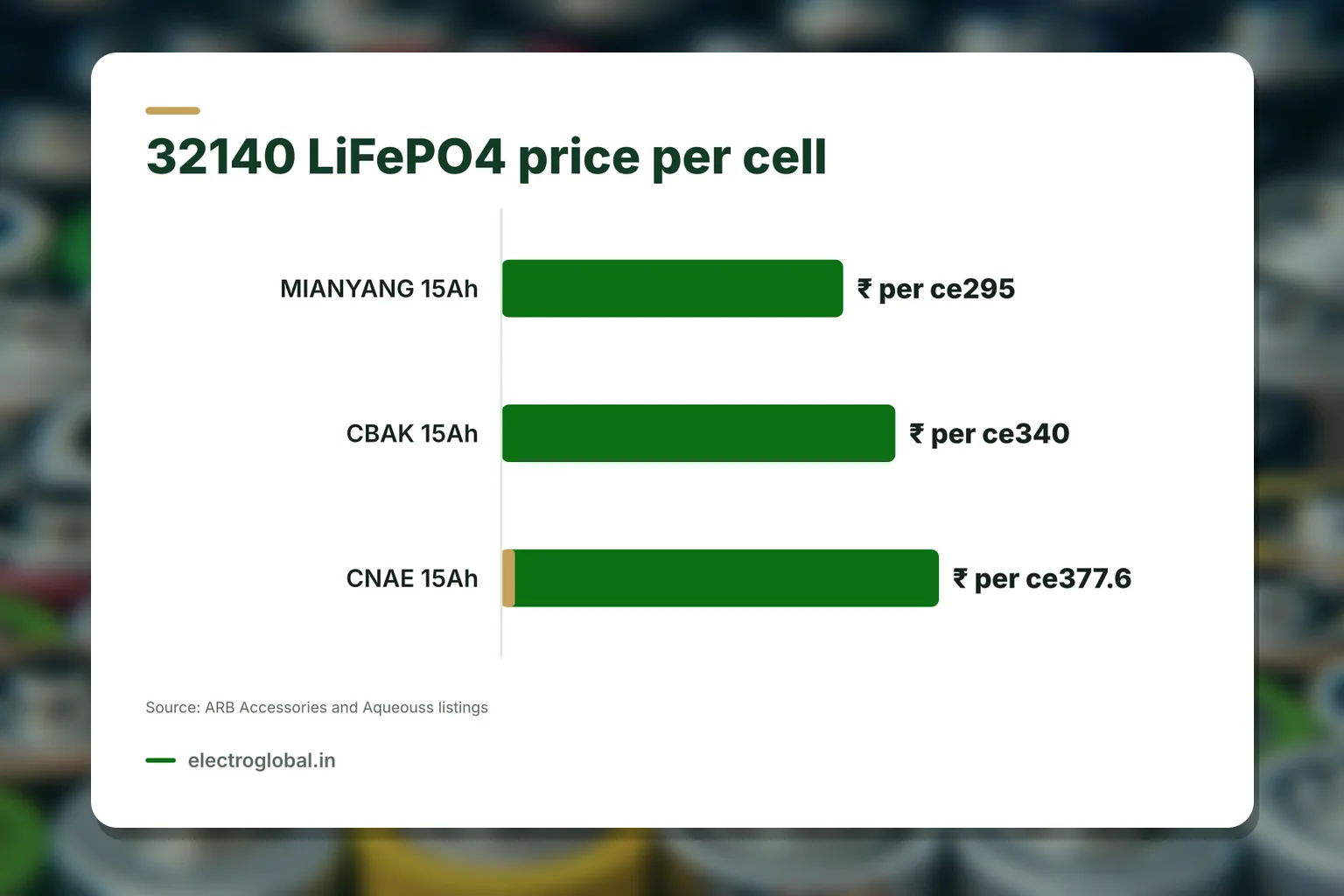
The 32140 and 32700 LiFePO4 cells were the best value per watt-hour in this search. MIANYANG ESS A-grade 15Ah cells were listed at ₹295 each and CBAK EV-grade 15Ah cells at ₹340. A CNAE 15Ah cell was listed at ₹377.60, down from ₹400. The MIANYANG and CBAK listings both need a minimum of 40 pieces, which comes to ₹11,800 and ₹13,600 before you add anything else. The HX 32700 6Ah EV-grade cell was ₹120, but its MOQ is 100 pieces, so the batch costs ₹12,000.
Advantages and limits of LiFePO4 and Li-ion cells
Neither chemistry wins every job. The right choice depends on the load, the space and how often you cycle the pack.
Where LiFePO4 wins
LiFePO4 is cheaper per watt-hour in the listings above, handles many more charge cycles and is less likely to run away when it is abused. That makes it the sensible choice for solar storage, inverters and any pack that sits on a shelf for months and gets topped up. Its limits are the lower voltage and the extra weight, so a drone or a racing robot is a poor fit.
Where Li-ion still wins
Li-ion cells give a higher voltage per cell and pack more energy into a small, light body. That is why 18650 and 21700 cells still power laptops, flashlights and most small handheld tools. The cost is a higher price per watt-hour in our listings, and a stricter need for a matched protection board. If you cannot fit a 32140 cell into the design, a Li-ion pack is the practical answer.
Lithium battery pack price versus cell price
A finished pack is more than a stack of cells. It adds a battery management system (BMS), busbars, wire, a fuse and a case, and the seller prices all of that into one number. The comparison is useful, but only if you know what is included. Our lithium battery pack category lists finished packs, so you can see the full price rather than working it out from cells.
Finished packs cost more per watt-hour
A 48V 30Ah electric scooter pack listed at ₹20,499 on MyInnovation stores about 1,440 Wh, which works out to about ₹14,230 per kWh. A 24V 5.8Ah e-cycle pack listed at ₹1,650 on LithiumIonBatteries.in stores about 139 Wh, or about ₹11,850 per kWh. Both come out at roughly 1.9 to 2.3 times the bare MIANYANG cell at ₹6,150 per kWh. That gap is what you pay for the BMS, the enclosure and the assembly. Two different sellers and two different pack designs make this a rough comparison, not a perfect one.
Building a lithium ion battery pack from cells
If you assemble your own pack, you pay for the cells, a BMS matched to the chemistry and voltage, and your time. For bench tests, start with a single original 18650 2600mAh cell from our lithium ion battery pack listings before you commit to a full build. Once you know how the cell behaves under your load, scale up one series group at a time.
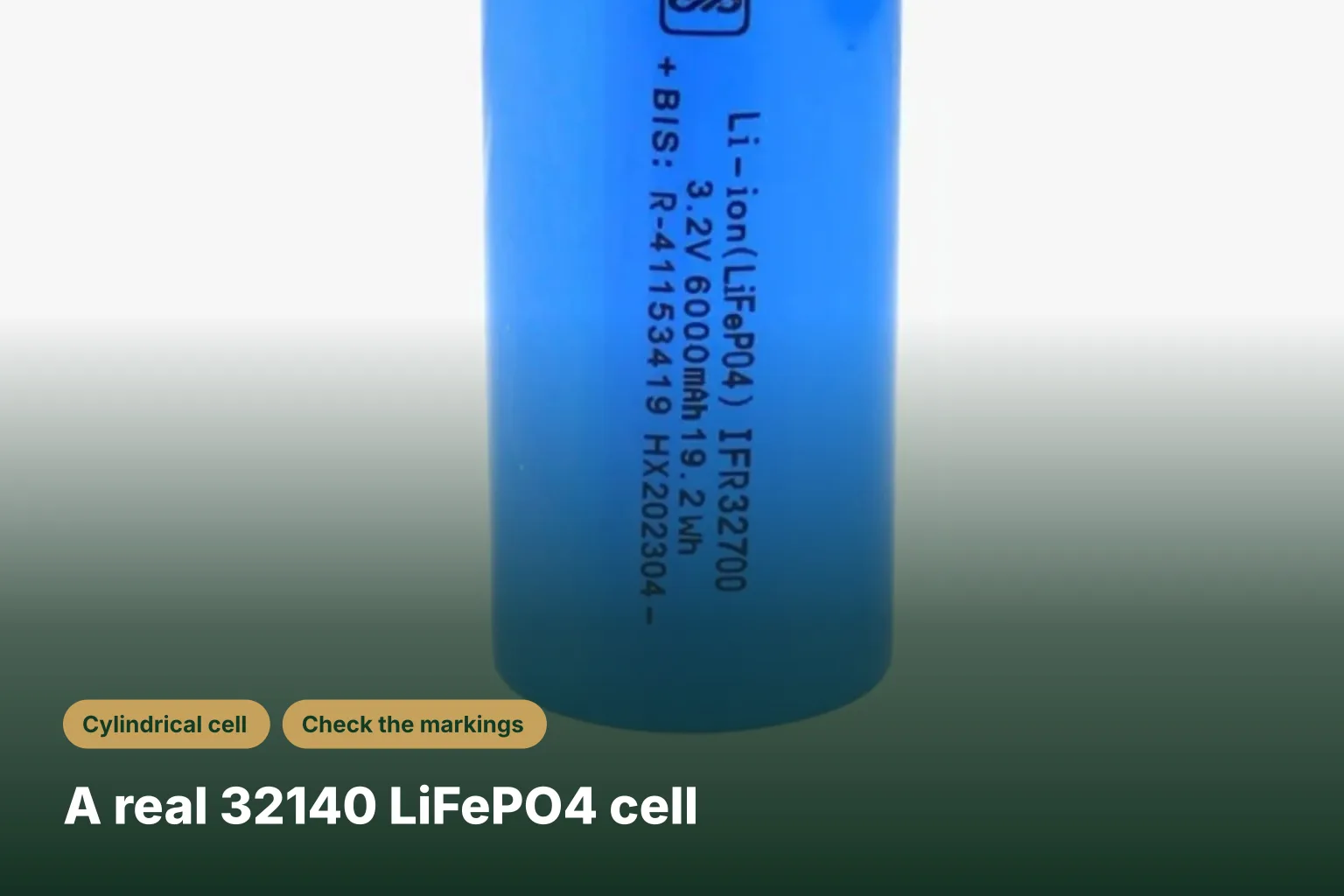
Building a 12V bank from 32140 and 32700 cells
A 12V LiFePO4 bank is four cells in series, or 4S. Four cells at 3.2 V give 12.8 V nominal, which is the usual 12V battery voltage. To reach roughly 100Ah, you add cells in parallel (P) until the total amp-hours are there.
The 4S layout
With 15Ah cells, seven parallel groups give 105Ah, so a 4S7P bank uses 28 cells. With 6Ah cells you need 17 parallel groups to reach about 102Ah, so a 4S17P bank uses 68 cells. More parallel cells mean more joints and more balancing work, so the 15Ah cells are the simpler build when you can get them.
Cell cost for a 100Ah bank
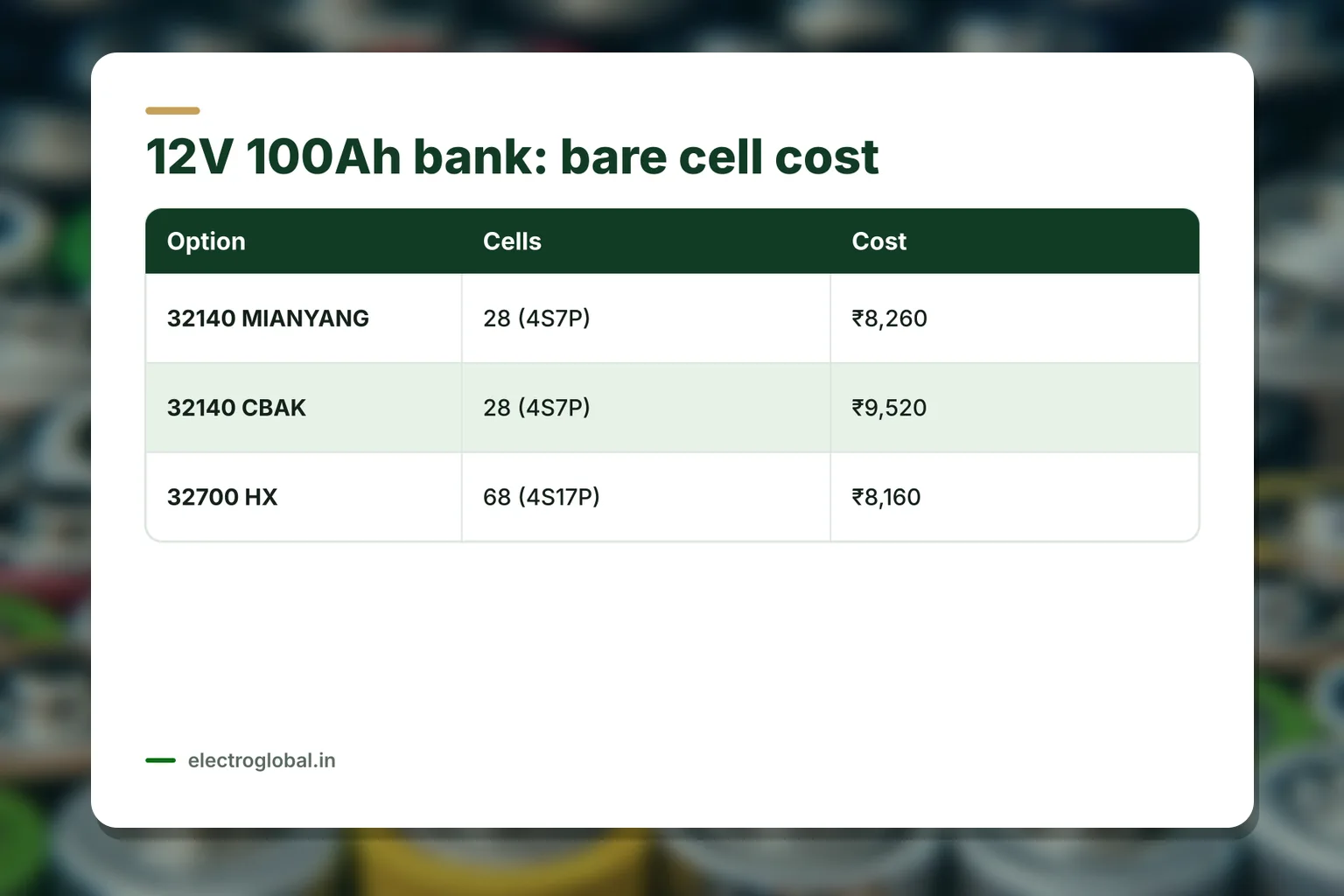
This is the bare-cell cost of a 12V 100Ah bank, before the BMS, busbars, wire and enclosure:
| Option | Cells needed | Cell cost |
|---|---|---|
| 32140 15Ah, MIANYANG | 28 cells (4S7P) | ₹8,260 |
| 32140 15Ah, CBAK | 28 cells (4S7P) | ₹9,520 |
| 32700 6Ah, HX | 68 cells (4S17P) | ₹8,160 |
The 32700 bank is the cheapest on paper, but at 68 cells it needs a 100-piece MOQ on the HX listing, and it takes far more space and joints. For a home bank we would pick the MIANYANG option, provided the seller confirms capacity and grade. Ask for a capacity test report before you order 28 cells.
Lithium battery price with a BMS and charger
A BMS stops over-charge, over-discharge and short circuits, and it balances the cells over time. For a 3S Li-ion pack, a lithium battery price check should start with a 3S 10A protection board, which is a common choice for drones, robots and small tools. Match the board to your cell chemistry and voltage. A LiFePO4 board has voltage limits set for LiFePO4, so it is wrong for NMC cells, and a 3S board is wrong for four cells in series.
The BMS is a small cost next to the cells, but a missing one can cost you the whole pack. Charger choice matters too. A charger set for 4.2 V per cell will overcharge a LiFePO4 pack, so check the charge voltage before you plug in.
Bench tip: Measure each cell's voltage before you join them. Cells that start far apart in voltage take much longer to balance, and the BMS works harder for the whole life of the pack.
Buying checklist and common mistakes
Choosing a lithium cell for your project
Start with the pack you want, then work back to the cell. Our lithium cell buying guide goes through capacity, discharge rating and voltage in more detail. Read it before you order a box of 40 pieces.
Common mistakes we see on the bench
Buying threads on Reddit keep returning to the same few mistakes, and we see them too:
- Buying on the lowest price per piece without checking Wh, so the pack ends up costing more per kWh.
- Ordering a box of 40 or 100 cells when the project needs four.
- Assuming the printed Ah is the real Ah. Test a sample before you wire it in.
- Skipping the BMS to save money, then losing the pack to one deep discharge.
Buying checklist
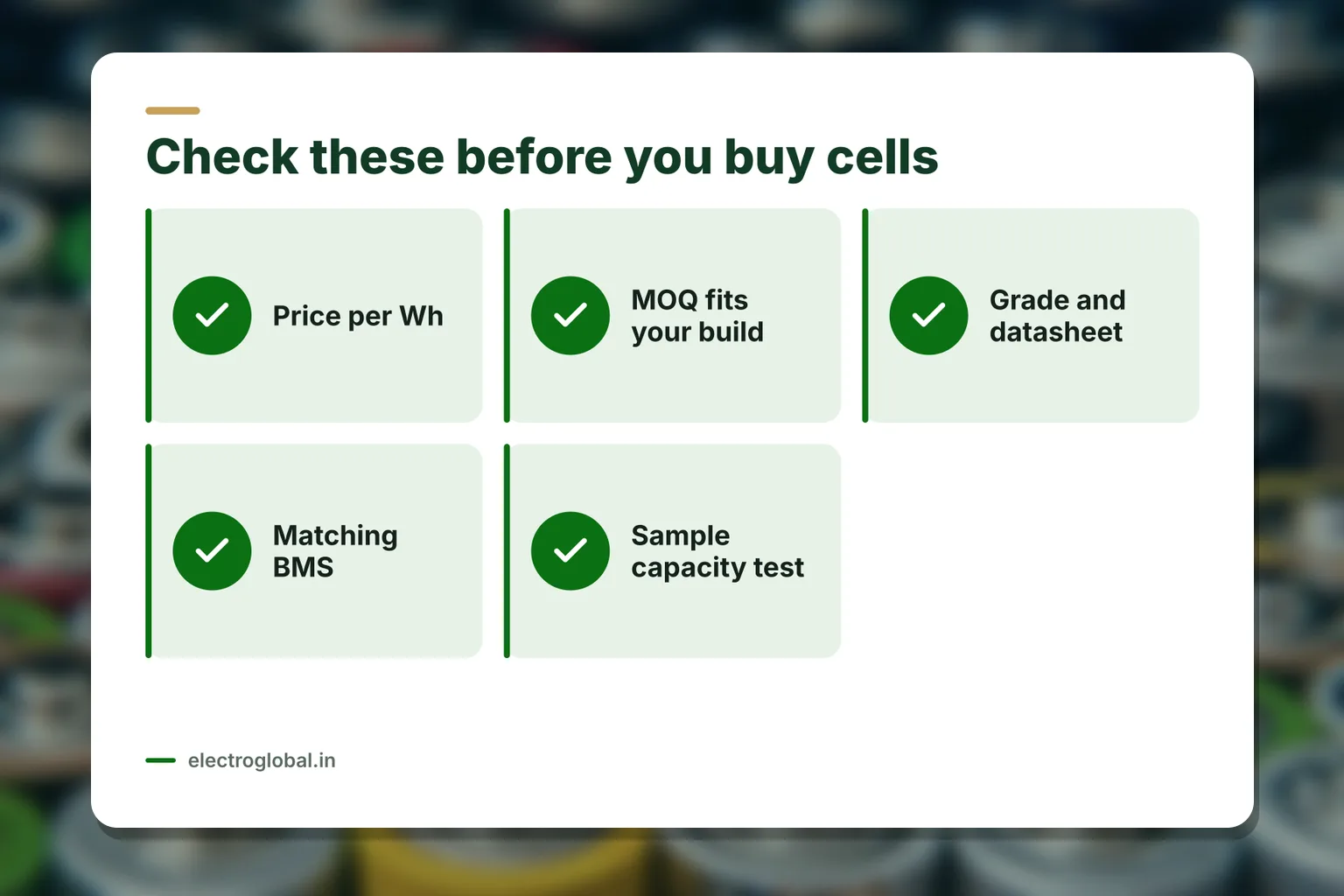
- Convert every price to ₹ per Wh or per kWh before you compare.
- Check that the MOQ fits your build.
- Confirm the cell format, grade and capacity in writing.
- Ask for a datasheet or a sample capacity test.
- Order the BMS and busbars in the same purchase as the cells.
Conclusion: buy by cost per watt-hour, not sticker price
For most home and robot projects, a 32140 LiFePO4 cell gives the lowest cost per watt-hour among the Indian listings we checked. A 21700 Li-ion cell costs roughly twice as much per unit of energy. Convert every listing to ₹ per kWh, then check the MOQ, the grade and the BMS before anything goes into the cart.
When you are ready to order, browse the cells and packs on electroglobal.in and pick the format that fits your build.
Tagged