
Lithium Battery Pack: The Honest 2026 Buying Guide to Chemistries, Voltages, Real Indian Prices and the BMS Checks That Stop Your Project Failing Mid-Run, Whether You Buy One or Build Your Own
A lithium battery pack needs the right chemistry, a BMS and a matched build. Here is what to check, with real Indian prices and a buying checklist.
Quick answer
A lithium battery pack is a set of lithium cells wired in series for voltage and in parallel for capacity, with a BMS to protect them. For solar and inverter backup, pick LiFePO4, and for robots and e-bikes, pick Li-ion NMC, always with a BMS.
- ✗ Robot resets when motors start → ✓ Right chemistry and BMS
- ✗ Unknown packs with no protection → ✓ Five checks before you buy
| Use | Pick | Why |
|---|---|---|
| Solar or inverter backup | LiFePO4 | Safe, 2000+ cycles |
| Robot or e-bike | Li-ion NMC | Light, high energy |
| Hobby robot on a budget | Li-ion NMC 3S | Light, needs a BMS |
Introduction
A lithium battery pack is the part of a robot, e-bike or solar build that gets the least thought and causes the most trouble. In our experience, most random resets in motor projects trace back to the battery, not the code. A pack is a set of lithium cells wired in series and parallel, with a protection board (BMS) that stops overcharge, over-discharge and short circuits.
This guide covers what a pack is, what packs cost in India, the three chemistries you will see on sale, how to choose one for your load, and the checks we run before a pack goes near a motor or an inverter. It's written for makers, students and small teams who want a pack that works on the first try.
If you plan to build your own, read the DIY section before you buy any cells. A cell with no protection is a hazard, and the reasons are set out below.
Lithium battery pack basics: cells, series and parallel
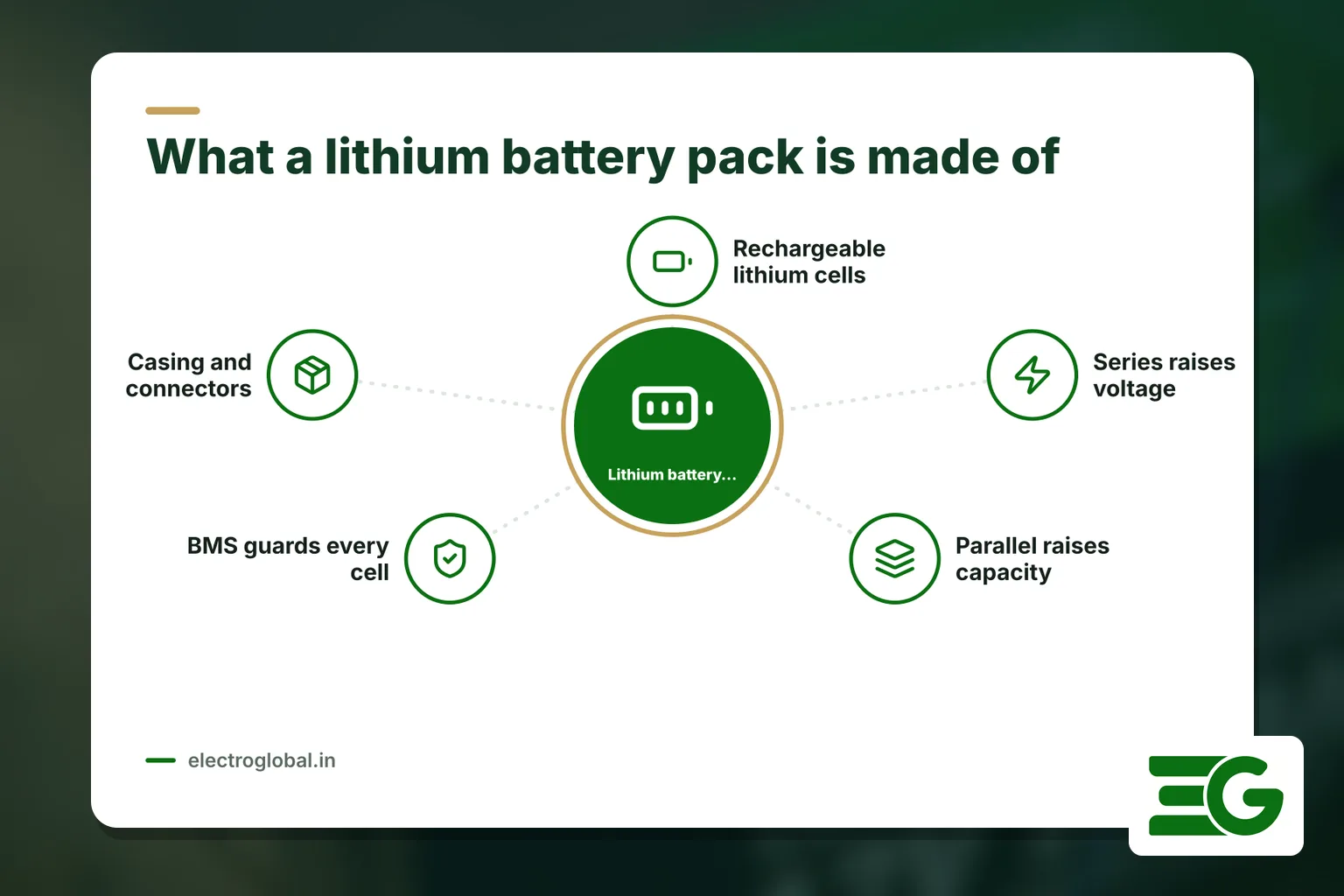
Every pack starts with single cells. The common ones in India are 18650 cylinders, about 18 mm across and 65 mm long, and prismatic LiFePO4 cells for bigger packs. Each cell has a nominal voltage set by its chemistry, and the pack voltage comes from how you join the cells.
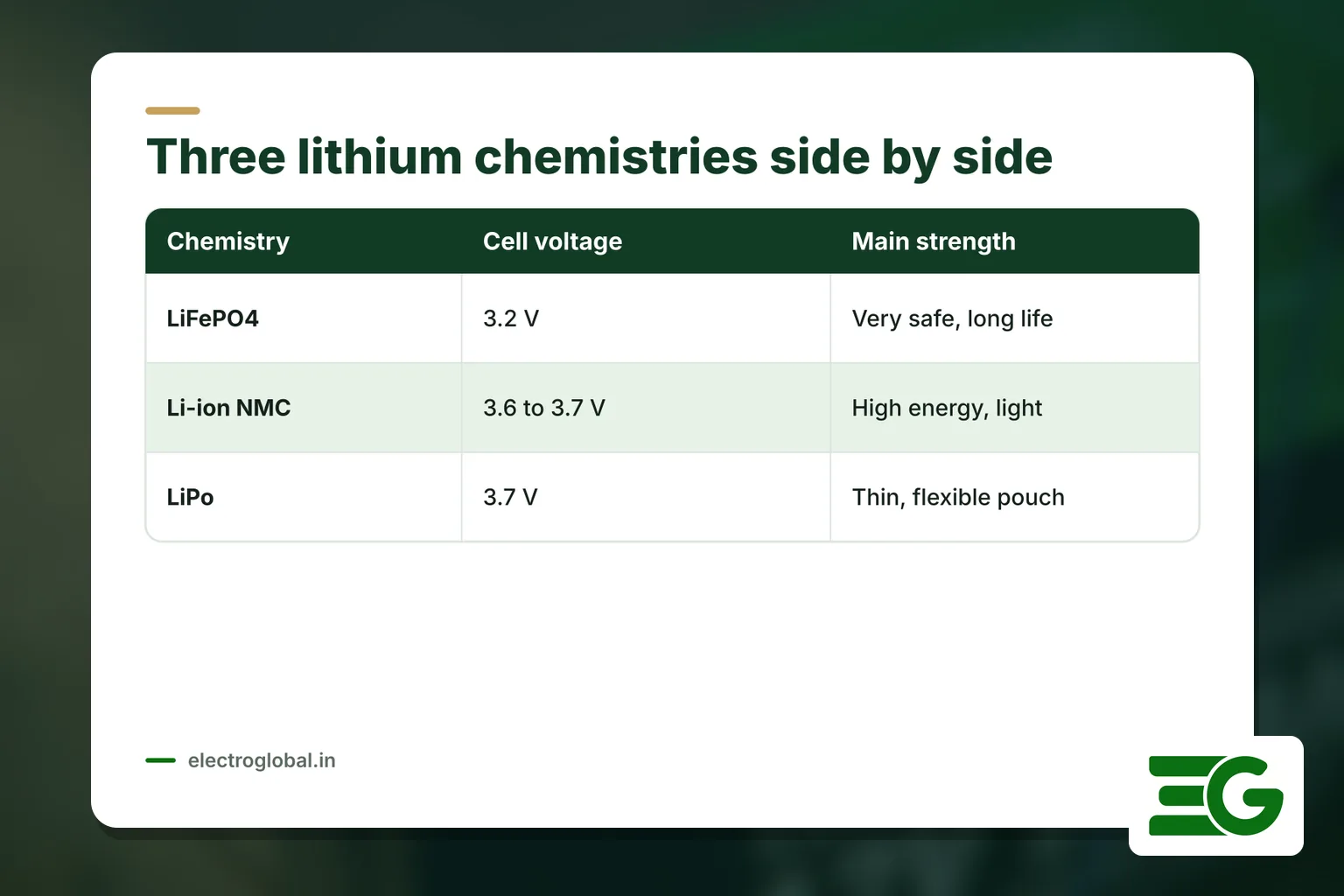
Series connections add voltage and parallel connections add capacity. A "4S2P 18650 pack" has four cells in series and two in parallel, so eight cells in total. With Li-ion NMC cells at 3.6 to 3.7 V each, that gives 14.8 V nominal. The same 4S layout built from LiFePO4 cells gives 12.8 V, because each LiFePO4 cell is rated at 3.2 V.
Series and parallel in plain words
Think of series as stacking cells end to end and parallel as lining them up side by side. Stacking raises the voltage your motor driver or inverter sees. Lining them up raises the capacity, so the same load runs for longer. Get the layout wrong and you either get the wrong voltage or a pack that heats up under load. That's the mistake we see most.
The rule is simple: set the series count from the voltage your load needs, then set the parallel count from the runtime you want. Don't work it the other way round.
Why every pack needs a BMS
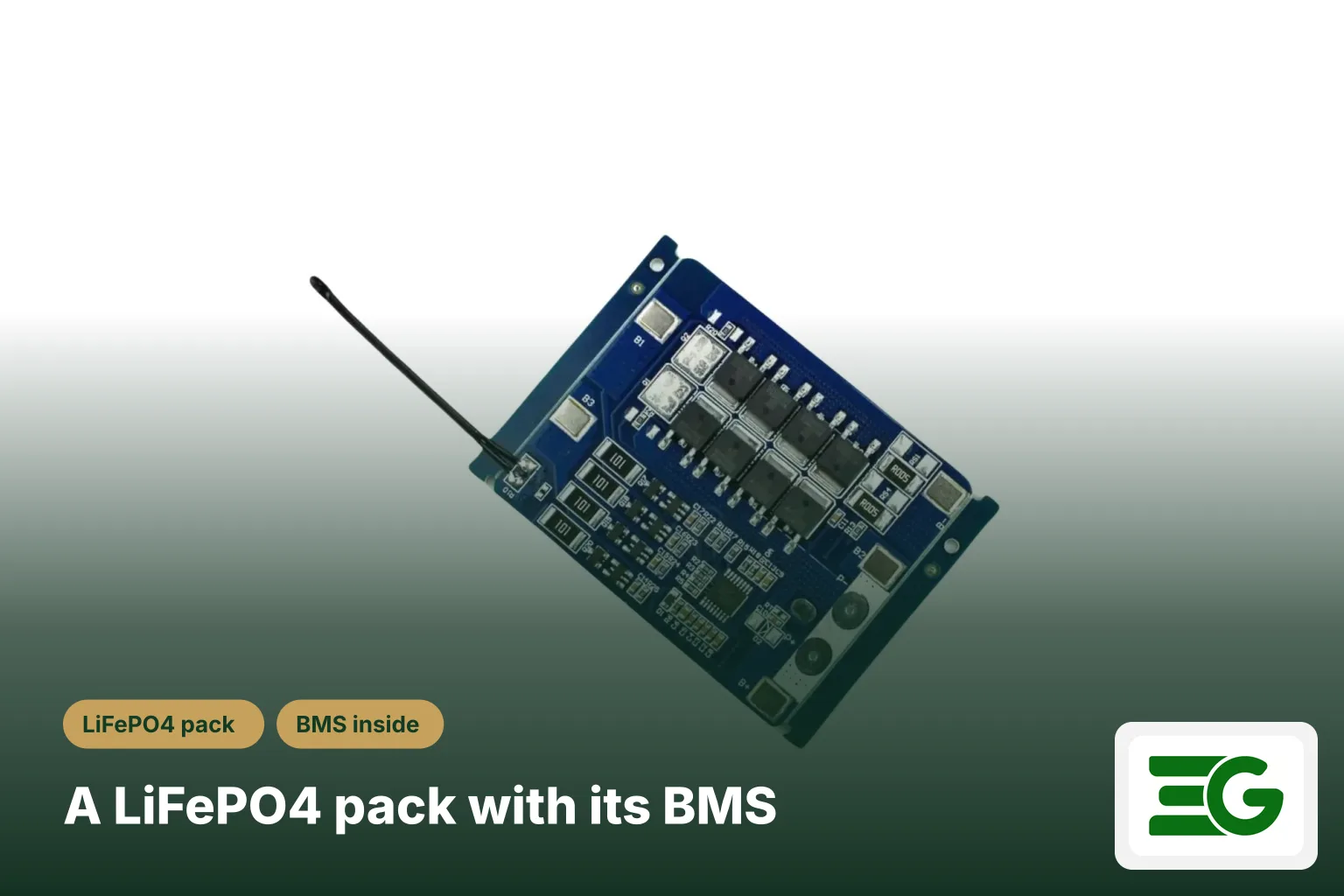
The battery management system, or BMS, is a small board that watches the cells. It stops the charge when a cell reaches its upper limit, cuts the load when a cell falls too low, and limits short-circuit current. Without one, a single cell that drifts out of balance can be pushed past its limits and nobody notices until the damage is done. No BMS, no safety net.
The job gets harder as the pack grows. In a pack of 15 or 16 cells, small differences between cells decide whether the pack ages evenly or gets limited by its weakest cell. That is why a BMS with balancing is worth the extra cost on any multi-cell build.
Lithium battery price in India: what you actually pay
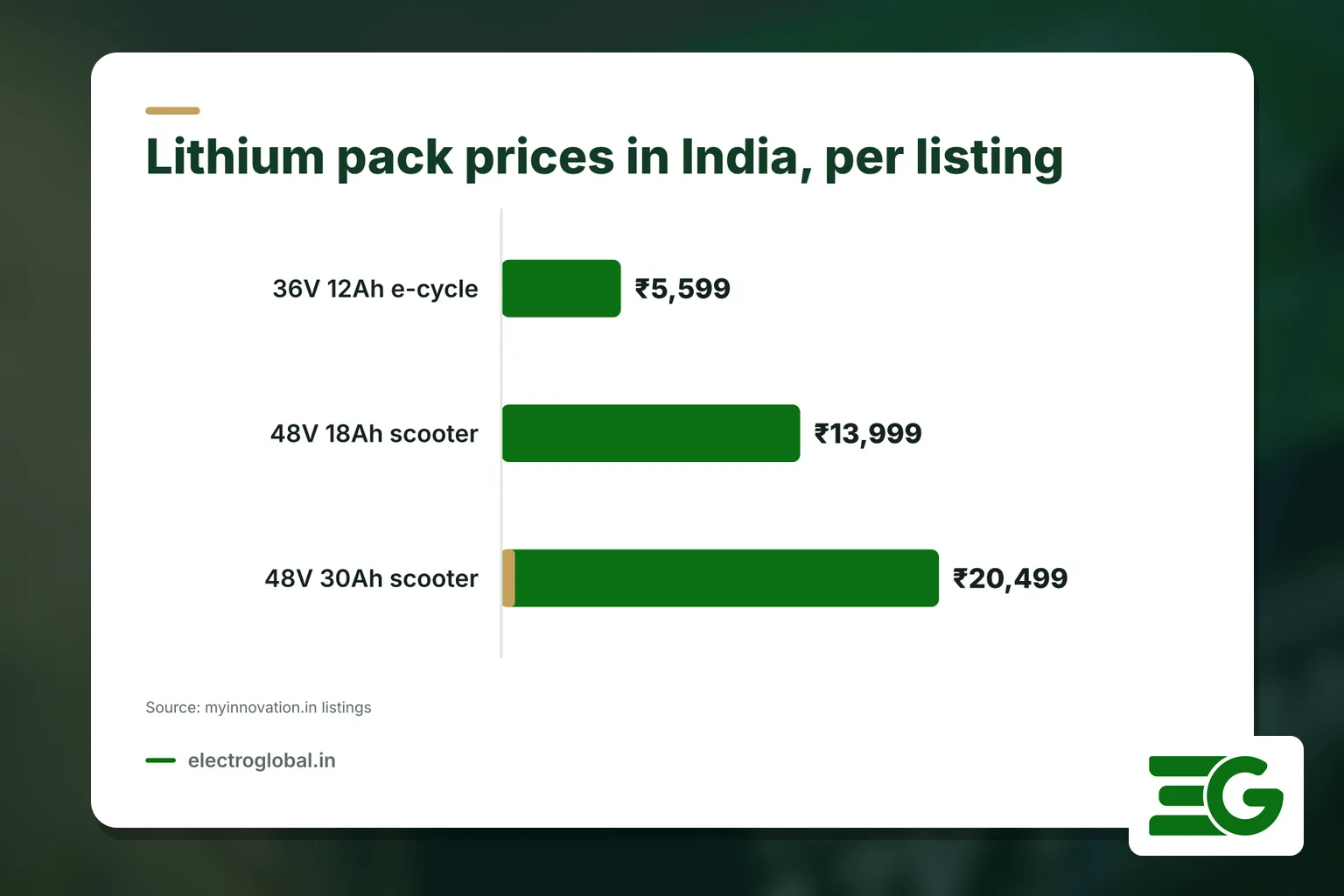
Prices move with chemistry, capacity and whether a BMS is included. The listings we looked at show the spread clearly. A 36 V, 12 Ah LiFePO4 e-cycle pack is listed at ₹5,599. A 48 V, 18 Ah e-scooter pack is at ₹13,999, and a 48 V, 30 Ah one is at ₹20,499, both with taxes included. Those three work out to roughly ₹13 to ₹16 per watt-hour, which is a better comparison than the sticker price alone.
Bigger solar and home storage packs run into lakhs. A 51.2 V, 400 Ah home storage pack with a 20.5 kWh rating is listed on sale at about ₹2.4 lakh, so always compare on watt-hours per rupee rather than on price alone.
Prices change often, so check the current lithium battery price on our battery pack category before you set a budget.
Lithium battery cell price and what drives it
Single cells are where the price per watt-hour is lowest, if you can handle the assembly. One listing sells a pack of ten 1200 mAh 18650 cells for ₹589, about ₹59 a cell. A 2600 mAh cell gives more than twice the capacity of a 1200 mAh cell in the same holder, so check the price per mAh in each listing, not the price per cell. Compare per watt-hour, every time.
If you are weighing a 6000 mAh build, our guide on lithium battery cell price choices goes through the numbers step by step.
Lithium battery pack chemistries you can buy in India
Three chemistries cover almost every product on sale. They differ in voltage per cell, energy per kilogram, safety margin and how forgiving they are when something goes wrong.
LiFePO4 for safety and long life
LiFePO4 (LFP) cells run at a nominal 3.2 V each. They are the most forgiving of the three and the cheapest to own over the years, with a typical life of 2000 to 4000 cycles. Their energy per kilogram is lower, so the packs are heavier for the same runtime. That trade-off is why you see LiFePO4 in solar, inverters, UPS backups and e-rickshaws rather than in drones. The chemistry is covered in Wikipedia's lithium iron phosphate battery article.
For backup power, usable capacity matters as much as the rating. MuscleGrid, a lithium seller, puts the usable share of a LiFePO4 pack at 80 to 90%, against roughly half for a tubular lead-acid battery. Treat that as a supplier claim and check it against the datasheet. It still explains why a 100 Ah lithium pack can do the work of a much larger lead-acid one.
Li-ion NMC for energy in less weight
Li-ion NMC cells run at 3.6 to 3.7 V and pack more energy into less weight, which is why they show up in e-bikes, robots and portable devices. The negative electrode is usually graphite, and the cells are compact enough to build tight packs. The trade-off is that NMC needs a proper BMS and more respect for overcharge and heat. For the chemistry basics, see Wikipedia's overview of lithium-ion batteries.
Common 18650 cells sold in India range from 1200 mAh to 3000 mAh. An EV-grade 2600 mAh cell, for example, is rated at 3.65 V. Read the datasheet for the charge voltage and the maximum discharge current before you pick a cell for a motor.
LiPo for thin, flexible packs
LiPo packs use a soft pouch instead of a metal can. Cells sit at about 3.7 V, the same as NMC, and the pouch lets makers fit a pack into flat or odd-shaped spaces. The pouch is also the weak point. Over-discharge or hard charging can make it swell, so charge LiPo only with a charger set for lithium polymer, and never leave a pouch cell sitting fully discharged. Treat that as a rule, not a tip.
Choosing a lithium ion battery pack for your project
Start with the load, not the pack. Work out the voltage your motor driver, inverter or controller needs, then the current it draws at peak, and only then the runtime you want. A pack picked from its label alone won't survive the first peak.
A ready-made pack is the simplest route. A ready 3S 18650 lithium ion battery pack for robots or power tools saves you the cell matching and assembly. For a DIY build, a single 2600 mAh 18650 cell is a common starting point, and you can see one in our lithium ion battery pack listing. Read its datasheet first, and you'll see the limits.
Match voltage and current to the load
Check the minimum voltage as well as the nominal. A 3S Li-ion pack sits at 11.1 V nominal and 12.6 V fully charged, and it should not be pulled below about 9 V (3.0 V per cell) under load. You'll want a driver that accepts that whole range.
Pick capacity from runtime, not the label
Runtime is capacity divided by average current. A 10 Ah pack feeding a steady 2 A load runs for about five hours in theory. In practice the BMS cuts out early under high peaks, and converters lose some energy, so plan for less. We leave a margin of about 20% on any runtime we calculate.
Building a lithium battery pack for a robot or e-bike
Building your own pack saves money, but the risks are real. Loose cells need a protection board before they can become a lithium battery pack for robots or e-bikes. A Reddit poster asking how dangerous a home-built 6S1P pack is says they have heard horror stories. The worry is fair, but the risk is manageable if you follow a strict order of work.
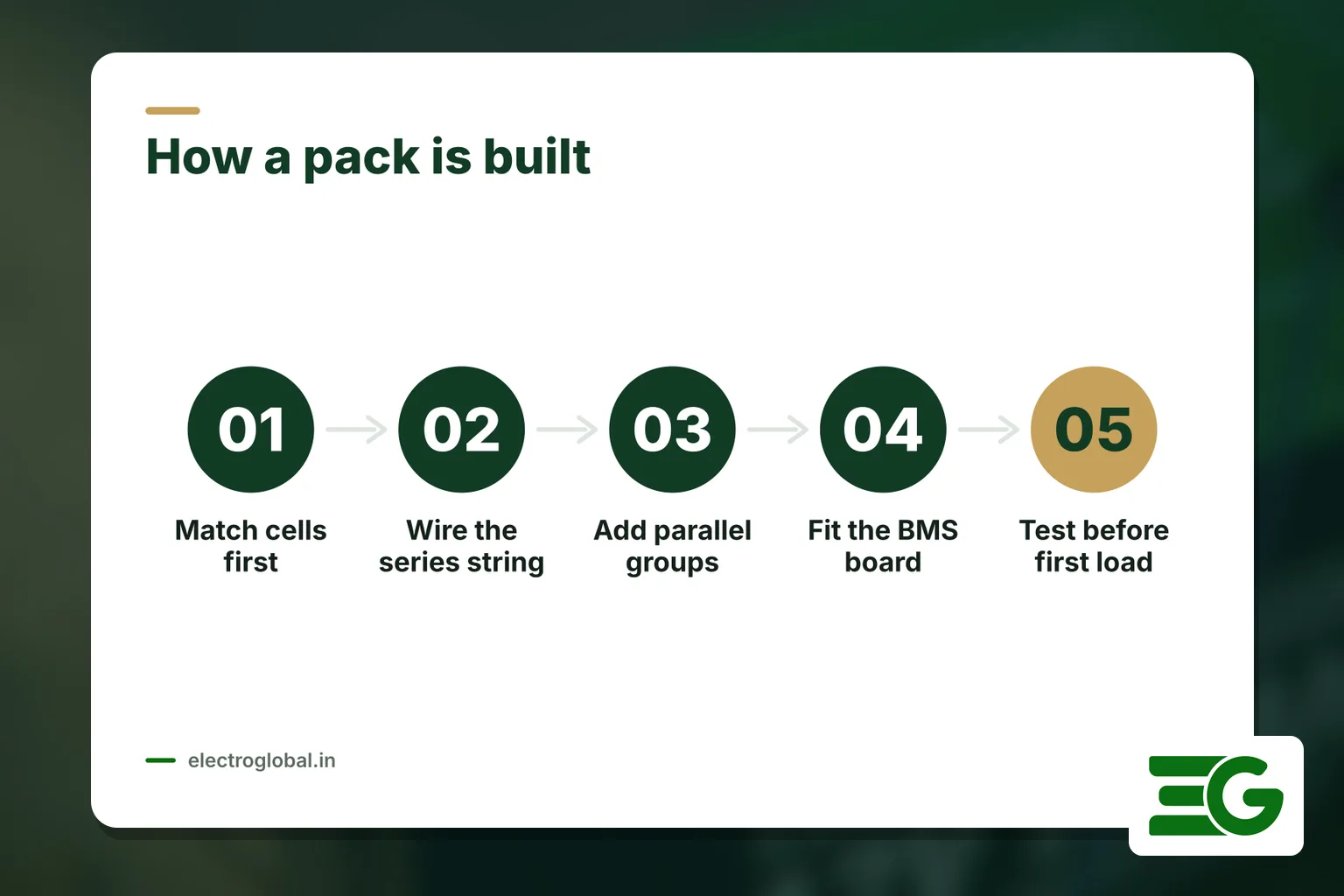
- Buy cells from one batch and check that their voltages match before you join them.
- Choose a BMS rated for your series count, for example a 3S board for three Li-ion cells.
- Join the cells with nickel strip, not solder applied directly to the cell, to avoid heat damage.
- Charge the finished pack with a charger that matches its chemistry and series count.
- Test under a light load and check cell temperatures before you run it hard.
Lithium battery for inverter backup: what to check
Inverter backup is where lithium packs have grown fastest in India. The usual swap is a lead-acid battery for a LiFePO4 pack of matching voltage. Before you buy, check that the inverter supports lithium charging. Many inverters were set up for lead-acid charging, and the wrong profile shortens a lithium pack's life. Our guide to lithium battery for inverter setups walks through the settings.
Size the pack from the load: watts multiplied by hours, divided by the usable share. A 12.8 V, 30 Ah LiFePO4 pack holds 384 Wh, which runs a 60 W load for about six hours before losses. Sparkel sells 12.8 V, 30 Ah and 48 Ah LFP packs for computer UPS use, and 24 V, 24 Ah packs for larger backups. A 51.2 V, 100 Ah pack holds 5.12 kWh, which is in the range used for home storage systems.
Lithium battery pack mistakes that cause failures
Most failures described online follow a few patterns. The same worries keep coming up in builder forums:
- Unbranded packs with no clear protection. One Reddit poster was "deeply suspicious" of an eBay pack whose listing only mentioned charging protection.
- Mixing cells of different age or capacity, so the weakest cell sets the limit for the whole pack.
- Wiring the wrong series count for the driver, which either starves the controller or overstresses it.
- Charging with a charger that does not match the chemistry or the series count.
- Replacing lead-acid batteries without checking the charge profile. One builder replaced two 12 V lead-acid batteries wired in series with 18650 packs, each with its own BMS.
Each of these is avoidable. The fix is almost always a BMS, a matched build and a charger that knows what it's charging.
Five checks before you buy or build
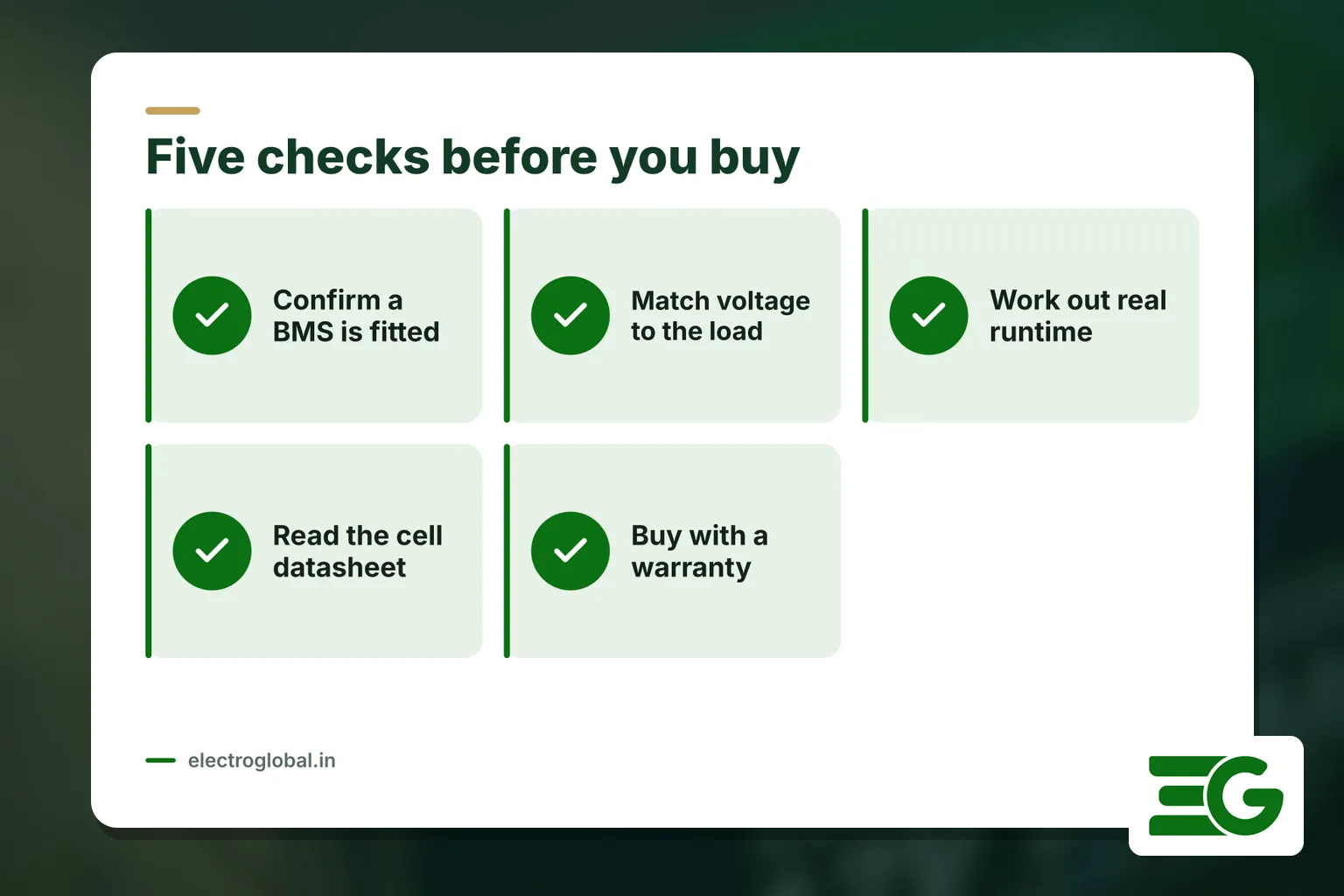
We run these five checks before any pack goes near a motor or an inverter. They take about ten minutes and catch most of the problems above.
- Confirm a BMS with over-charge, over-discharge and short-circuit protection, and note its rated current.
- Match the series count and voltage range to your driver or inverter.
- Work out runtime at your real load, not from the Ah printed on the label.
- Ask for the cell brand and model, and read the datasheet before you trust the rating.
- Buy from a seller who offers a warranty and a clear return route.
Bench tip: Charge a new pack once at a low current and feel each cell and the BMS board. Any hot spot is a reason to stop and check the wiring.
Conclusion: pick the chemistry and BMS before the price
For most robot and e-bike builds, a Li-ion NMC pack with a BMS gives the best energy for its weight. For solar, inverters and UPS backup, we'd pick LiFePO4 for its safety and cycle life, even though it weighs more. Set the voltage from the load, check the BMS, and only then compare prices.
When you are ready to buy, browse the battery pack range on electroglobal.in and check the latest prices before you budget.
Tagged