
Resistors Explained: Understanding Resistance, Color Codes, and Ohm's Law
Probably the most fundamental components in any electronic circuit are resistors. Resistors limit currents, distribute voltages, and provide protection to other components from damage.
Table of Contents:
- Introduction
- What Is a Resistor?
- Understanding Resistance
- Ohm's Law: The Foundation of Electronics
- Resistor Color Codes: How to Read Them
- Types of Resistors
- Common Applications of Resistors
- How to Choose the Right Resistor for Your Project
- Conclusion
Introduction
Resistors Explained probably the most fundamental components in any electronic circuit are resistors. Resistors limit currents, distribute voltages, and provide protection to other components from damage. This is an essential thing to know for both a beginner in electronics and an engineer with years of experience-thus it is so valuable to discuss the basics of resistance and explore Ohm's Law while deciphering the color-coded markings found on most resistors.
What Is a Resistor?
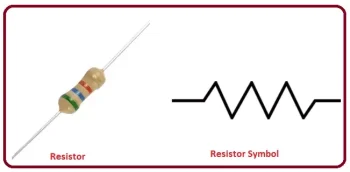
A resistor is an anti-electric current component that works in opposition, restricting the free flow of electric current in a circuit. Resistors are made from materials such as carbon or metal, which have an inherent resistance to the movement of electrons. The unit of measurement for the resistance offered by a resistor is called ohms (Ω), and it was named after German physicist Georg Simon Ohm, who discovered the relationship between voltage, current, and resistance.
Resistors are commonly used to:
- Limit current for the protection of sensitive parts.
- Divide voltage in circuits.
- To set up time constants in RC circuits.
Understanding Resistance
Opposition to the flowing electrical current is known as resistance. Intrinsic to any material is resistance, yet different materials resist in varying degrees. For example, while resistance of a conductor such as copper is extremely low, that of an insulator, like rubber, is highly resistant.
The formula for resistance is derived from Ohm’s Law, which states:
R=VIR = frac{V}{I}R=IV
Where:
- R is the resistance in ohms (Ω),
- V is the voltage across the resistor in volts (V),
- I is the current through the resistor in amperes (A).
Thus, a higher resistance value results in less current flowing through the circuit for a given voltage.
Ohm's Law: The Foundation of Electronics
Ohm’s Law is one of the fundamental principles in electronics. It defines the relationship between voltage (V), current (I), and resistance (R) in a circuit. This law is expressed as:
V=I×RV = I times RV=I×R
This formula is crucial because it helps engineers and hobbyists alike understand how changing the voltage or resistance in a circuit affects the current flow. For instance:
- If the resistance increases, the current decreases (for a given voltage).
- If the voltage increases, the current increases (for a given resistance).
Example:
If a circuit has a voltage of 10V and a resistor of 5Ω, the current can be calculated using Ohm’s Law:
I=VR=10V5Ω=2AI = frac{V}{R} = frac{10V}{5Ω} = 2AI=RV=5Ω10V=2A
This means 2 amperes of current flow through the circuit.
Resistor Color Codes: How to Read Them
Most resistors use a standardized color code system to indicate their resistance value. The color bands painted on the resistor represent specific numbers that can be decoded to find the resistance. Typically, resistors have 4, 5, or 6 color bands.
Understanding the 4-band resistor code:
|
Color |
Digit (Band 1 & 2) |
Multiplier (Band 3) |
Tolerance (Band 4) |
|
Black |
0 |
x1 |
|
|
Brown |
1 |
x10 |
±1% |
|
Red |
2 |
x100 |
±2% |
|
Orange |
3 |
x1,000 |
|
|
Yellow |
4 |
x10,000 |
|
|
Green |
5 |
x100,000 |
±0.5% |
|
Blue |
6 |
x1,000,000 |
±0.25% |
|
Violet |
7 |
x10,000,000 |
±0.1% |
|
Gray |
8 |
x100,000,000 |
±0.05% |
|
White |
9 |
x1,000,000,000 |
|
|
Gold |
x0.1 |
±5% |
|
|
Silver |
x0.01 |
±10% |
Example: For a resistor with bands brown, black, and red, the resistance is calculated as follows:
- Brown = 1 (1st digit),
- Black = 0 (2nd digit),
- Red = x100 (multiplier).
Therefore, the resistance is 10 x 100 = 1,000Ω (or 1kΩ).
Tolerance: The 4th band (gold or silver) indicates the tolerance, which tells you how accurate the resistor is. A gold band indicates ±5% tolerance, meaning the resistor's actual value can vary by 5%.
Types of Resistors
There are several types of resistors. Each of them has different characteristics due to which it is used in specific applications. These are as follows:
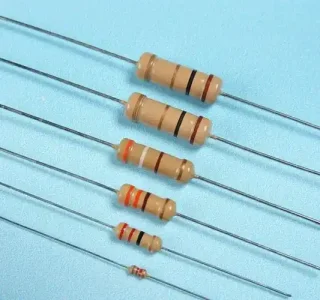
Carbon film-based resistors are very extensively used in general electronics as they are very economical.
- Metal Film Resistors:
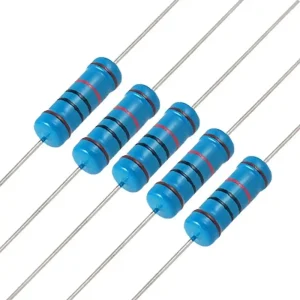
Since metal film resistors have more precision and stability than carbon film resistors, they are used for high accuracy applications.
- Wirewound Resistors:
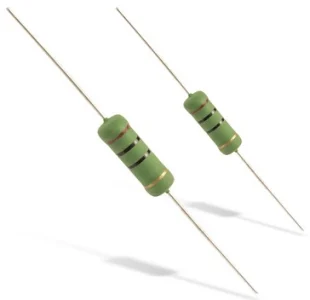
An inductor with a core of ceramic, to which coiled wire wraps, has a higher power level and is used in the circuits of powers.
- Variable Resistors (Potentiometers):
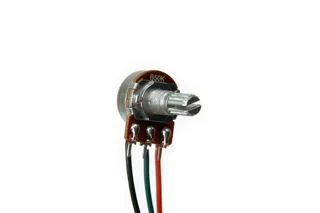
There are variable resistors which allow the users to vary the resistance manually. These are generally used for dials controlling the volumes.
Common Applications of Resistors
- Current Limiting:
Resistors are used in circuits to limit the amount of current flowing to a component. For example, in an LED circuit, a resistor is often used to prevent excessive current from damaging the LED. - Voltage Division:
Resistors are commonly used in voltage divider circuits to reduce the voltage to a desired level. This is especially useful when working with analog signals and sensors. - Pull-up/Pull-down Resistors:
These are used in digital circuits to ensure a default state (high or low) for input pins on microcontrollers. - Filtering:
In combination with capacitors, resistors are used in filters to block certain frequencies in analog circuits (e.g., low-pass filters).
How to Choose the Right Resistor for Your Project
The correct resistor for your project is chosen on the following factors:
- Value of Resistance:
You may use Ohm's Law to find the value of the resistance in your circuit, whereby if you are restricting current to an LED, calculate based on supply voltage and desired current. - Power Rating:
Resistors are also rated at various power levels, in watts (W). For low-power circuits, it's common to find resistors that are rated for 1/4W or 1/2W. For use in more significant currents, you might need a resistor that can tolerate a higher amount of watts. - Tolerance:
Determine the level of accuracy your circuit requires. In circuits that are sensible, resistors with a lower tolerance, like ±1% are preferred, while general-purpose circuits may tolerate resistors with a ±5% tolerance. - Size and Type:
Carbon film or metal film type, depending on application and environmental conditions, including temperature or moisture exposure.
Conclusion
Resistors are some of the most fundamental components in any type of electronic circuit; whether it is just a simple LED circuit or one of today's leading computer systems, understanding how resistors work, the basic principles behind Ohm's Law, and how to read color codes are always going to be essential skills for anybody working on electronics. For hobbyists who are building a DIY project, as well as professionals who design intricate circuits, resistors are an integral part of determining and managing current in the design.

Tagged