
Optimize ESP32 Battery Life with a 3000mAh LiPo Battery
Enhance your ESP32 projects with a 3000mAh LiPo battery. Learn about lipo battery, charger options, and power optimization. Boost runtime today!
-8e922b22-17d0-4942-ae0a-a5030763ed77.webp)
June 2026By ElectroGlobal Team10 min readSEO
Table of Contents
Choosing and Charging the Right 3s and 4s LiPo Battery for ESP32 Projects
Implementing Efficient Battery Voltage Monitoring and Protection
Practical Power Optimization Techniques for ESP32 with 3000mAh LiPo Batteries
If you want your ESP32 project to last longer without plugging in, start with a good battery setup. A 3000mah lipo battery is a solid option—it gives you a good balance between size and runtime for both pros and hobbyists. With the right power tricks like deep sleep and smarter firmware, you can get way past 10 hours, sometimes days, on a single charge. Picking the perfect lipo battery, nailing your voltage regulation, and using a reliable lipo battery charger aren’t just for safety—they make your battery last way longer too.
LiPo batteries—those flat, light, punchy cells we all love—are pretty much standard in everything from robotics to field sensors across India. If you’re using a 3s lipo battery or 4s lipo battery setup, adding a good buck converter and tweaking your ESP32 code can seriously boost efficiency. Some projects have seen a 75% cut in energy use just by tightening up firmware. At Electro Global, we’re here to help with every step—whether it’s hardware, battery choices, or those last firmware tweaks.
Here’s what you’ll get in this guide: how to pick the right 3000mAh LiPo and charge it safely, how to watch battery voltage using ESP32 ADC, the big impact of sleep modes, and easy hardware/firmware tweaks that make your battery work harder for your project.
Key Takeaways
Reduce ESP32 current draw to 10μA with deep sleep for extended battery operation.
Select and regulate 3S or 4S LiPo packs for correct ESP32 voltage input (3.3V).
Use certified smart LiPo chargers like MCP73871 to prevent overcharging and speed up cycles.
Monitor battery voltage using ESP32 ADC and set thresholds to avoid deep discharge.
Duty cycle ESP32 Wi-Fi and sensors to stretch a 3000mAh LiPo battery runtime from hours to days.
Balance charge multi-cell LiPo batteries to ensure safety and long-term reliability.
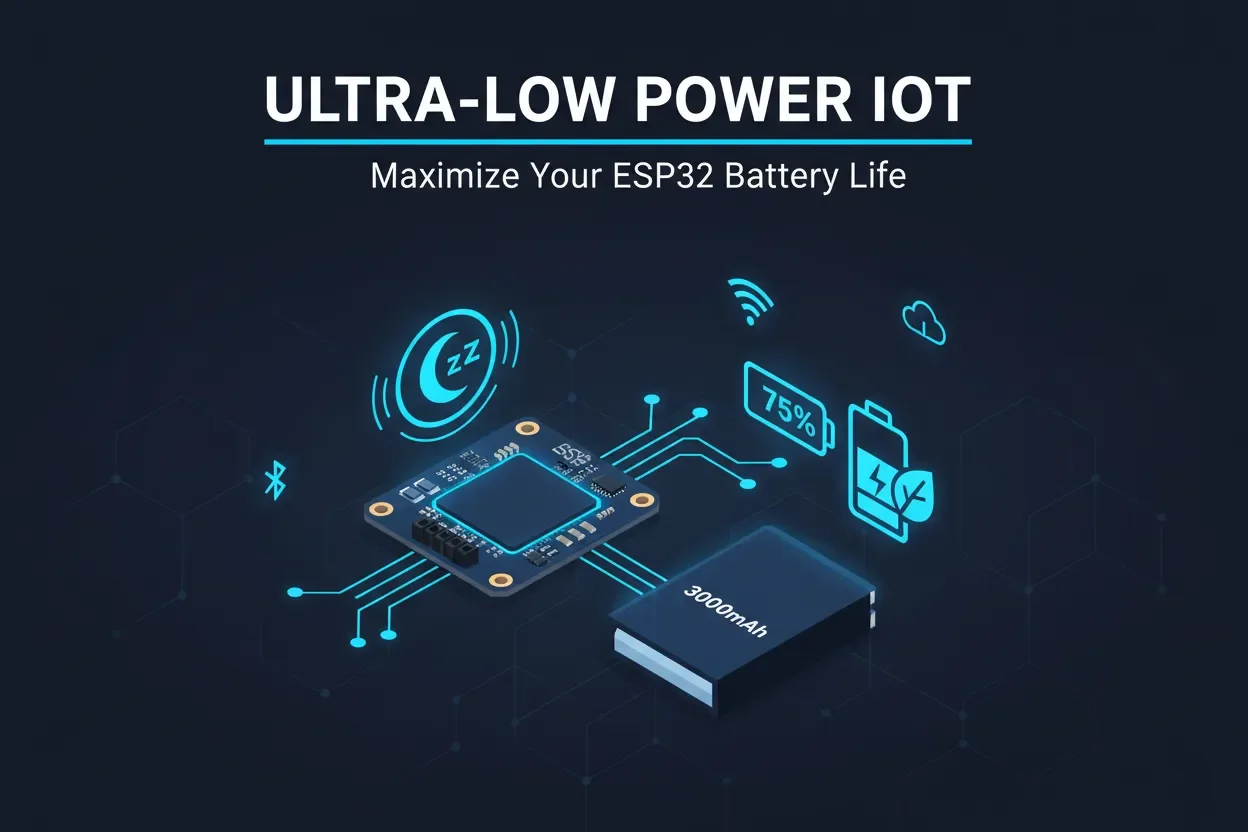
Maximizing ESP32 Battery Life Using a 3000mah lipo battery
battery life power savingESP32
Understanding ESP32 Power Consumption and Sleep Modes
If your ESP32 is running from a battery, every milliamp counts. With Wi-Fi active, you’ll see 80–240mA current draw, and Bluetooth uses 40–60mA. That’s not going to give you long runtime on a 3000mah lipo battery. The real game-changer? Deep sleep. In deep sleep, current drops to around 10μA. That’s why sensor nodes or monitoring devices can easily last many hours, or even days, if you keep radio activity short and wakeups rare.
ESP32 has three main sleep modes: light sleep (some peripherals stay on), deep sleep (almost everything off except RTC and memory), and hibernation (just the RTC timer alive). Deep sleep is what you should aim for in most cases. Use hibernation if you need absolutely minimal drain—like waking only for a sensor reading every hour or more.
esp_sleep_enable_timer_wakeup(60 * 1000000); // Sleep for 60 seconds (1 minute)
esp_deep_sleep_start();
Best Practices to Extend Run-time on a 3000mAh LiPo
Major battery killer? Leaving Wi-Fi or Bluetooth running. Every data burst can spike your current up to 240mA, but if you schedule activity every few minutes instead, your 3000mAh LiPo battery can go much further. For example, one weather station with deep sleep and 5-minute intervals gave over 12 hours on a single charge—even with Bangalore traffic on the network!
Just cleaning up the firmware and reducing unnecessary power use can save you more than 75% energy. Track your real power usage, optimize your code to “duty cycle” everything, and you’ll be shocked how much longer your battery lasts. Remember, old batteries and hot weather can take away 10–20% of your runtime, so plan accordingly.
Expert Tip: Every 10mA you save in average current means roughly 12 more hours from a 3000mAh LiPo. Don’t rely on specs—measure your actual load with a USB meter or multimeter.
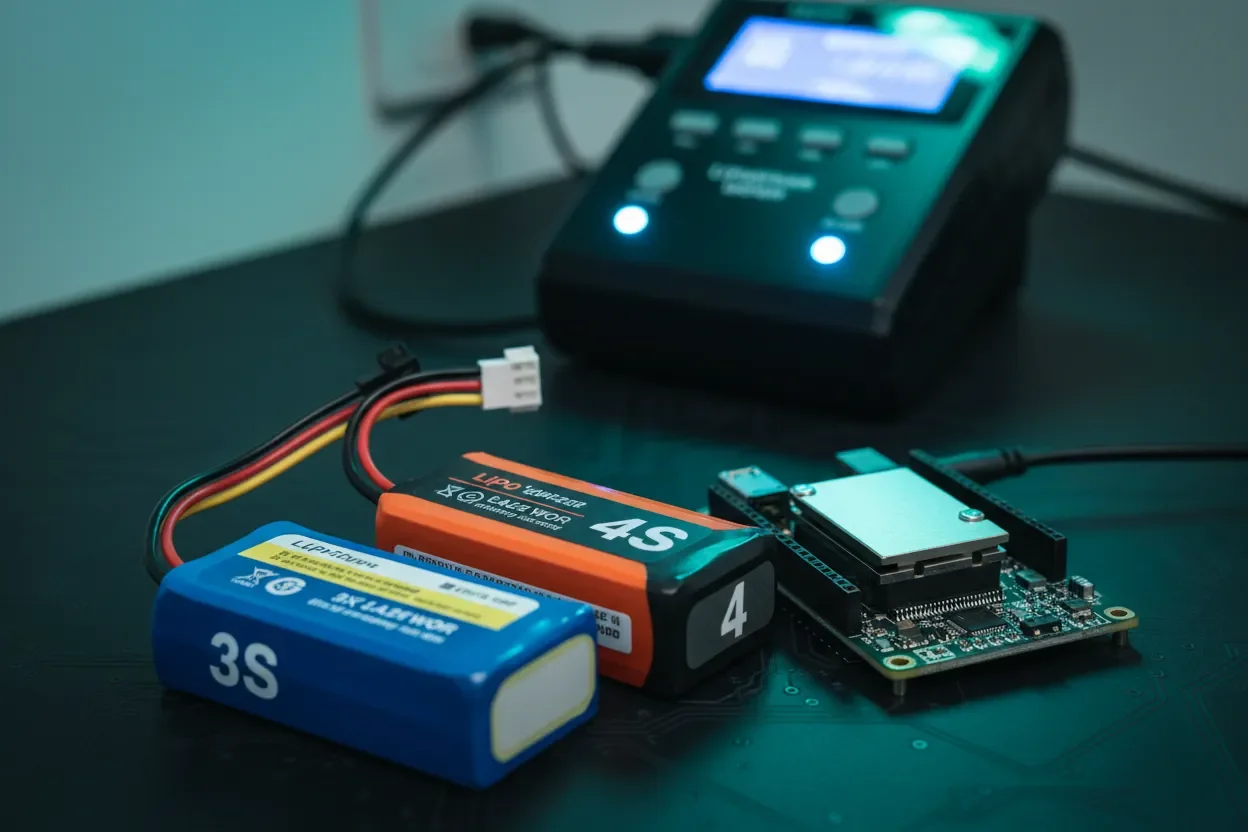
Choosing and Charging the Right lipo battery: 3S and 4S for ESP32 Projects
LiPo charging3s 4s LiPo voltage regulation
Voltage Requirements and 3s lipo battery & 4S Packs
Getting the battery setup right is crucial. A 3s lipo battery gives you 11.1V (up to 12.6V fully charged, down to 9V when empty). A 4s lipo battery delivers 14.8V (full at 16.8V, empty at 12V). But since ESP32 needs 3.3V, you must use a good DC-DC buck converter. Avoid linear regulators—they just turn that extra voltage into heat and waste battery life.
A 90% efficient buck converter stretches your battery way more than a standard LDO regulator. If your setup draws a lot of current or you want to minimize battery size, pick your voltage converter carefully for the best balance of runtime and compactness.
Checklist: Choosing the Correct LiPo Pack
Check your system's required voltage and current peaks
For single-cell (1S), use a boost or buck converter for 3.3V
For 3S/4S, use a synchronous buck converter (rated 2A+ output)
Ensure battery C rating covers maximum ESP32 draw
Use balance leads for multi-cell packs — never skip balancing
Smart Charging Techniques with Certified lipo battery charger ICs
Never cut corners with charging. Always use a certified smart charger IC like MCP73871. It lets you charge and run your ESP32 at the same time, managing power safely. To fast-charge a 3000mAh LiPo, set the current to about 1.5–3A (no more than 1C).
If you’re using 3S or 4S packs, always hook up the balance leads. Charging without balancing is risky and kills the battery early. We’ve seen folks in Chennai run drone controllers off a 4S with an MCP73871 charger and a buck converter—worked smooth and safe. Extra safety features like overcharge and thermal cutoff really matter for long battery life.
Expert Tip: Always charge LiPo batteries in a fireproof bag and never leave them unattended. Only use certified smart chargers. Skipping these steps can lead to serious fire risks.
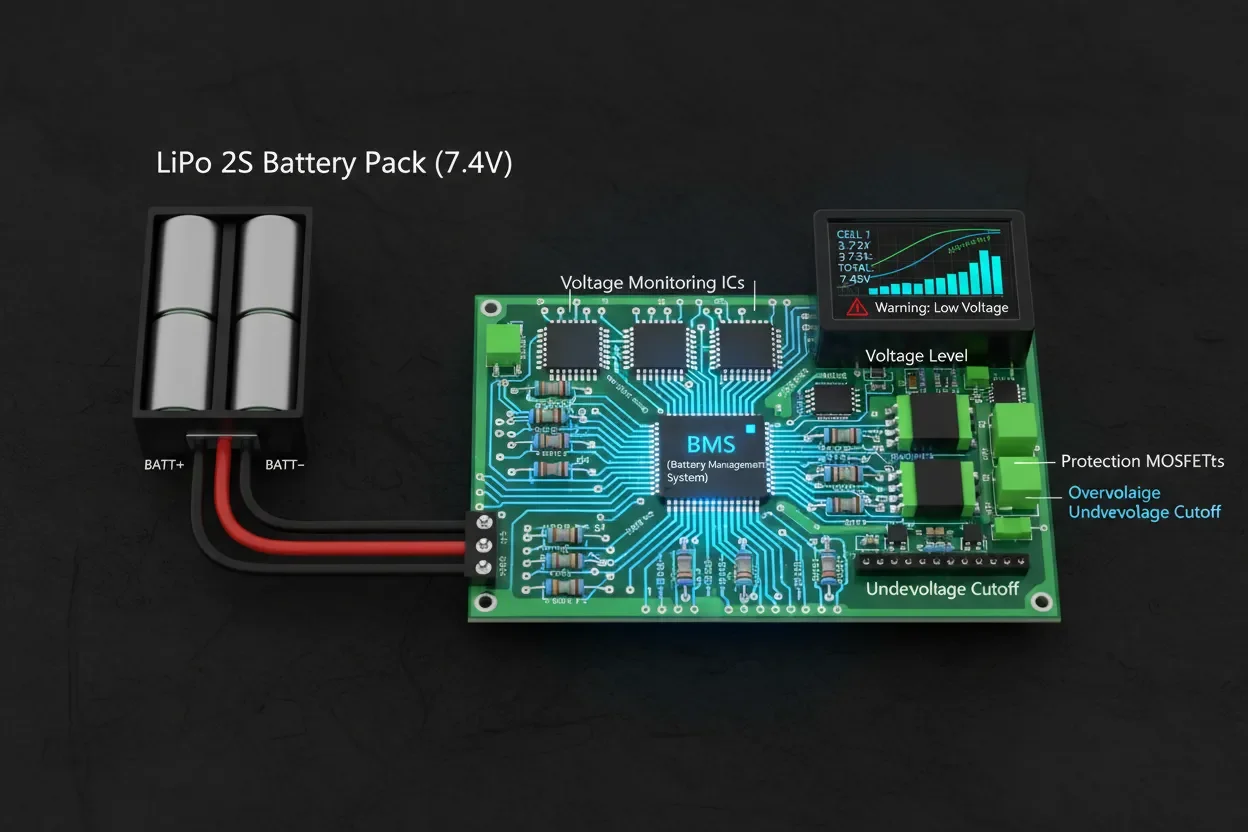
Implementing Efficient lipo battery Voltage Monitoring and Protection
battery monitoring deep dischargeESP32 ADC
Using ESP32 ADC for Battery Voltage Monitoring
Don’t risk killing your LiPo battery—track voltage in software. The ESP32 ADC can read a simple resistor divider hooked straight to your battery. Sample every minute or wakeup, and you’ll know your pack’s charge state at a glance.
Just use a resistor divider so the voltage to the ESP32 ADC never goes above 3.3V. A few lines of code and you’ll have real-time battery stats for safety and data logging.
// Example: Read divided battery voltage
float voltageDivider(float adcValue, float R1, float R2) {
    return adcValue * ((R1 + R2) / R2);
}
Cutoff your ESP32 or trigger an alert if you’re near the safe limit (around 3.0V per cell). Many monitoring projects do this and save tons by not killing batteries prematurely.
Preventing Deep Discharge and Extending Battery Lifespan
Letting LiPo batteries drop below 3.0V per cell is a recipe for swelling or permanent damage. Always set your firmware to sleep or shut down if voltage gets close to that point—use 3.2V as a warning level for 1S, higher for multi-cell packs.
Don’t shortcut safety. Use only certified chargers and, for mission-critical projects, add a temperature sensor as a backup. Even a simple ADC check doubled the battery life on an air quality node in Pune—battery swap costs went down by a third.
Practical Power Optimization Techniques for ESP32 with 3000mah lipo battery Packs
power optimization firm ware hardware
Firmware Duty Cycling and Peripherals Management with lipo battery
If you want your ESP32 to sip power, start with firmware. Shut down Wi-Fi, Bluetooth, and any unused peripherals between jobs. Use duty cycling—don’t keep sensors and radios on all the time. For many projects, just sending updates every 10 minutes slashes power use by up to 90%.
Here’s your step-by-step:
Switch off hardware blocks you don’t need (like ADC/I2C/SPI).
Call
esp_wifi_stop()andbtStop()before sleeping.Trigger ESP32 wakeup with RTC or GPIO just for quick jobs.
Measure your firmware’s real current draw—don’t guess.
One telemetry project in Hyderabad did all this and now gets 72+ hours from a single 3000mAh cell. These savings mean you can go cheaper on battery, or just stay unplugged longer.
Hardware Approaches to Reduce Power Consumption with lipo battery charger
It’s not just code—hardware upgrades help too. Always use a synchronous DC-DC buck converter to drop voltage from a 3S or 4S LiPo pack. Go for converters with 90% efficiency or better to save power and reduce heat.
Stick to LiPo batteries instead of NiMH or lead-acid for portable devices. LiPos pack more juice into the same space and last hundreds of cycles if you avoid deep discharges and cheap chargers. For larger projects, multi-cell packs work great, but never skip a battery management system (BMS) for cell safety and balancing.
If your firmware supports it, add brown-out detection so your ESP32 shuts down before the voltage drops too low and damages the battery.
Frequently Asked Questions
What is a 3000mAh LiPo battery and how does it work with ESP32?
Think of a 3000mAh LiPo battery as a tank that holds 3000 milliamp-hours of power. With an ESP32, it means you can draw 300mA for 10 hours, or less current for even longer. Great for projects where you need stable, portable power in a small package.
How long can an ESP32 run on a 3000mAh LiPo battery?
If your ESP32 code uses deep sleep and just wakes up to send data every few minutes, you’ll get 10–15 hours or sometimes days per charge. If Wi-Fi stays on constantly, don’t expect more than a few hours.
Why use a LiPo battery instead of NiMH or lead-acid for ESP32?
LiPo batteries are lighter and give you more energy in the same space. Voltage stays steady for longer, and charging is much faster. NiMH and lead-acid are old school and don’t last as long for small electronics.
What type of LiPo battery charger should I use for 3S or 4S packs?
Always pick a smart lipo battery charger with balancing. Something like MCP73871 is perfect for safety and lets you use the battery while it charges. Never try to charge a 3S or 4S with a charger made for only one cell—you’ll damage the pack.
How do I monitor LiPo battery voltage with ESP32?
Just add a resistor divider from the battery to the ESP32 ADC pin. Sample the voltage in your firmware and set a warning if it drops near the safe low limit. This saves your battery and your device!
What happens if a LiPo battery is deeply discharged?
Don’t do it! Running a LiPo below 3.0V per cell can kill its capacity forever or even make it swell up. Set your code to sleep or shut off before it gets that low. Your battery will thank you.
Can I use a 3S or 4S LiPo battery directly with ESP32?
Nope, don’t connect those packs straight to ESP32! Their voltage is way too high. Always use a good buck converter to drop voltage to 3.3V. Going direct can fry your board.
How many charge cycles does a 3000mAh LiPo battery last for?
Most LiPo batteries will handle about 300 to 500 full charges before capacity drops noticeably. Avoid deep discharges and overheating—they’ll get you more cycles and better performance for longer.
Is fast charging safe for LiPo batteries?
Fast charging is safe if your lipo battery charger keeps current within the battery’s specs—usually up to 1C (3A for a 3000mAh). Don’t push higher, and never use a cheap, uncertified charger.
What maintenance is needed for a 3S or 4S LiPo battery in ESP32 projects?
Regularly balance charge, check all cell voltages, and store at mid-charge if not using for a while. If you notice swelling or odd voltage readings, retire the pack. Never ignore heat—it’s a warning sign.
Can I use a regular phone charger to charge a LiPo battery?
No, never use a phone charger or power bank directly for LiPo batteries. LiPos need constant current/constant voltage charging and balance features—using a phone charger isn’t safe and can overheat or damage your pack.
What’s a safe storage voltage for a LiPo pack?
For long-term storage, keep each LiPo cell at about 3.7–3.8V. Fully charged or fully drained packs degrade faster over time. Good storage habits mean longer battery life and safer handling.
With a 3000mAh LiPo, you can easily get days of ESP32 runtime—if you use deep sleep and charge smart. Choosing the right hardware, tweaking firmware, and always keeping an eye on battery voltage makes all the difference.
Small steps—like using a proper DC-DC for your lipo battery or picking a certified lipo battery charger—go a long way. You’ll avoid field failures and battery damage, which is key for both hobby projects and industrial IoT.
Looking to squeeze every last hour from your 3000mah lipo battery? Electro Global’s got you covered with expert battery management ICs, converters, and all the tech support you could want. Whether you’re pushing the limits with EGPT designs or tinkering at home, we’ll help you get more from your ESP32.
Tagged
Related Content
Related Products
From the Blog
- Complete LiPo Battery Safety Guide for Engineers and Hobbyists
- Raspberry Pi Pico Battery Guide Featuring 3000mAh LiPo Battery Insights
- 3s LiPo Battery Capacity Explained for Electronics Projects
- Choosing the Best 3.7 V LiPo Battery 2000mAh for Reliable DIY Electronics
- Swollen 4s LiPo Battery Issues and Maintenance Best Practices