
12V Battery Buying Guide 2026: Inverter, UPS, Charger & More
Compare 12V battery types for Indian inverters, UPS units and DIY projects, with charger and safety checks before buying.
Introduction
12v battery shopping gets confusing the moment two products with the same voltage promise completely different jobs. A small sealed pack can keep a router alive; a large tubular battery can support selected home circuits; a car starting battery is designed for a brief burst of current. Their labels may all say 12V, but swapping them is a poor bet.
We'd begin with the equipment, not the battery brand. Check the required DC voltage, expected load, backup duration and charger. In India, summer heat and long power cuts can make the wrong choice expensive long before the warranty ends.
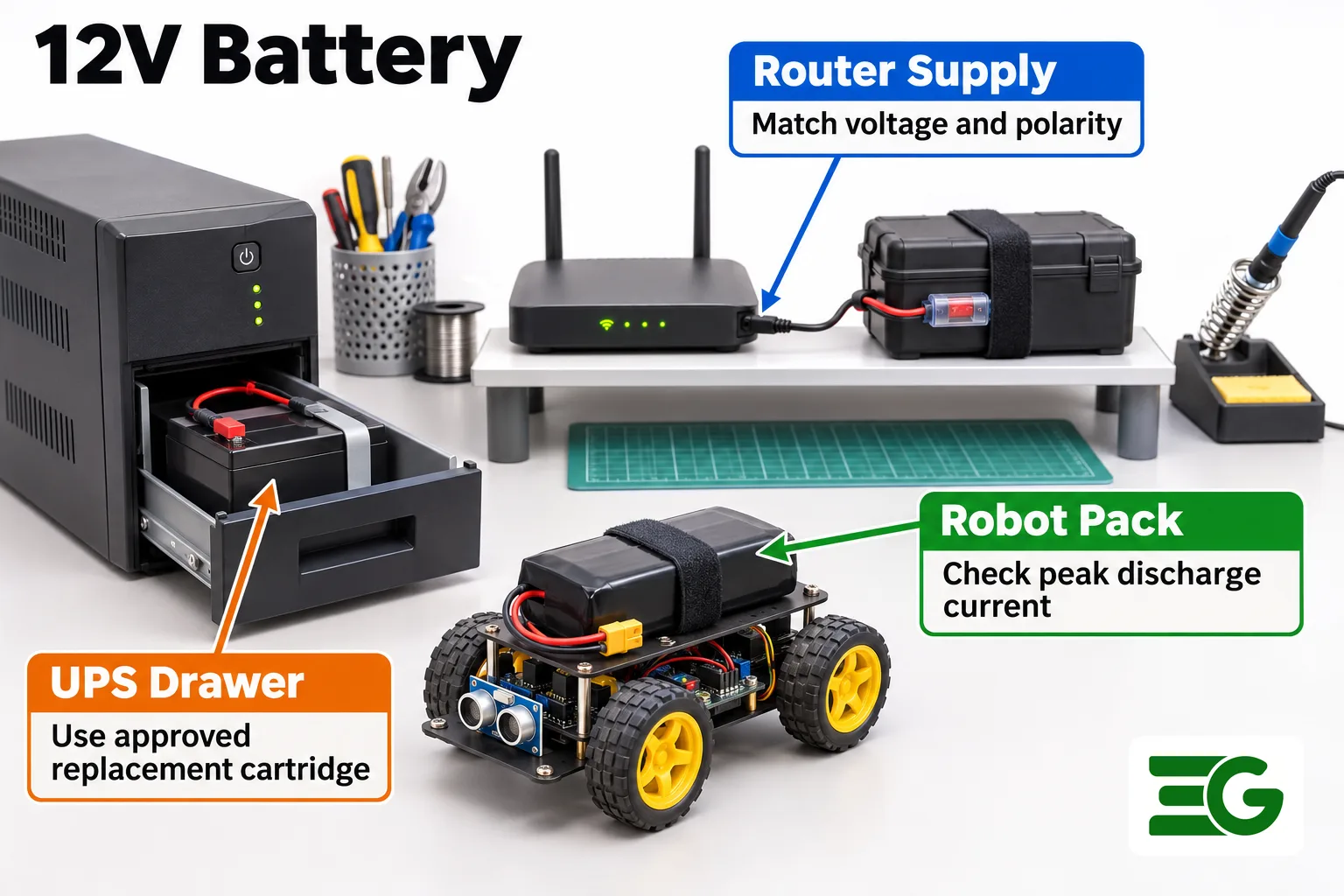
For a PC UPS, use the approved replacement cartridge. For a home inverter, size the battery bank and charger together. For a DIY project, check the output connector, current limit and protection board before you buy a rechargeable pack.
What a 12v battery actually supplies
Voltage is not the same as capacity
A battery marked 12V provides a nominal voltage, not a fixed amount of energy or a guaranteed runtime. Capacity is usually marked in amp-hours (Ah). Multiply nominal volts by amp-hours for a rough watt-hour figure: a 12V 7Ah battery has 84Wh on paper. That is not 84Wh guaranteed at the socket. Inverter losses, high discharge current, ageing and the battery cutoff reduce usable energy. A 12V 150Ah home battery is vastly larger than a 12V 7Ah UPS pack even though the nominal voltage matches.
Where 12V batteries turn up
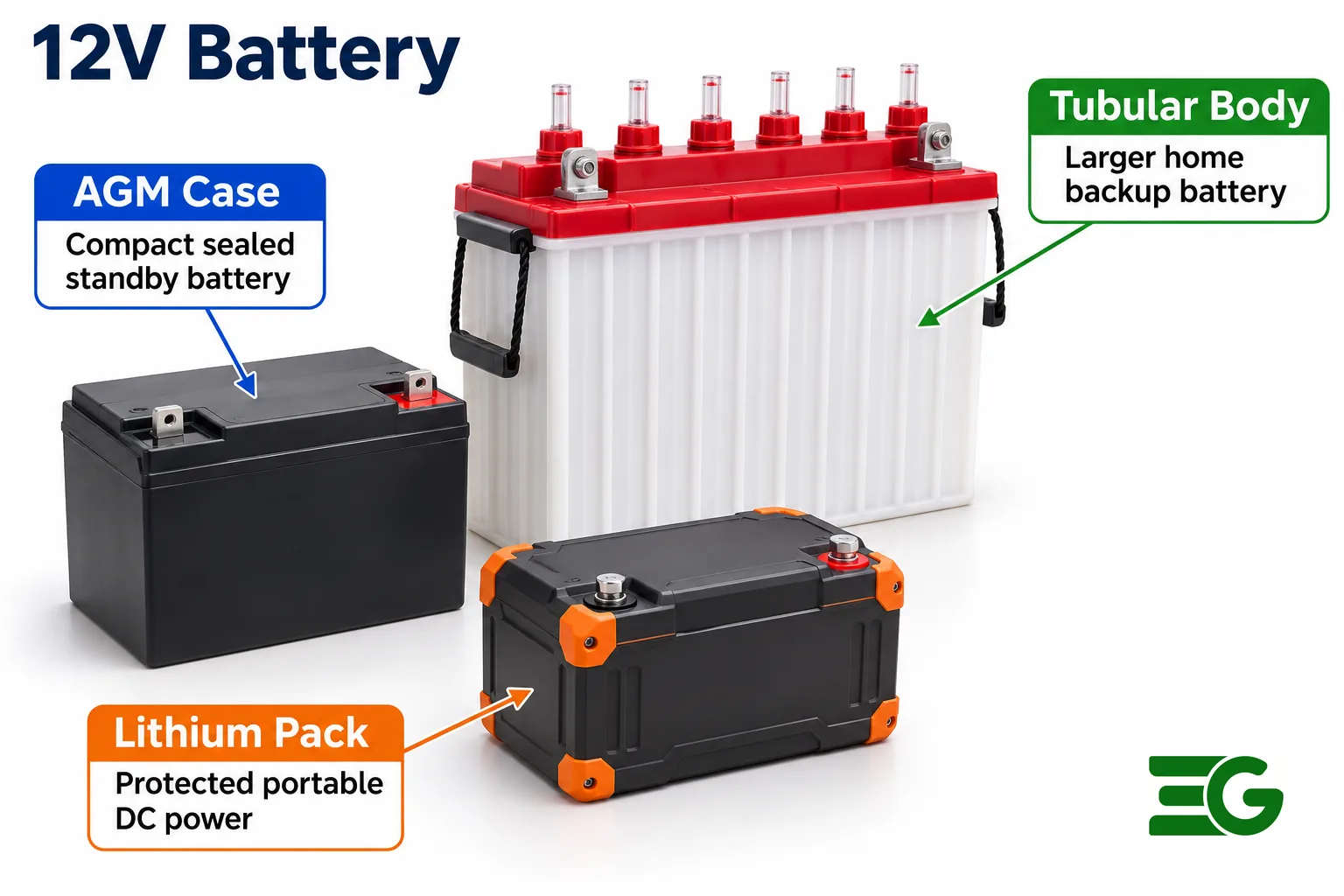
A compact sealed 12V battery is common in small UPS equipment, alarms and emergency lighting. A tubular lead-acid model often sits beside a home inverter. A protected lithium pack may power a camera, sensor installation or mobile robotics build. Vehicle starting batteries are another category: they deliver a short high-current burst to crank an engine and are not generally designed for routine deep discharge. We would never select a battery solely because its voltage matches a device label.
12V versus a 9V battery
A rectangular 9v battery is generally used in low-power electronics, meters and some alarms. It has different connectors and substantially less energy than a large 12V backup battery. Some rechargeable 9V products also differ in actual cell voltage and charger requirements. A 9V battery cannot replace a 12V inverter or ups battery. For an electronics project, read the device's permitted input range and polarity; a nominal label is only the starting point.
Compare lead-acid, AGM, tubular and LiFePO4
Sealed lead-acid for standby duty
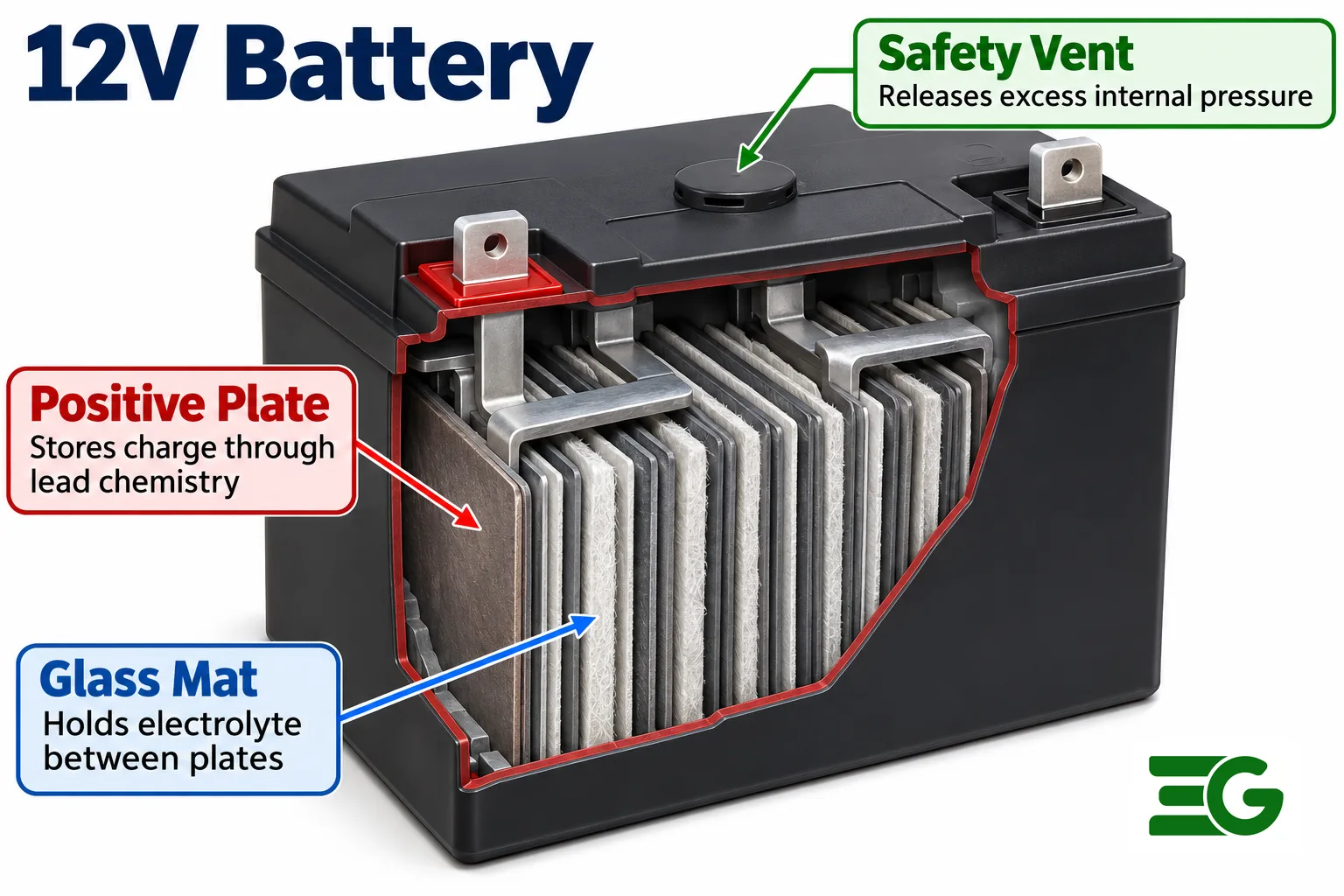
Valve-regulated lead-acid (VRLA) batteries, including AGM versions, are widely used in UPS units. They are compact, have no routine water top-up and can deliver high current briefly. Their weakness is deep cycling and heat. The sealed case still needs ventilation and should not be opened. For a UPS that spends most of its time waiting for a short outage, we'd stick with the chemistry the manufacturer specifies rather than gamble on an unapproved upgrade.
Tubular batteries for home inverters
A flooded tubular lead-acid battery is designed for repeated backup duty and is often selected for an inverter and battery for home installation. Some models require electrolyte maintenance according to the manual. Exide's Home InvaTubular range lists 150Ah, 200Ah and larger models, with size and weight figures that make clear why these batteries need a stable, ventilated location. A tubular battery is not a drop-in replacement for the sealed pack inside a desktop UPS.
LiFePO4 packs and their limits
LiFePO4 batteries can tolerate deeper routine discharge and provide more cycles than many lead-acid options, but only in a correctly designed system. A nominal 12V-class LiFePO4 pack is commonly specified at 12.8V, and its battery management system (BMS) must protect against overcurrent, incorrect cell voltage and temperature limits. The charger and inverter must support that chemistry. We'd consider a compatible lithium system for frequent cycling; we'd reject a lithium pack offered as a universal lead-acid replacement.
A useful side-by-side check
| Battery type | Typical job | Main trade-off |
|---|---|---|
| Sealed AGM or VRLA | PC UPS, standby electronics | Compact but dislikes deep discharge |
| Flooded tubular | Home inverter backup | Large, heavy, may need maintenance |
| LiFePO4 with BMS | Compatible cyclic backup, portable DC | Higher initial cost and charger requirements |
| Automotive starting | Engine cranking | Not intended for regular deep cycling |
Choose an inverter and battery for home
Calculate the load first
List only the appliances that must stay on during a cut. Add their operating watts, not their marketing VA ratings. A fan, LED lights and a router have a different duty from a kettle or air conditioner. Decide the backup hours you genuinely need. For example, a 200W essential load running for three hours consumes 600Wh at the appliance. The battery must supply more because conversion is not lossless. We'd leave headroom instead of sizing for an optimistic best case.
Estimate battery capacity
- Measure or estimate the watts of the essential appliances.
- Multiply by backup hours to get required watt-hours.
- Allow for inverter losses and the usable discharge fraction.
- Divide by the battery bank nominal voltage to estimate Ah.
- Check the inverter and battery manufacturer runtime guidance before buying.
For a rough planning estimate, divide appliance watt-hours by inverter efficiency and the fraction of battery capacity you plan to use, then divide by nominal battery voltage to obtain Ah. If 600Wh of output is needed, assume 85% inverter efficiency and a conservative 50% usable fraction for a lead-acid example: 600 / 0.85 / 0.5 / 12 is about 118Ah. This is a teaching example, not a product recommendation. Real capacity at high discharge current, ageing and the inverter's cutoff can change the result.
12V and 24V inverter compatibility
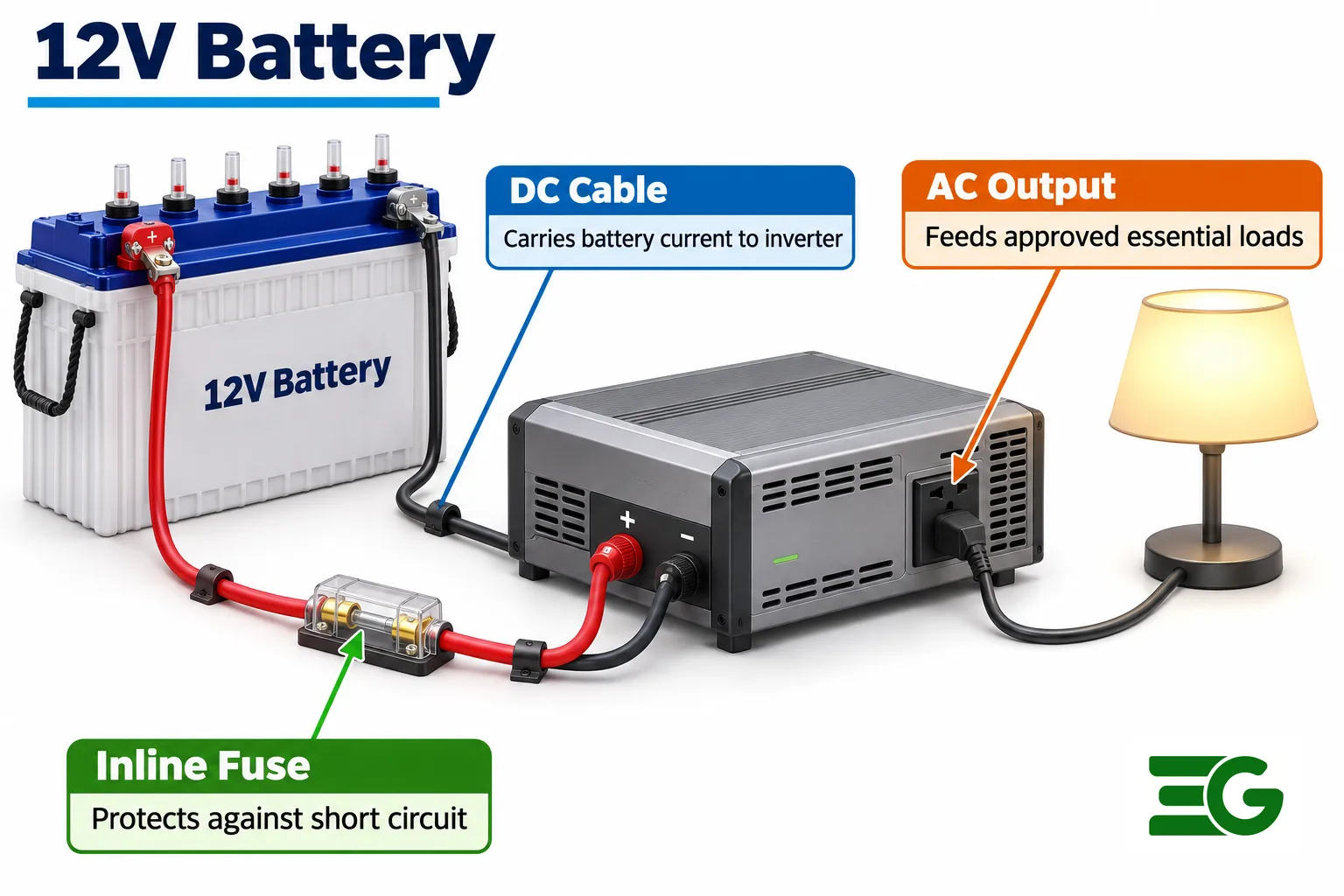
A 24V inverter generally requires a nominal 24V battery bank. One 12V battery cannot directly power it as intended. Two compatible 12V batteries may be wired in series only if the inverter and battery manufacturer approve the arrangement and a qualified installer designs the protection. Never combine mismatched ages, capacities or chemistries. A 12V inverter similarly should not receive a 24V bank. The DC input rating on the inverter is the deciding specification.
Install for Indian conditions
Keep a heavy battery on a stable stand in a dry, ventilated area away from direct sun and children. Flooded lead-acid batteries can release gas while charging, so follow the maker's ventilation and maintenance instructions. An installer should select correctly rated cables, fuses, terminals and isolation hardware. Poor joints heat up under load. In a humid monsoon room, corrosion and water ingress are additional reasons not to improvise an installation.
Select a 12v battery for a UPS
Match the replacement cartridge
A small desktop UPS is meant to bridge a brief interruption or give you time to save work. Its battery is often a sealed 12V unit, but some UPS models use multiple batteries or a different bank voltage. APC advises locating the UPS model number and using its replacement selector. The correct terminal style, dimensions, chemistry and battery count matter. We would not assume a higher Ah pack is safe just because the plastic case appears to fit.
Battery failure versus UPS failure
Short runtime after a full manufacturer-recommended recharge can mean the battery has aged. A failed self-test is another clue. Yet a new gaming PC, faulty charger or overloaded UPS can create similar symptoms. APC says a UPS battery commonly needs replacement after about three to five years, with environment and use affecting the result. Check the load and fault indicators first. If the UPS electronics are damaged, another battery will not repair them.
Replacement without electrical improvisation
Follow only the manufacturer-approved user-accessible battery procedure. Switch off connected equipment and disconnect the UPS as directed. Do not open a mains electronics compartment, bridge battery terminals or attempt to repair a swollen battery. If the battery is not user-replaceable, use authorised service. Return the old lead-acid pack through a recognised dealer or recycler; don't put it into ordinary waste. We would ask about an exchange credit, but never treat a quoted discount as guaranteed.
Match the rechargeable battery charger
Chemistry determines the charging profile
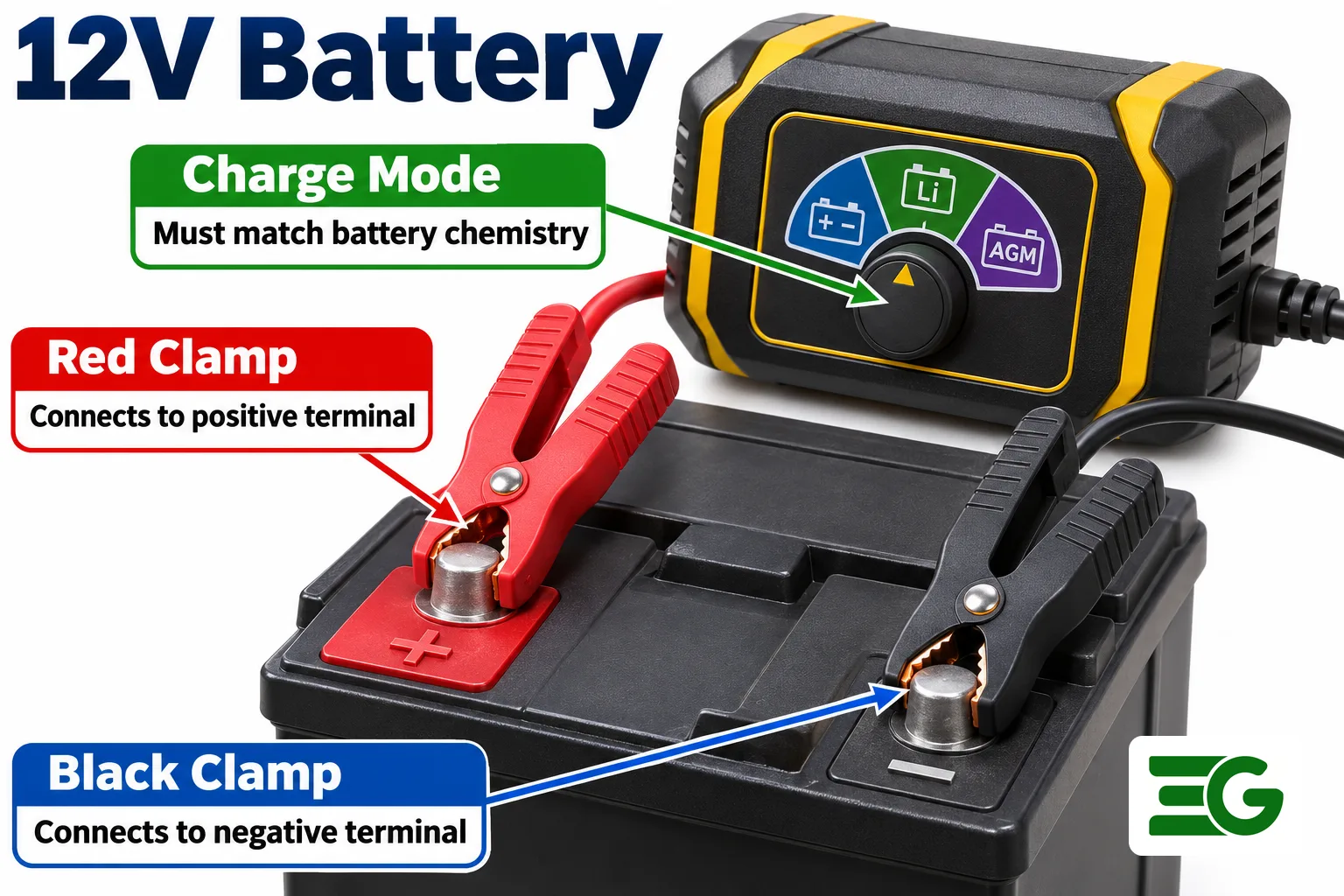
A rechargeable battery charger is not a universal 12V power adapter. Lead-acid chargers commonly use staged bulk, absorption and float operation. Lithium packs need the voltage profile and protective controls specified by their manufacturer. Victron's charger specifications, for example, show different lead-acid and lithium settings. A charger labelled 12V can still be wrong for your pack. Read the battery's permitted charging voltage and current before buying.
Connectors, polarity and current limits
For a DIY 12V pack, check the connector type, positive and negative polarity, and maximum charge current. A DC barrel plug can fit while having the wrong polarity. A USB-C power bank with a negotiated 12V output and a compatible trigger circuit may suit some low-power projects, but only if every component is rated for the load. Never attach a bare lithium cell directly to a bench supply without appropriate charging and protection circuitry.
Charging and storage routine
Keep the charger and battery on a suitable nonflammable surface with ventilation, away from water and loose metal tools. Stop if a pack swells, leaks, becomes unusually hot or smells strange. A lead-acid battery left discharged for long periods can sulphate and lose capacity; Victron describes this ageing mechanism in its 2026 technical note. Follow the product's storage and maintenance schedule. We prefer a charger with the correct preset and clear fault indication over an unlabelled cheap adapter.
Price and warranty checks in India
Compare the complete system cost
A small UPS replacement battery and a large home inverter battery belong to different price categories. Even among home batteries, capacity, construction, warranty and exchange credit change the quote. Research discussions mention Indian buyers comparing roughly ₹7,500 to ₹22,000 options, but that broad anecdotal span is not a current verified shop price. We would request a dated local quotation for the exact model, plus installation, cables, delivery and any old-battery credit. Comparing sticker prices alone hides these costs.
Read the warranty wording
A long warranty can contain a free-replacement period followed by pro-rata credit rather than a new battery at no charge. Exide's product pages publish the warranty split for specific tubular models. Check the invoice date, registration requirements, excluded uses and service availability in your city. Also inspect the manufacturing date and packaging. A battery that has been stored poorly can disappoint before its warranty period has run out.
The practical buying checklist
- Confirm the appliance voltage, power draw and required runtime.
- Match chemistry, Ah capacity, discharge current and charger profile.
- Verify battery dimensions, terminal type, polarity and protection.
- Check ventilation, installation space and access for servicing.
- Get a dated invoice, warranty terms and recycling or exchange details.
We would buy the simplest compatible product rather than pay for extra capacity that the charger or enclosure cannot support.
Common mistakes with 12V power systems
Treating all 12V batteries as interchangeable
A battery's voltage says nothing about whether it can deliver a motor's startup current or withstand daily deep discharge. An automotive starter battery, a UPS AGM block and a protected LiFePO4 pack have different intended uses. The charger may also be incompatible. If a seller cannot provide a datasheet, we'd skip that listing for any safety-critical backup application. A reliable replacement has a traceable model and clear electrical limits.
Overloading a battery pack
A motor's stall current can be much higher than its normal running current. Small protected lithium packs may shut down when their BMS detects excessive draw. Lead-acid voltage can sag under a heavy load, causing electronics to reset. Use an appropriate fuse and correctly rated wiring, and never bypass the pack's protection circuit. For a robotics build, test the load safely with a current-limited bench supply before committing to a battery.
Ignoring a 9V alternative or an adapter
Sometimes the best purchase isn't a battery at all. If the device stays near mains power, a certified regulated DC supply can be simpler than a rechargeable pack. If a handheld meter specifies a 9v battery, use that format instead of adding a bulky 12V converter. For a router, a correctly rated DC mini UPS may be more efficient than converting battery DC to AC and back again. We would choose based on the device's real input specification.
Conclusion: buy the battery your equipment can use
Start with the device label and manual. For a UPS, match the specified replacement; for a home inverter, size the load and battery bank together; for a maker project, check connectors and current limits. Browse ElectroGlobal batteries, battery accessories and the 12V DC jack battery pack for electronics projects. Verify the exact specifications before ordering, and use a qualified installer for mains-connected home backup.
Tagged