
3.7 V Battery Guide: Types, Prices & How to Charge (2026)
Learn how a 3.7 V rechargeable cell works, how to charge it safely, how long it lasts and what Indian retail prices really include.
Introduction
3.7 v battery sounds like a fixed 3.7 V supply, but many rechargeable lithium-ion cells read about 4.2 V when fully charged. That surprise leads to damaged modules, wrong chargers and poor battery choices. The label tells you nominal voltage, not the complete operating range.
In our electronics projects, the practical questions are simple: which cell fits, what charger is safe, how long will it run and what should it cost in India? A bare 18650 cell and a protected battery with wires are different products, even when both advertise 2600 mAh.
The short answer is to check chemistry, voltage limits, discharge current, capacity and protection before ordering. Here's how we would work through those checks at the bench.
What is a 3.7 v battery?
Battery definition without jargon
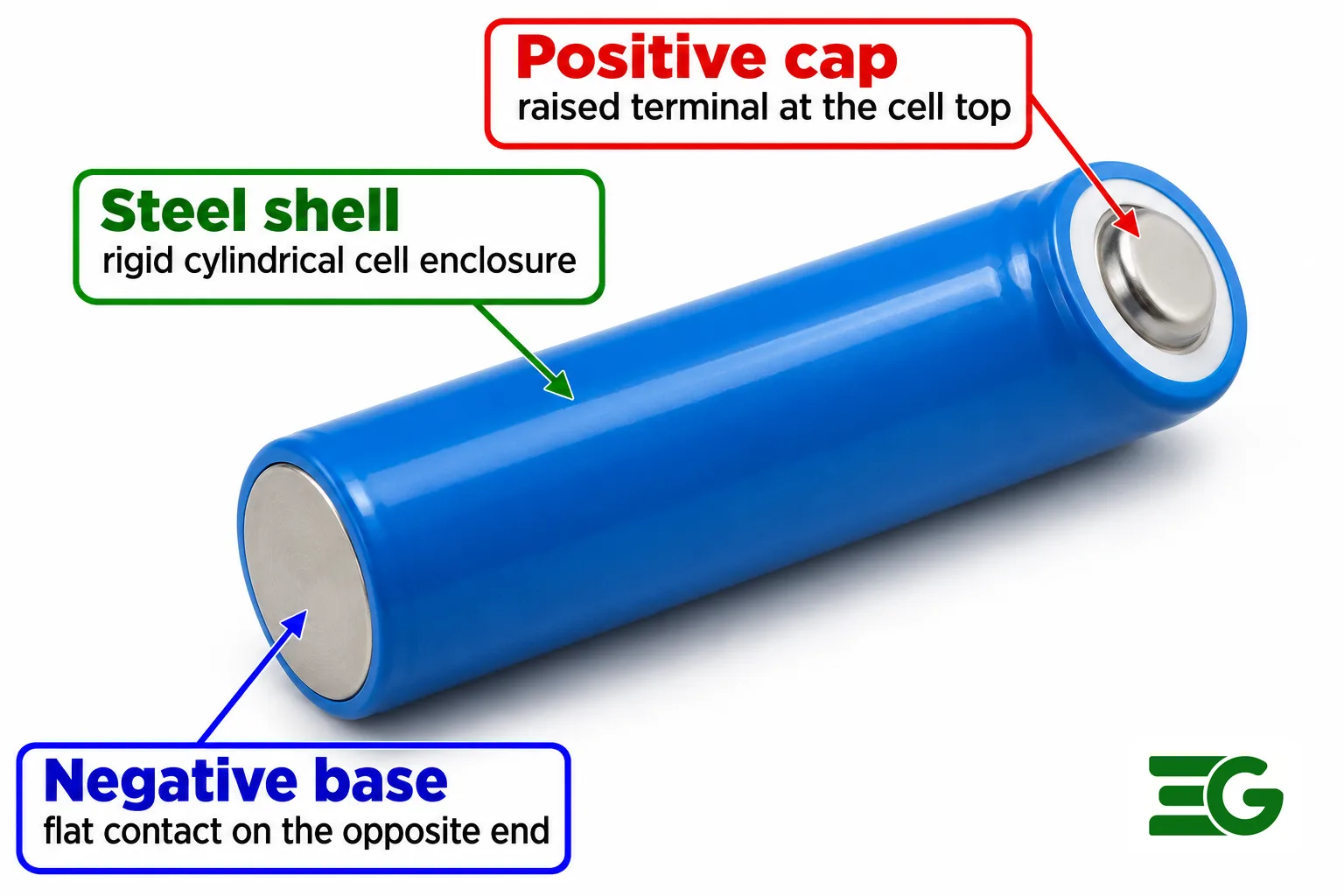
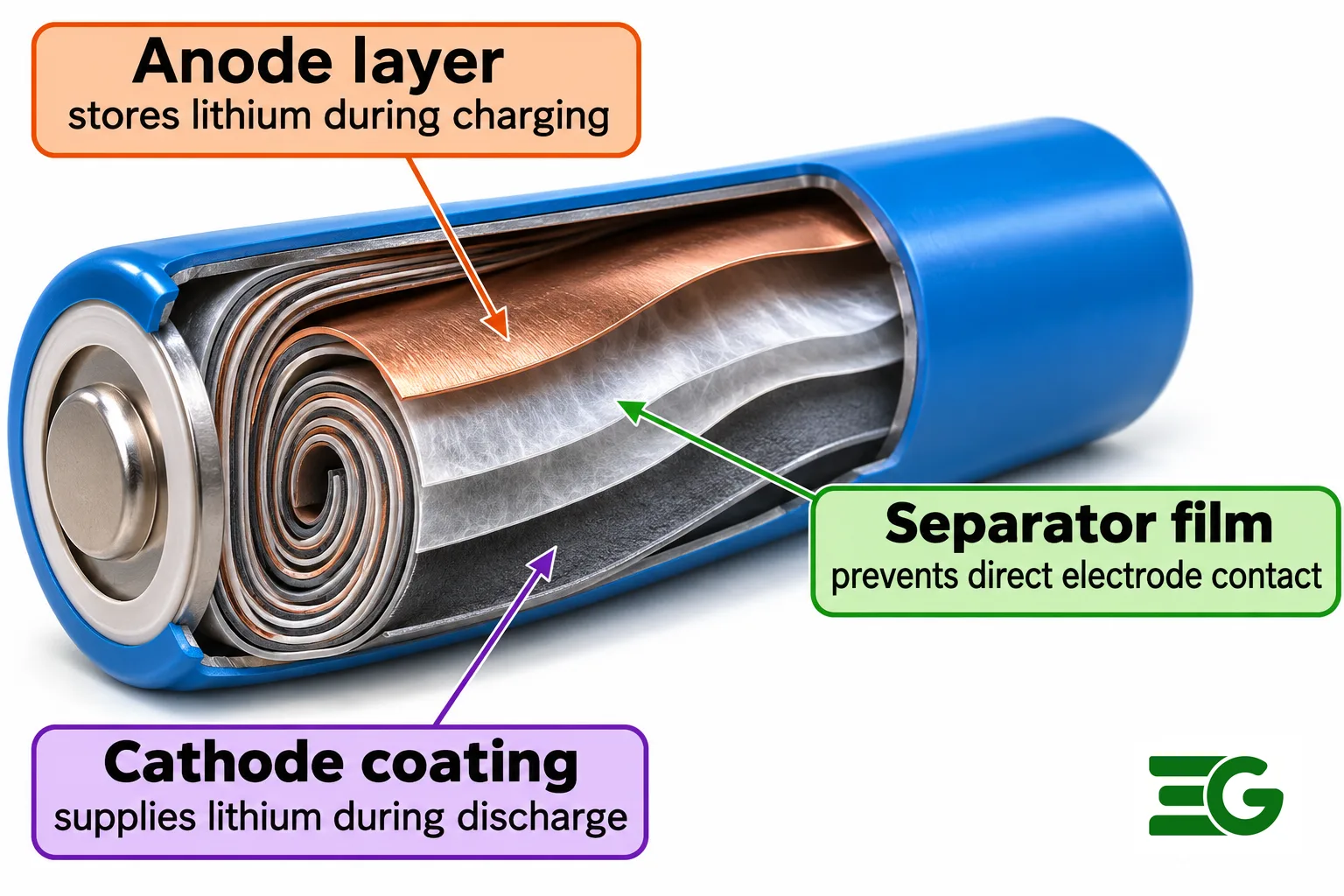
A 3.7 v battery is usually a single rechargeable lithium-ion cell with a nominal voltage of 3.7 V. Nominal means a reference value, not the reading you get every minute. During discharge, lithium ions move inside the cell while electrons flow through your circuit. Charging reverses that process under controlled conditions. We see beginners confuse a cell with a battery pack. A cell is one electrochemical unit; a pack may include several cells, insulation, protection electronics and connectors. That distinction explains why two products marked 3.7 V can cost very different amounts.
Why a charged cell reads 4.2 V
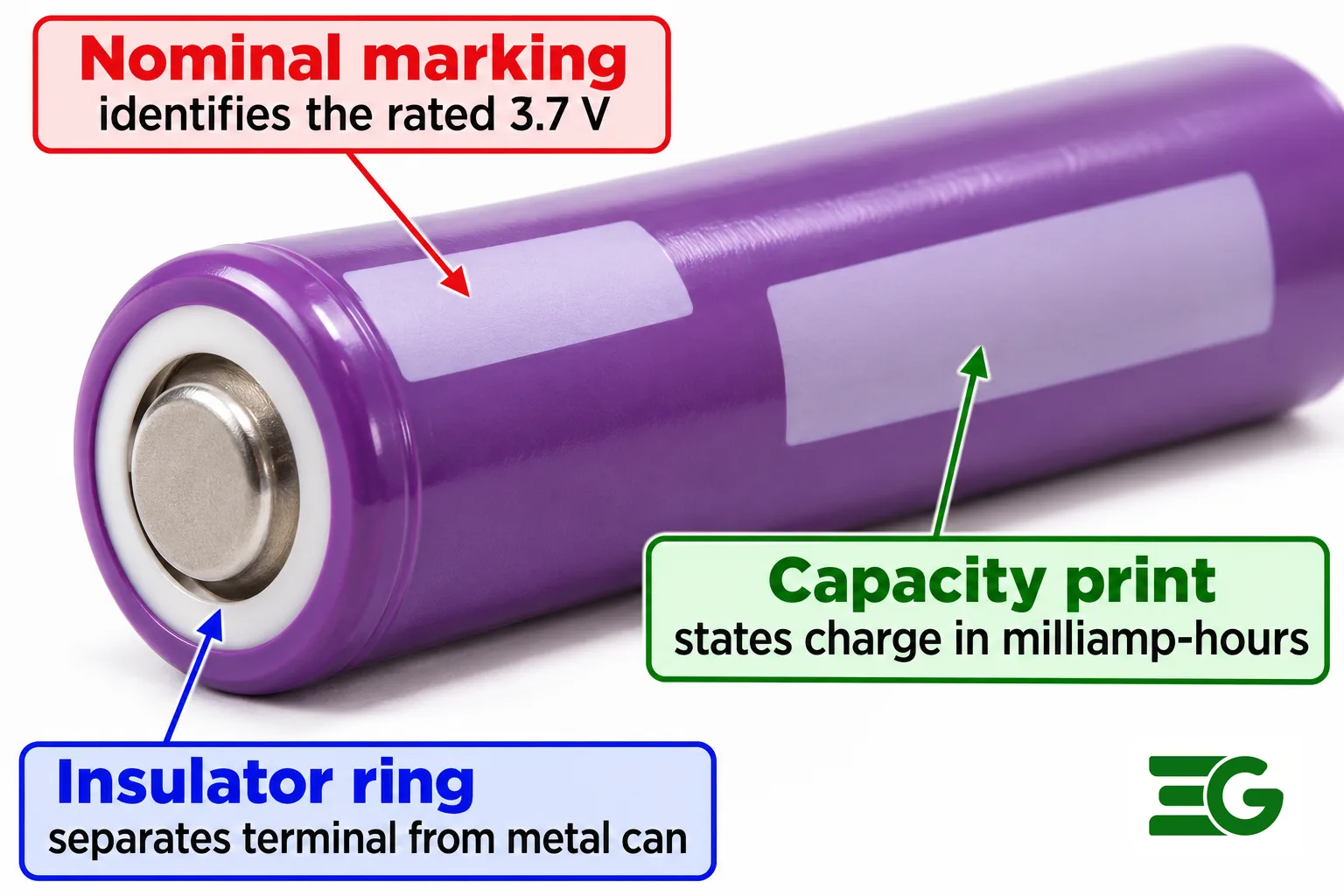
For many conventional lithium-ion cells, about 4.2 V is the specified full-charge voltage. It then drops towards its nominal rating as you use it. It may approach 3.0 V near the end of discharge, depending on the cell and its protection settings. Exact limits belong to the manufacturer's datasheet, not a rule copied from a forum. Adafruit's voltage explanation illustrates this change. We'd measure a new cell with a multimeter before connecting it, but that reading cannot prove its capacity, health or authenticity.
Reading capacity and energy ratings
The printed voltage identifies a nominal operating range. Capacity, usually in mAh, estimates how much charge a cell holds under stated test conditions. A 2600 mAh cell is rated at 2.6 Ah. Multiplying 3.7 V by 2.6 Ah gives approximately 9.62 Wh of nominal energy. That calculation helps compare batteries at different voltages. It does not establish safe discharge current. A robot motor can demand a high surge even when average current is modest. Always check the manufacturer's current rating and the load's worst-case demand.
Types of 3.7 v battery and rechargeable cell
Cylindrical 18650 and 21700 cells
An 18650 cell is approximately 18 mm in diameter and 65 mm long. A 21700 is larger and may hold more energy, depending on its design. These numbers describe dimensions, not chemistry or quality. Some cells have button-top terminals, others flat tops, and protected versions may be longer than bare cells. A holder that fits one variant may reject another. For a college project, we'd buy a documented cell and matching holder rather than force a tight fit. Check whether the listing includes protection; a metal can alone does not guarantee it.
LiPo pouch cells for compact electronics
A lithium polymer pouch cell is often thin and light, making it useful in wearables, small robots and speakers. Its nominal voltage may also be 3.7 V, but connector, dimensions and allowable current vary. A pouch can be punctured or swollen more easily than a rigid cylindrical cell. We would not mount one where a sharp PCB edge or moving wheel can rub against it. SparkFun's battery technology guide explains why lithium polymer cells require dedicated charging and careful handling.
Why LFP and NiMH are different
| Cell chemistry | Typical nominal voltage | Buying implication |
|---|---|---|
| Conventional Li-ion | 3.6 to 3.7 V | Check full-charge voltage and current |
| LFP | 3.2 V | Requires an LFP-compatible charger |
| NiMH | 1.2 V | Check device voltage tolerance |
Lithium iron phosphate, usually called LFP, is commonly around 3.2 V nominal per cell rather than 3.7 V. It has a different full-charge voltage and needs a compatible charger. NiMH rechargeable AA cells are typically 1.2 V nominal, while alkaline AA cells are commonly labelled 1.5 V. These chemistries are not universal substitutes for lithium-ion. Chemistry determines voltage behaviour, charging method and usable current. We'd choose a 3.7 V lithium-ion cell only when the device accepts its entire operating voltage range.
How to charge a 3.7 v battery safely
Can a 5 V USB adapter charge it?
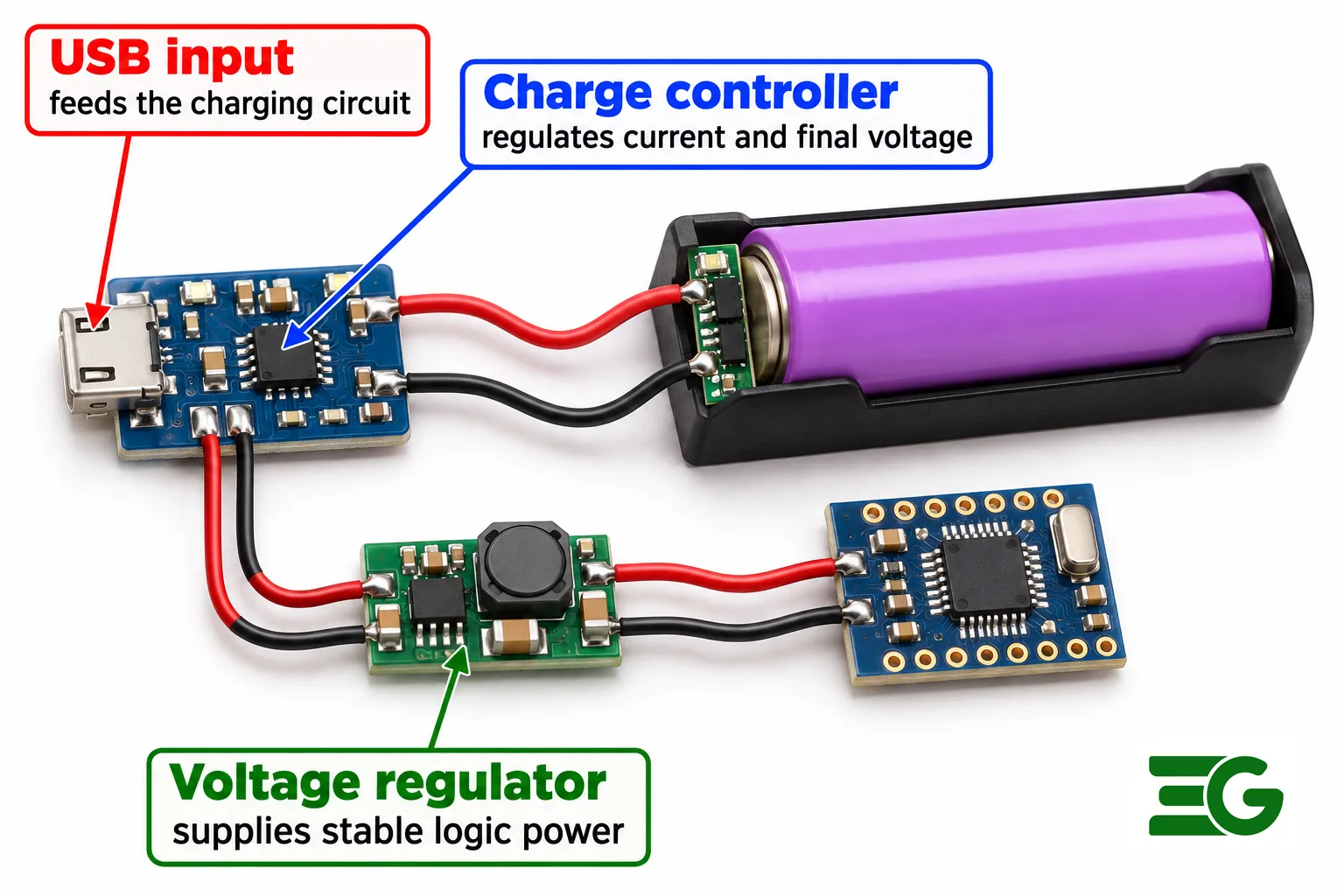
A 5 V USB adapter can power a suitable lithium-ion charging circuit. It must not be connected directly across a bare 3.7 V cell. The charging circuit regulates current and controls the cell voltage, commonly to 4.2 V for compatible conventional lithium-ion cells. That difference between USB input and battery output causes confusion. Texas Instruments' BQ24074 is an example of a charging chip with power-path control. Its existence is not permission to ignore the battery datasheet or wire an unknown pack directly.
Match charger to chemistry and capacity
A charging module must match the number of cells in series, chemistry and maximum permitted current. A one-cell charger is not a two-cell charger. For example, a 1000 mAh cell charged at 500 mA receives a nominal 0.5C current before the constant-voltage stage reduces it. The cell manufacturer may specify another limit. A protection PCB is not necessarily a complete charger, and an indicator LED cannot prove every safety requirement has been met. We prefer a tested module with documented charge termination and thermal protection.
A careful first-charge procedure
- Inspect the cell and confirm chemistry, polarity and the exact charger.
- Connect through the proper holder, not bare exposed wires.
- Charge within specified current and temperature limits.
- Stop if heat, swelling or smell is abnormal.
Inspect the cell for damage or swelling. Confirm polarity and identify its exact model. Use the manufacturer's specified charger, current and temperature limits. Place the battery on a suitable non-flammable surface away from metal tools. Connect through its intended holder or connector, then supply power to the charger as instructed. Monitor the first charge and stop if you notice unusual heat or smell. Never improvise direct charging from a bench supply or leave an unfamiliar setup unattended. These checks take longer than guessing, but a damaged cell can destroy far more than the project budget.
How long does a 3.7 v battery last?
Estimate runtime from measured current
A first estimate is capacity in mAh divided by average load current in mA. A 2000 mAh cell supplying a steady 500 mA suggests four hours in an ideal calculation. Actual runtime depends on converter efficiency, temperature, age, discharge current and cut-off voltage. A microcontroller that sleeps most of the day needs a different calculation from a motor that repeatedly stalls. We would measure average current over a realistic operating cycle instead of trusting a development board's headline consumption figure.
Why motors and Wi-Fi change runtime
An ESP32 can draw current bursts when Wi-Fi transmits, while a DC motor draws a larger surge when starting. Battery voltage may sag briefly even if substantial capacity remains. If the regulator cannot hold its output, the controller restarts. A bigger mAh number alone will not fix weak wiring or a cell with inadequate current capability. Check continuous discharge rating, regulator input range and connector resistance. For a robot, measure supply voltage at the controller while both motors start. That test tells you more than unloaded cell voltage.
Cycle life and storage habits
A rechargeable cell gradually loses capacity. Ageing depends on chemistry, charge limits, depth of discharge, heat and storage conditions. A seller's cycle count is useful only alongside its test conditions. Keeping a cell fully charged in a hot enclosure for months can shorten its useful life. For equipment stored between school projects, follow the maker's storage recommendations and inspect the pack periodically. We would not leave an unprotected cell loose in a toolbox. Insulate terminals for transport and use a suitable battery recycling route when the cell is no longer serviceable.
Li ion battery price in India for 3.7 V cells
Observed Indian retail examples
Indian online retail prices vary even among products marked 2600 mAh. Techtonics displayed ₹120 including GST for a 3.7 V 18650 cell. TechyTron listed ₹178 for a 3.7 V, 2600 mAh battery with BMS and connector. Robocraze listed a Witty Fox 3.7 V, 2600 mAh battery at ₹233. These advertised prices were checked in November 2026 and are not guaranteed checkout quotations. The products are not necessarily equivalent. Compare protection, current rating, terminal style, provenance, delivery and warranty before deciding which is cheaper.
Why bare cells and packs cost differently
A bare cell may need a holder, protection circuit, charging module, connector and enclosure before it can safely power your project. A finished pack includes some of those parts plus assembly and testing. Price changes with chemistry, capacity, brand and quantity. A wholesale quote for hundreds of cells is not comparable with one protected retail pack. We'd calculate the complete ready-to-use cost rather than the lowest cell price. Check the rechargeable battery category for suitable formats, then verify what the current listing includes.
Compare energy and the full bill
A 3.7 V, 2600 mAh cell contains about 9.62 Wh nominal energy. Two identical cells in parallel increase capacity at the same nominal voltage; two in series increase voltage at the same Ah rating. Neither arrangement is safe to improvise with mismatched cells. For purchasing, write down cell, protection, charger, connectors and delivery costs. The cheapest option can become expensive once extras are added. If you're replacing a product battery, a properly matched preassembled pack is often worth paying more for.
Can you replace a 3 V or 3.2 V battery?
Why a 3 V replacement can fail
A device designed for a 3 V primary lithium coin cell may not tolerate a fully charged 4.2 V lithium-ion cell. Nominal numbers look close, but the maximum voltage can exceed the circuit's rating. A coin cell also has different size, internal resistance and current capability. We would never replace a CR2032 with a random rechargeable cell just because both are called lithium batteries. Check maximum input voltage and the manufacturer's replacement instructions. If you need rechargeability, redesign the power path instead of forcing the wrong chemistry into the holder.
What about 3.2 V LFP or 3.6 V cells?
A 3.2 V LFP cell has a different charging profile from a conventional 3.7 V lithium-ion cell. Some 3.6 V lithium-ion cells are close relatives of 3.7 V nominal products, but other 3.6 V batteries use different chemistry. Labels alone cannot establish interchangeability. Compare full-charge voltage, discharge cut-off, chemistry, current and connector polarity. A charger set for 4.2 V may overcharge an incompatible cell. If a product specifies one chemistry, use it unless the manufacturer explicitly approves an alternative.
Regulate voltage for sensitive electronics
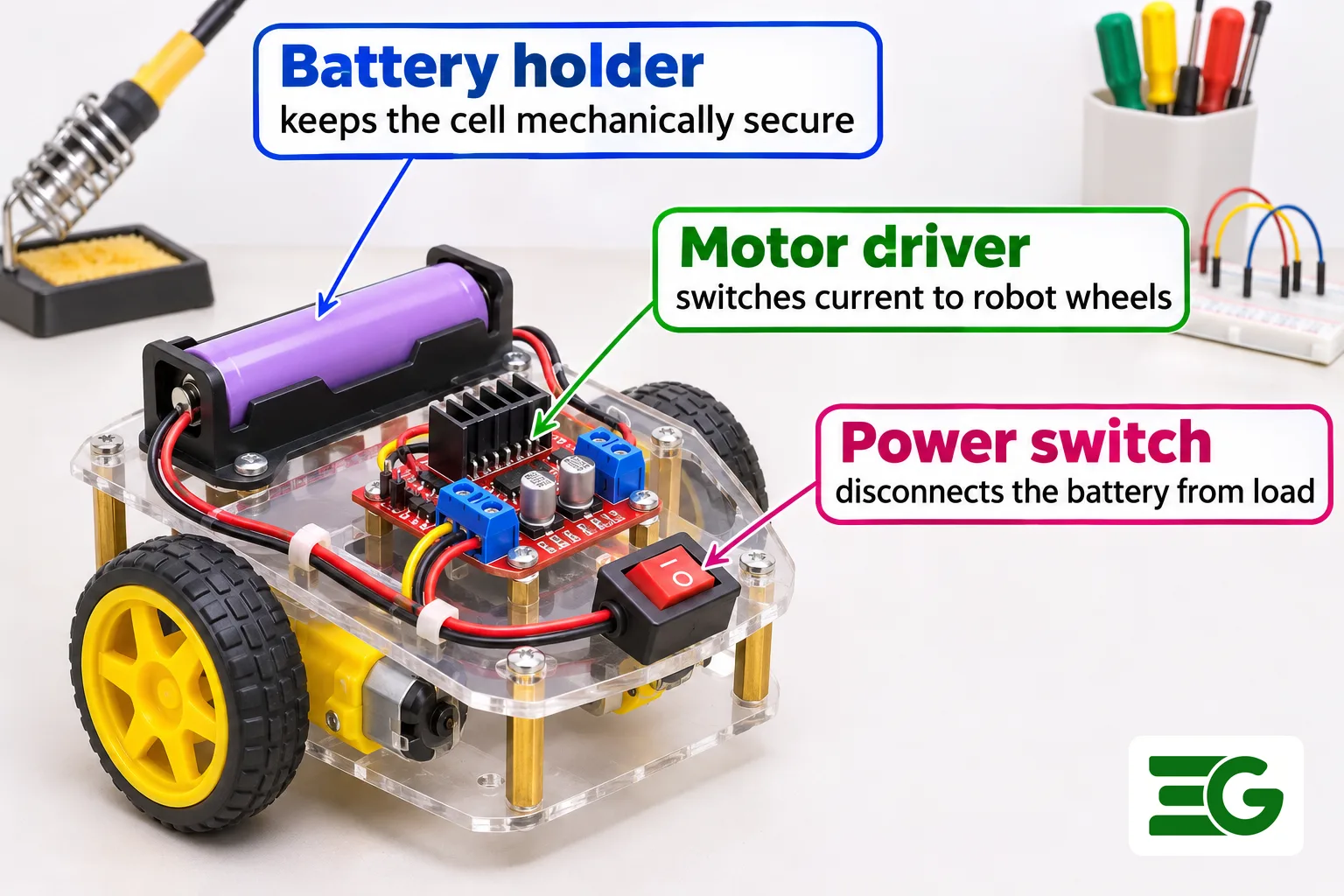
Many microcontrollers and sensors need regulated 3.3 V or 5 V rather than raw lithium-ion output. A suitable buck, boost or buck-boost converter can provide that voltage if its input range covers the cell from full charge to cut-off. Check startup current and heat dissipation too. For an Arduino robot, the battery may power a motor driver while a separate regulator supplies the controller. Inspect the battery parts category for holders and connectors. We'd verify regulator output with a meter before plugging in the board.
How to choose and test a rechargeable cell
A buying checklist that catches mistakes
- Match chemistry and full voltage range.
- Check capacity, current and connector dimensions.
- Verify protection, charger, warranty and delivered price.
Start with chemistry and the exact cell model. Check nominal and maximum voltage, capacity in Wh, continuous current, dimensions and terminal style. Ask whether protection and a compatible charger are included. Compare delivered price, warranty and supplier documentation. We reject listings that promise enormous capacity in a standard cell without a traceable datasheet. For a thin enclosure, look at the lithium polymer battery category and verify pouch dimensions. Don't select a cell by photograph alone.
Test polarity and voltage before connecting
A multimeter test takes less time than repairing a reversed connector. Set the meter to DC volts, identify positive and negative terminals and measure without shorting contacts. Confirm the reading is consistent with chemistry and charge state. Connect a suitable regulator without the controller attached. Measure its output, add the controller and finally the load. If voltage collapses under load, stop and investigate current demand, wiring and cell rating. We prefer staged testing because a damaged cell can still show a plausible no-load voltage.
Common mistakes we would avoid
Don't connect a bare cell directly to a 5 V adapter, mix used and new cells in a homemade pack or assume a BMS replaces a charger. Don't use a swollen pouch or cell with torn insulation. Keep batteries away from summer heat in a closed vehicle and prevent metal objects touching exposed terminals. When building a kit, use the right holder and a fuse where appropriate. For more on chemistry, see ElectroGlobal's battery definition guide. The best purchase is one you can charge and use safely with documented parts.
Conclusion: choose a 3.7 V cell you can charge safely
A 3.7 V lithium-ion cell is useful for robotics, portable electronics and small IoT projects, but only when the entire power system is compatible. Check maximum voltage, continuous current and charger before looking at mAh. The lowest price is rarely the whole cost.
For a first project, we'd choose a documented protected cell and matching charger instead of a mystery cell with an oversized capacity claim. Start with ElectroGlobal's rechargeable battery selection, then confirm specifications and the current price on each product page.
Tagged