
Types of Battery: Complete Guide to Every Cell in 2026
Types of battery explained for Indian makers: compare chemistry, voltage, safe charging, prices and the right cell for each project.
Introduction
Types of battery matter more than the shape printed on a product listing. Two cells can fit the same holder yet need different chargers, deliver different voltages and behave very differently when a motor starts. That is how a simple battery replacement turns into a damaged board or an unreliable robot.
For an Indian electronics project, start with three questions: is the cell rechargeable, what voltage range does the circuit accept, and how much current does it draw? A 3.7 V lithium-ion cell can reach about 4.2 V when fully charged. A rechargeable AA using NiMH chemistry is normally rated 1.2 V, not 1.5 V.
We compare the common chemistries, show what the numbers mean and use real Indian listing prices rather than pretend that one battery suits every device. The goal is to help you choose a safe power source without buying parts twice.
Battery definition: cells, packs and stored energy
What happens inside a battery
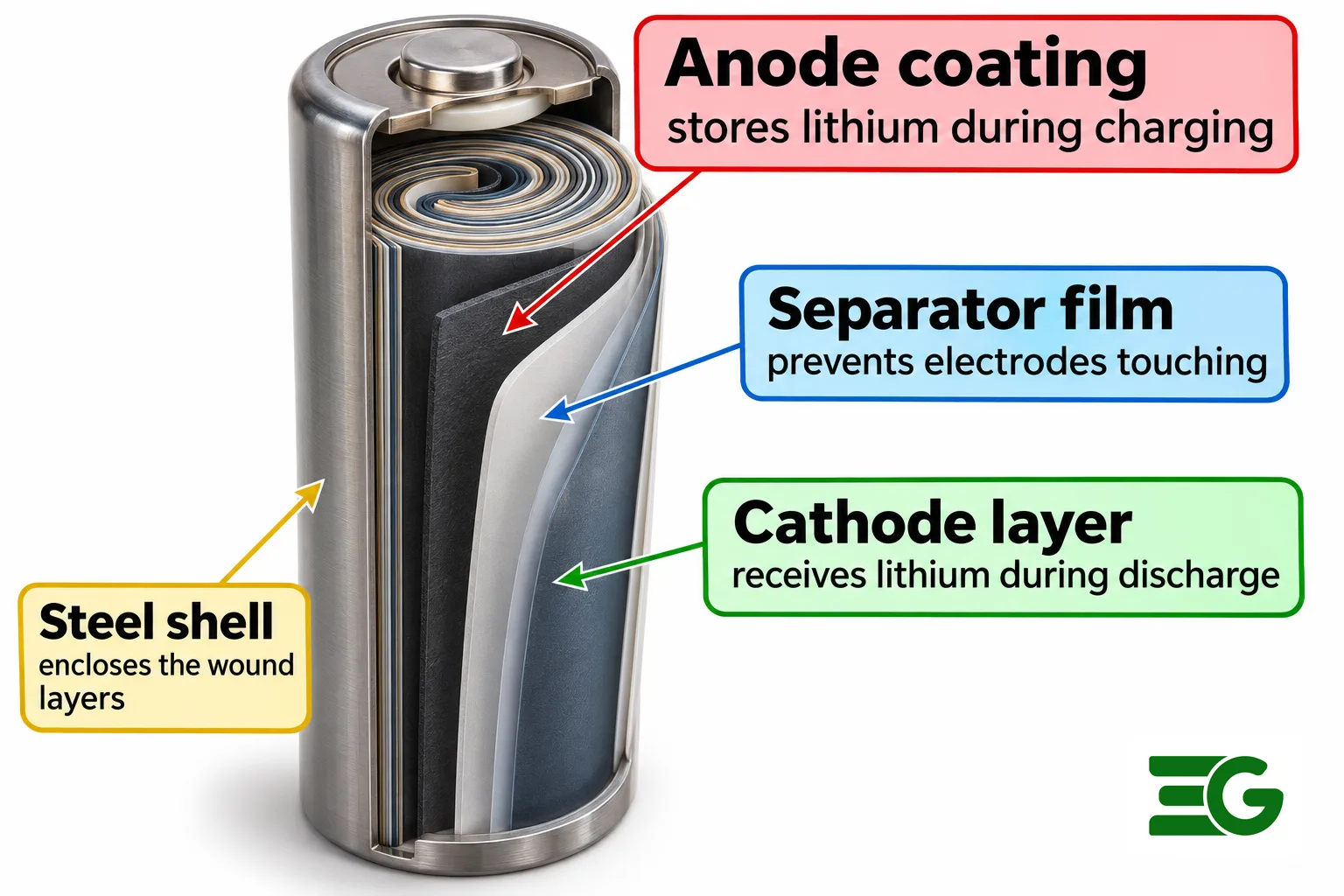
A battery converts stored chemical energy into electrical energy. Its positive and negative electrodes are separated by an electrolyte, which lets ions move internally while electrons travel through your external circuit. During charging, a rechargeable chemistry reverses the reaction using controlled electrical energy. The US Department of Energy's battery explanation is useful if you want the electrochemistry behind the simple circuit diagram. A battery is not a tiny tank of electricity; the chemical reactions set its operating behaviour.
One cell versus a battery pack
A cell is one electrochemical unit. A battery pack may connect several cells in series for higher voltage or in parallel for more capacity, with suitable protective electronics. A single cylindrical 18650 is a cell, while a laptop or inverter battery is usually an assembled pack. You cannot infer the pack voltage from the shape of one cell. When we inspect a replacement, we read the complete pack label and connector pinout before opening a product catalogue.
Voltage, current and capacity are different
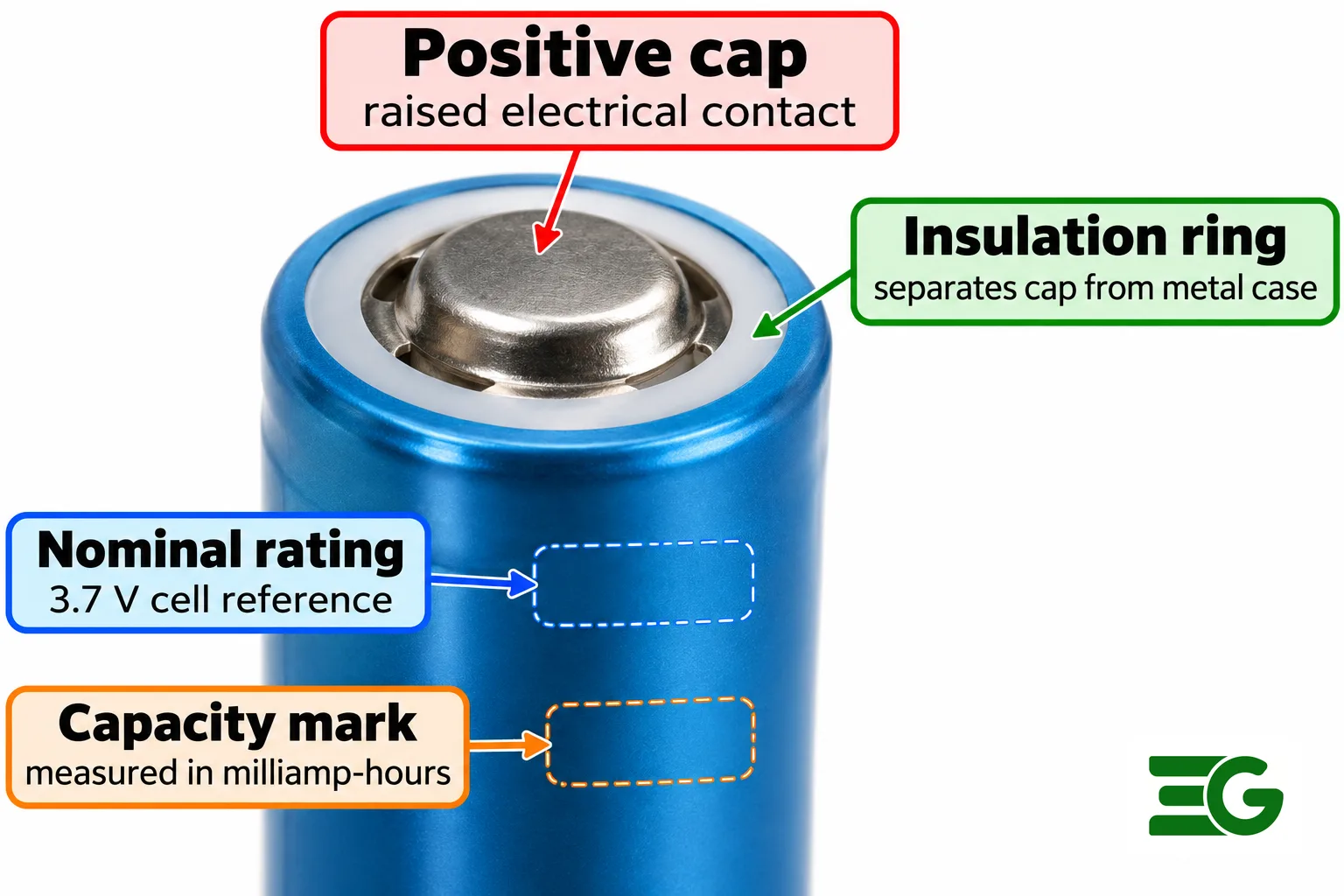
Voltage describes electrical potential, current describes the rate of charge flow and capacity in milliamp-hours describes stored charge under specified test conditions. A 3.7 V, 2000 mAh cell has roughly 7.4 watt-hours of nominal energy. At an ideal constant 2 W load, that suggests 3.7 hours, before regulator losses and cutoffs. Current rating matters separately: a high-capacity cell can still struggle with a motor's starting surge. We'd rather have a documented current rating than an impressive wrapper claim.
Primary and rechargeable types of battery
Primary cells for occasional use
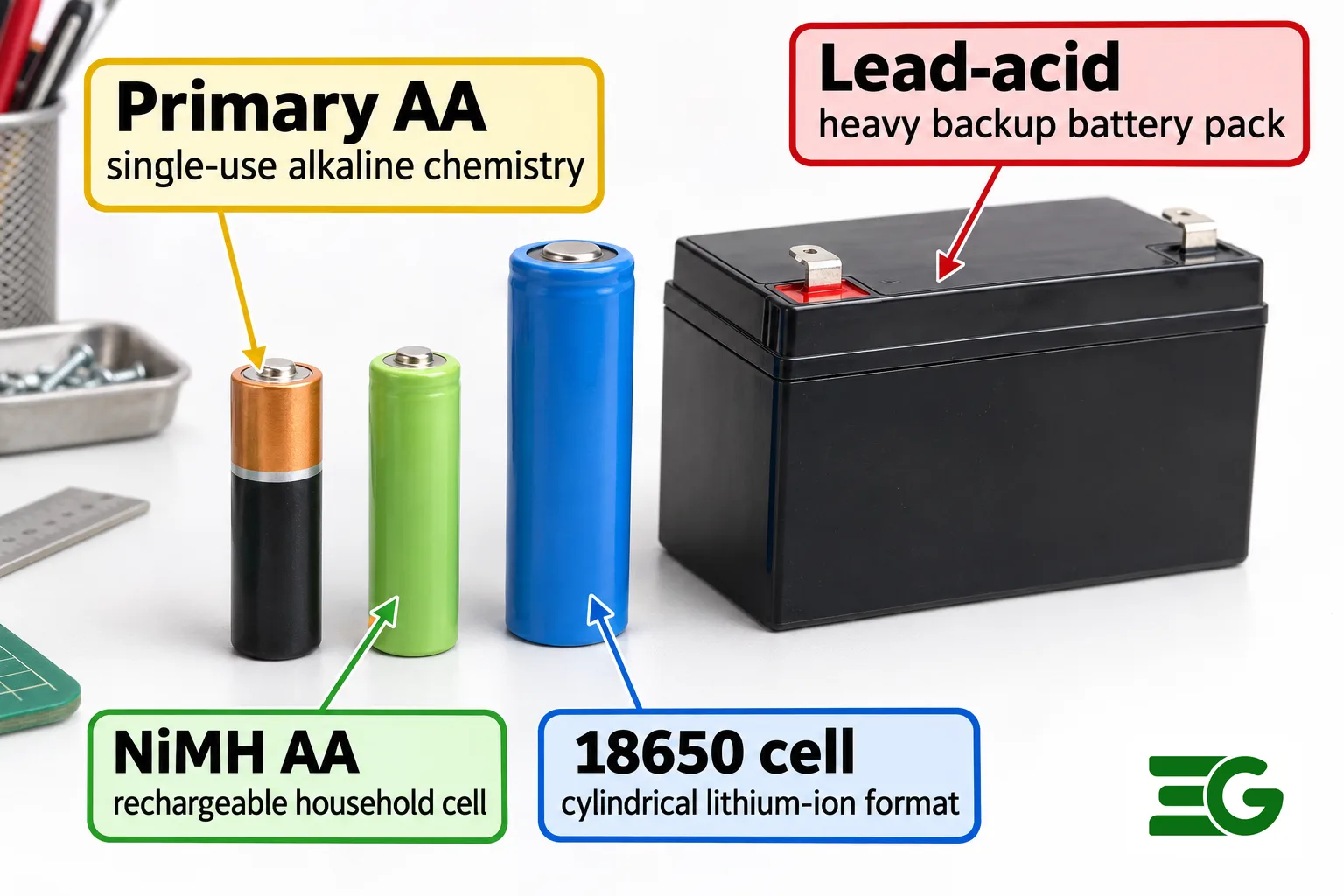
Primary batteries are designed for a single discharge period. Alkaline AA and AAA cells are common in remotes, wall clocks and small toys. Zinc-carbon cells are another inexpensive primary option, usually better suited to low-drain applications. Primary lithium coin cells and some cylindrical lithium cells also exist, but their chemistry is not the same as rechargeable lithium-ion. Do not put an ordinary alkaline or primary lithium cell into a charger. For a rarely used remote, a good primary cell can be the simpler purchase.
Secondary cells for repeated cycles
A rechargeable cell is called a secondary cell. Common families include nickel-metal hydride (NiMH), lithium-ion, lithium iron phosphate (LFP) and lead-acid. Their charge profiles differ, so one universal-looking connector does not mean one charger fits all. A typical NiMH AA is nominally 1.2 V; a conventional lithium-ion cell is often 3.6 or 3.7 V; an LFP cell is commonly around 3.2 V; and a lead-acid cell is nominally around 2 V. Check the manufacturer's exact limits rather than treating these as fixed outputs.
How to read the chemistry comparison
Use the table as a first filter, not a charging instruction. Actual full-charge voltage, safe discharge limit and current rating vary with cell model. A sealed lead-acid inverter battery is not a substitute for a lithium pack merely because both can be labelled 12 V. Equally, a rechargeable AA may physically fit a toy yet cause its battery gauge to read differently. We start with the device's permitted voltage range, then check its charger and physical space.
| Chemistry | Typical nominal cell voltage | Common use | Rechargeable? |
|---|---|---|---|
| Alkaline | 1.5 V | Remotes and clocks | No |
| NiMH | 1.2 V | Reusable AA devices | Yes |
| Conventional Li-ion | 3.6 to 3.7 V | Portable electronics | Yes |
| LFP | 3.2 V | EVs and storage | Yes |
| Lead-acid | 2 V | Backup power | Yes |
Common types of battery and where each belongs
Alkaline, NiMH and lead-acid
Alkaline cells are convenient for infrequent low-drain household use. NiMH is a sensible rechargeable choice for compatible AA-powered toys, camera accessories and controllers. Its voltage curve differs from alkaline, so a device may show a low-battery warning earlier than expected. Lead-acid batteries remain common in backup systems and vehicles because they are established and can deliver substantial current, but they are heavy. For an inverter, we'd buy a battery specified for the inverter's charging profile, backup duty and ventilation requirements, not a loose cell assembled at home.
Lithium-ion, LiPo, LFP and lithium primary
Lithium-ion covers several rechargeable chemistries, including nickel-rich types and LFP. A cylindrical 18650 and a flat lithium polymer pouch may both use a conventional 3.7 V nominal chemistry, yet need different mechanical mounting. LFP has lower nominal cell voltage and is widely used in electric vehicles and stationary storage. A disposable lithium coin cell is primary and must not be charged. We would not replace one of these with another until voltage limits, charger behaviour and protection have been verified.
Battery formats are not chemistries
AA, AAA, 18650, pouch and prismatic describe physical formats, not necessarily the chemical system. The name 18650 roughly indicates a cylinder 18 mm in diameter and 65 mm long, although protected cells can be longer. A pouch cell is thin and easy to fit into a small enclosure but must be kept away from sharp edges and compression. Prismatic cells have rigid rectangular cases and suit dense packs. If a product listing says only 'lithium battery', ask for the exact cell model.
Why a 3.7 V battery reads 4.2 V
Nominal voltage is an average reference
A conventional lithium-ion cell marked 3.7 V can measure close to 4.2 V just after charging. That is not automatically a fault: nominal voltage is a reference for normal operation, not the maximum output. Some specialised lithium chemistries use different charge limits. A product advertised as a 3.7 V battery therefore needs a regulator or load that can tolerate its full voltage range. We would never wire it straight to a 3.3 V-only microcontroller pin.
Charging and protection do different jobs
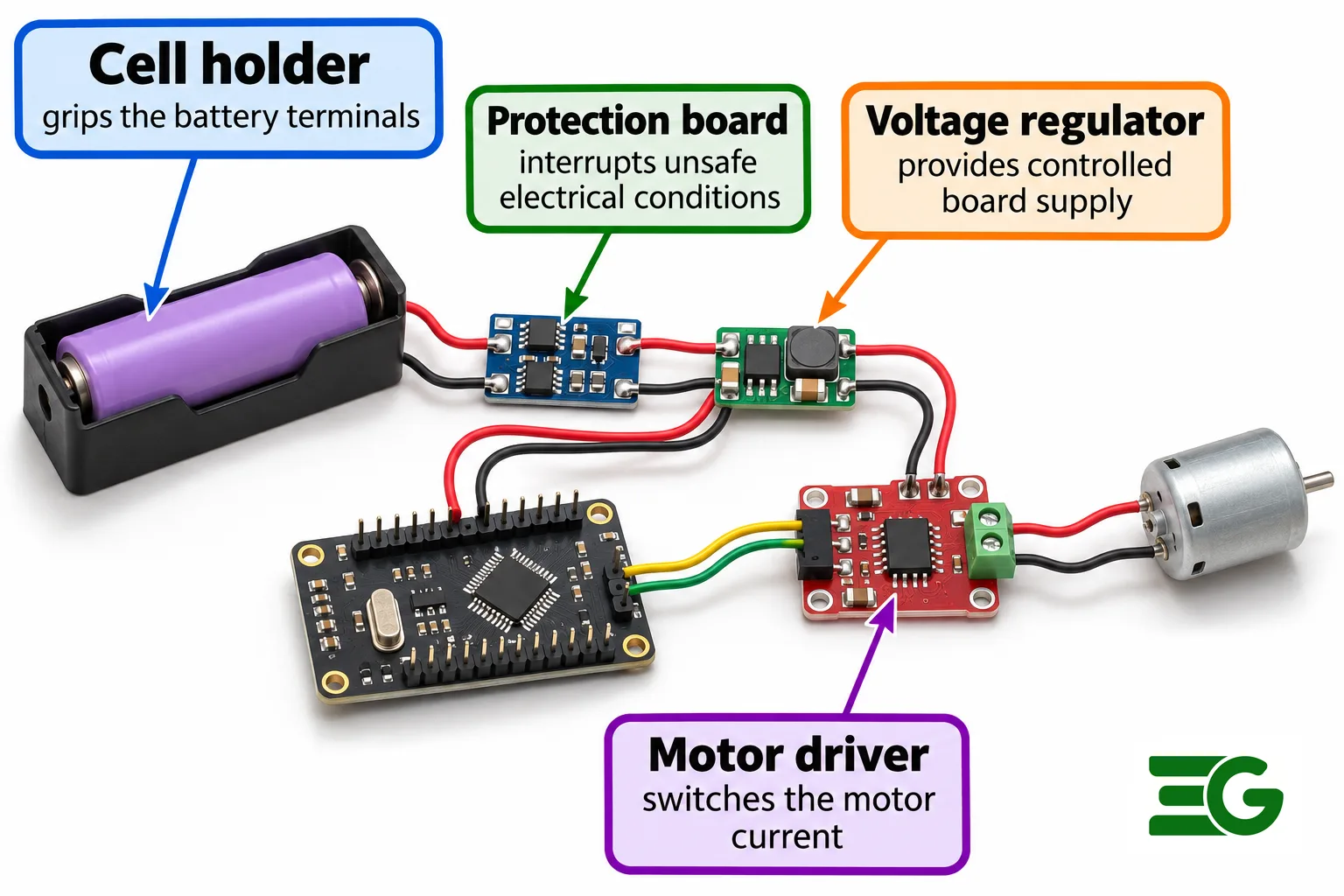
A suitable lithium-ion charger normally controls current, holds the specified final voltage and terminates charging properly. A USB wall adapter alone is not that controller. A protection circuit may disconnect the cell under unsafe conditions, but it does not automatically implement a full charging algorithm. Multi-cell series packs need an appropriately rated charger and pack protection, often including balancing. The EPA's lithium-ion safety guidance also explains why loose terminals must be insulated during storage and recycling.
What a low reading can mean
Voltage can fall as a cell discharges, and it drops further under load because of internal resistance and contact losses. An ESP32 robot may restart when two motors accelerate even though the battery measured normally with the switch off. Measure the supply while the motors start, and check regulator input limits, wire thickness and holder contacts. A low reading alone does not tell you the cell's remaining capacity or safety. We'd stop using a swollen, punctured or unusually hot battery rather than try to revive it.
Li ion battery price in India: real comparisons
Why one 18650 costs more than another
Indian prices differ by manufacturer, capacity, current rating, protection and pack size. In a November 2026 listing snapshot, an ElectroGlobal 1800 mAh 18650 was shown at ₹119, while its protected 2600 mAh single-cell option was listed at ₹213. A documented Samsung 2600 mAh listing on Robu showed ₹499 and was out of stock when checked. These are product-page observations, not a promise of today's checkout price. We'd check stock and the actual datasheet before treating any offer as equivalent.
Compare a single cell with a complete pack
ElectroGlobal's six-cell 2600 mAh listing showed ₹1,121 for the pack, which is about ₹187 per cell before considering any additional hardware. A finished inverter or EV pack can cost thousands of rupees because it also needs interconnects, insulation, a battery management system, enclosure and testing. Comparing a ₹119 loose cell with a complete inverter pack is misleading. Compare usable watt-hours, current rating, protection and warranty instead. For a first electronics project, a protected single cell can be easier to integrate.
Beware of capacity claims and hidden costs
A very cheap 18650 advertised with extraordinary capacity but no traceable manufacturer part number deserves caution. The 18650 label guarantees neither capacity nor authenticity. Budget for a holder, compatible charger, connector, protective electronics and shipping. A lower price can be reasonable for a small experiment, but we'd avoid undocumented cells in high-current robots or multi-cell packs. If you need a pack assembled, ask who is responsible for matching cells, checking insulation and testing the protection circuit.
Choose the best battery for each device
Remotes, toys, power banks and wearables
For a remote used infrequently, alkaline AA cells may be practical. For compatible toys that run through batteries every week, NiMH often makes more sense. Power banks normally use managed lithium-ion packs rather than loose cells. Wearables frequently use compact pouch cells, but the soft package needs a safe enclosure and the connector polarity must be checked. We wouldn't buy a pouch cell merely because it fits the available space; the device's charging circuit still has to match the chemistry.
Robotics, inverters and electric vehicles
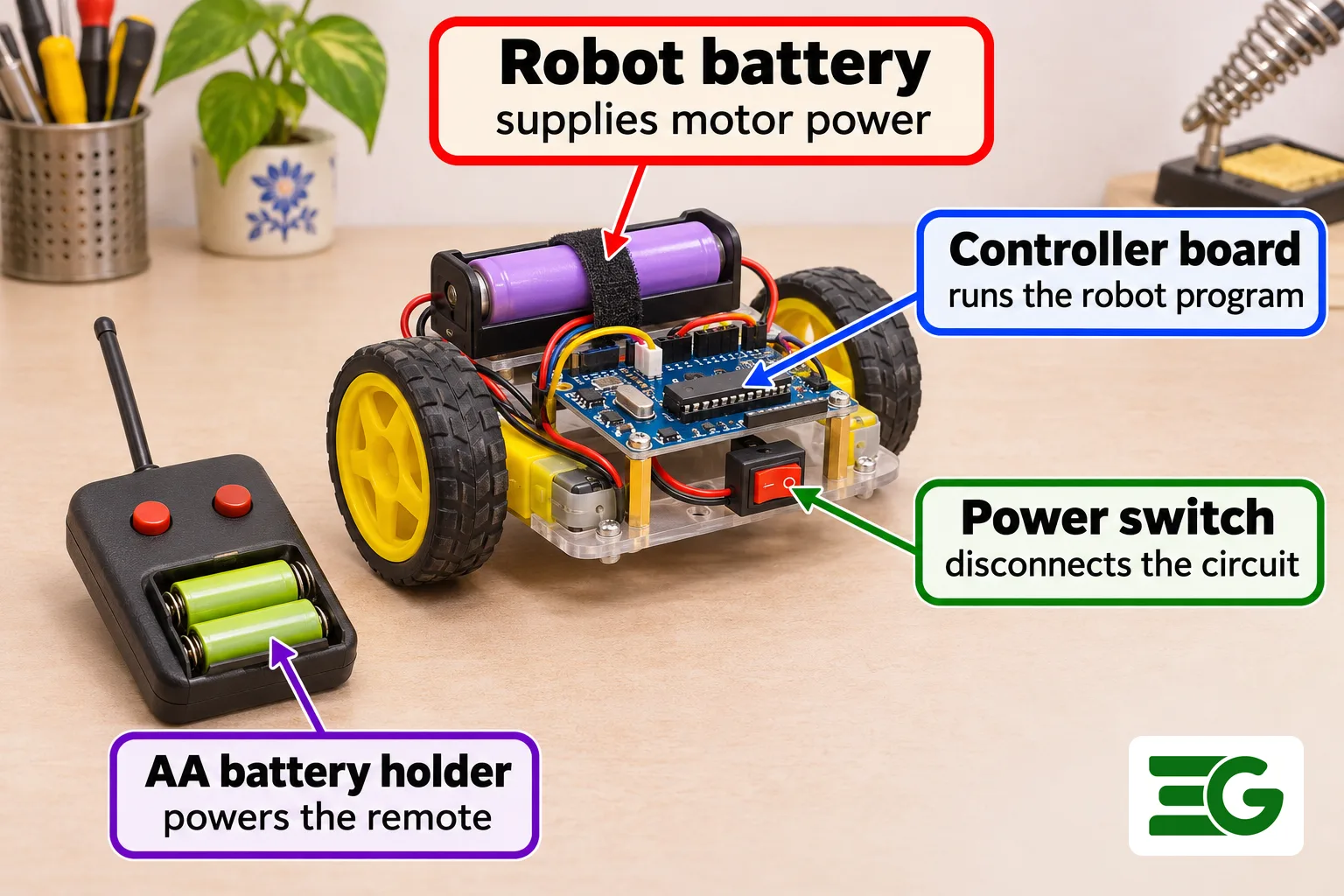
For an ESP32 robot with two DC motors, choose the cell and regulator from measured startup and stall current. Motor noise and voltage sag can reset the controller. A home inverter should use a manufacturer-supported battery chemistry and charging configuration; lead-acid and LFP systems are not drop-in replacements without verification. Electric vehicles use engineered battery packs with thermal management and safety controls. In its 2026 EV battery analysis, the IEA reported that LFP exceeded 55% of global EV battery deployment in 2025. That market trend does not mean LFP is automatically best for every small project.
Step-by-step selection and power test
Before ordering, work through the steps below with your actual circuit. Do not guess the current from the board's name alone. A motor driver, radio transmission and sensor heater can all change the load. If the project runs in a closed box in Indian summer heat, consider ventilation and manufacturer temperature limits too. We'd write down the cell model and measured voltage under load, so a future replacement can be checked against a known working setup.
- Read the device's minimum and maximum supply voltage and connector polarity.
- Measure normal current and startup or peak current with suitable equipment.
- Choose the chemistry, cell count, capacity and continuous discharge rating.
- Match the charger, protection board and regulator to that exact cell or pack.
- Power the regulator first, then add the controller, sensors and motors in stages.
- Measure voltage under the heaviest expected load and check for overheating.
Battery technology in 2026 and buying mistakes
Sodium-ion and solid-state progress
Sodium-ion batteries are moving into industrial scale-up, but they have lower energy density than many lithium-ion designs. The IEA's 2026 report describes sodium-ion as promising for shorter-range vehicles, industrial equipment and some stationary storage applications. Solid-state battery designs are also progressing, but full solid-state cells still face manufacturing and scale challenges. We'd avoid treating a prototype announcement as evidence that a cheap consumer replacement is already available. For a student project today, documented conventional cells remain easier to source and charge correctly.
Why battery prices and trends need context
The IEA reported an 8% fall in average battery prices during 2025, but regional prices and chemistries differed. LFP packs were more than 40% cheaper per kilowatt-hour than NMC alternatives on average in its analysis, partly because the markets served are different. Those figures describe industrial packs, not the retail price of a single 18650 in Jaipur. We'd use the trend to understand the market, then compare the actual local part and its warranty. No global average can tell you whether a specific cell is genuine.
Mistakes to catch before checkout
Don't assume every rechargeable cell can use the same charger. Don't mix old and new cells in a series pack, ignore connector polarity or trust a 3.7 V label as a fixed voltage. A damaged wrapper can expose a cylindrical cell to a short. Keep loose cells in insulating cases and send end-of-life lithium batteries to an appropriate collection channel rather than ordinary household rubbish. The EPA's household battery guidance explains safe terminal isolation. We prefer a boring, documented battery over an exciting capacity claim.
Our buying checklist
- Exact manufacturer model and chemistry, not just the battery size.
- Full-charge limit, safe cutoff, discharge current and usable energy.
- Protection, connector polarity, holder fit and charging method.
- Current listing price, stock, shipping and warranty.
Conclusion: match chemistry to the circuit
A practical final recommendation
The best battery is the one whose voltage range, discharge rating, charger and dimensions suit your device. Use NiMH where a compatible AA product is cycled often, a properly protected lithium-ion cell for many portable electronics projects, and manufacturer-approved packs for inverters or vehicles. Before you buy, read the exact cell model and confirm the charger. Browse ElectroGlobal rechargeable batteries and battery holders and protection parts to compare what your build actually needs. If you're choosing a compact pouch cell, check the lithium polymer battery range as well. Don't buy a battery on capacity alone.
Tagged