
Rechargeable Battery Charger Buying Guide: AA, AAA, 9V & 12V
Choose a rechargeable battery charger for AA, AAA, 9 V or 12 V batteries without guessing about chemistry, charging time or safety.
Introduction
Rechargeable battery charger mistakes often begin with a familiar-looking slot. An AA cell fits, the light comes on, and you assume the charging circuit knows what to do. That assumption can ruin a battery or create a safety problem. The printed chemistry matters more than the shape of the plastic case.
At ElectroGlobal, we tell buyers to read the battery label first: NiMH, lithium-ion, LiFePO4 and lead-acid require different charging methods. A charger for 1.2 V AA cells is not a charger for a 12 V UPS battery. Even two batteries marked 9 V may use different chemistries and charge limits.
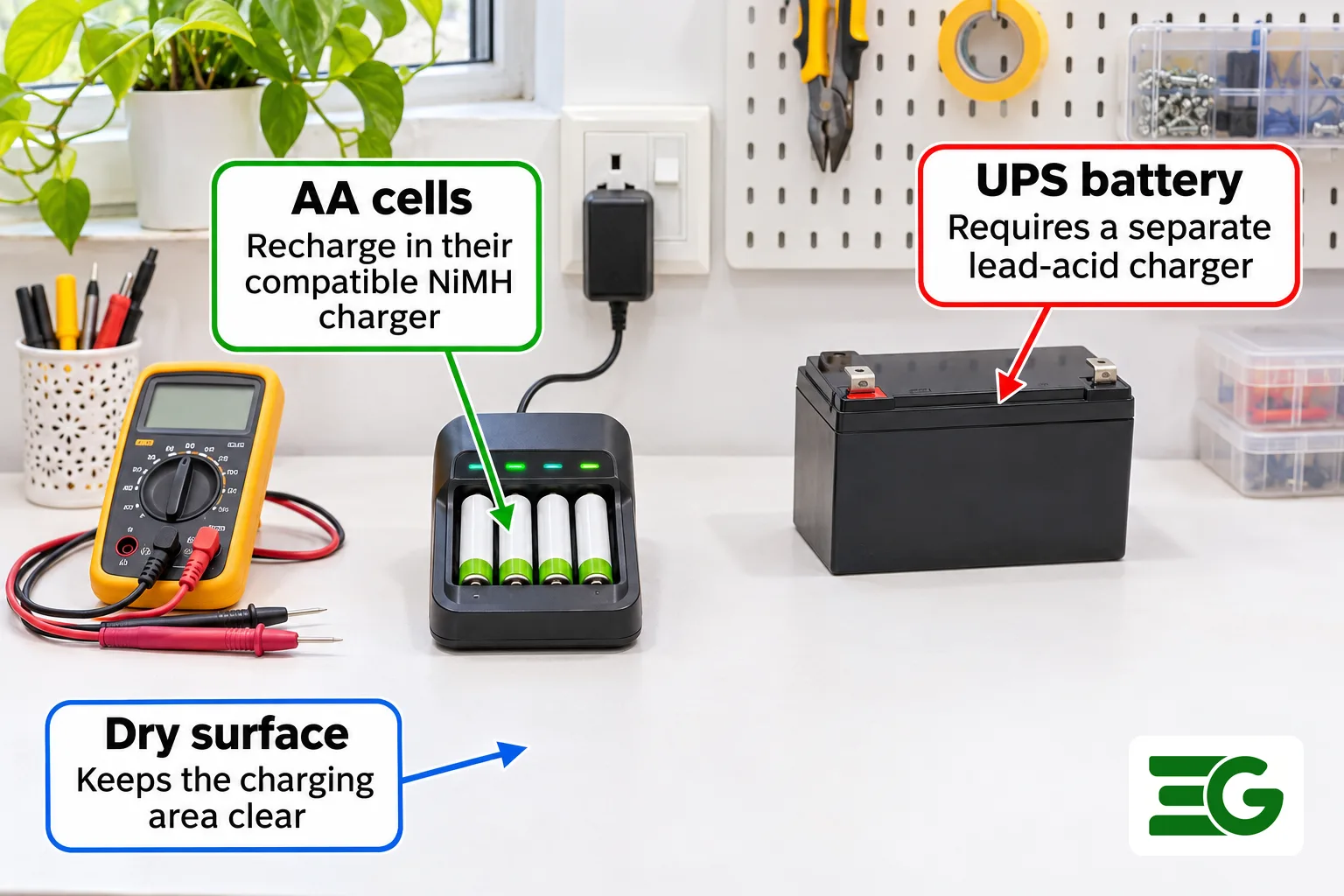
Our practical pick for everyday AA and AAA cells is a smart NiMH charger with independent slots and automatic charge termination. For a home inverter or sealed UPS battery, choose a charger specified for the exact battery chemistry and capacity. Here is how to check the details before spending money.
Why a rechargeable battery charger matters
Charging is a controlled electrical process
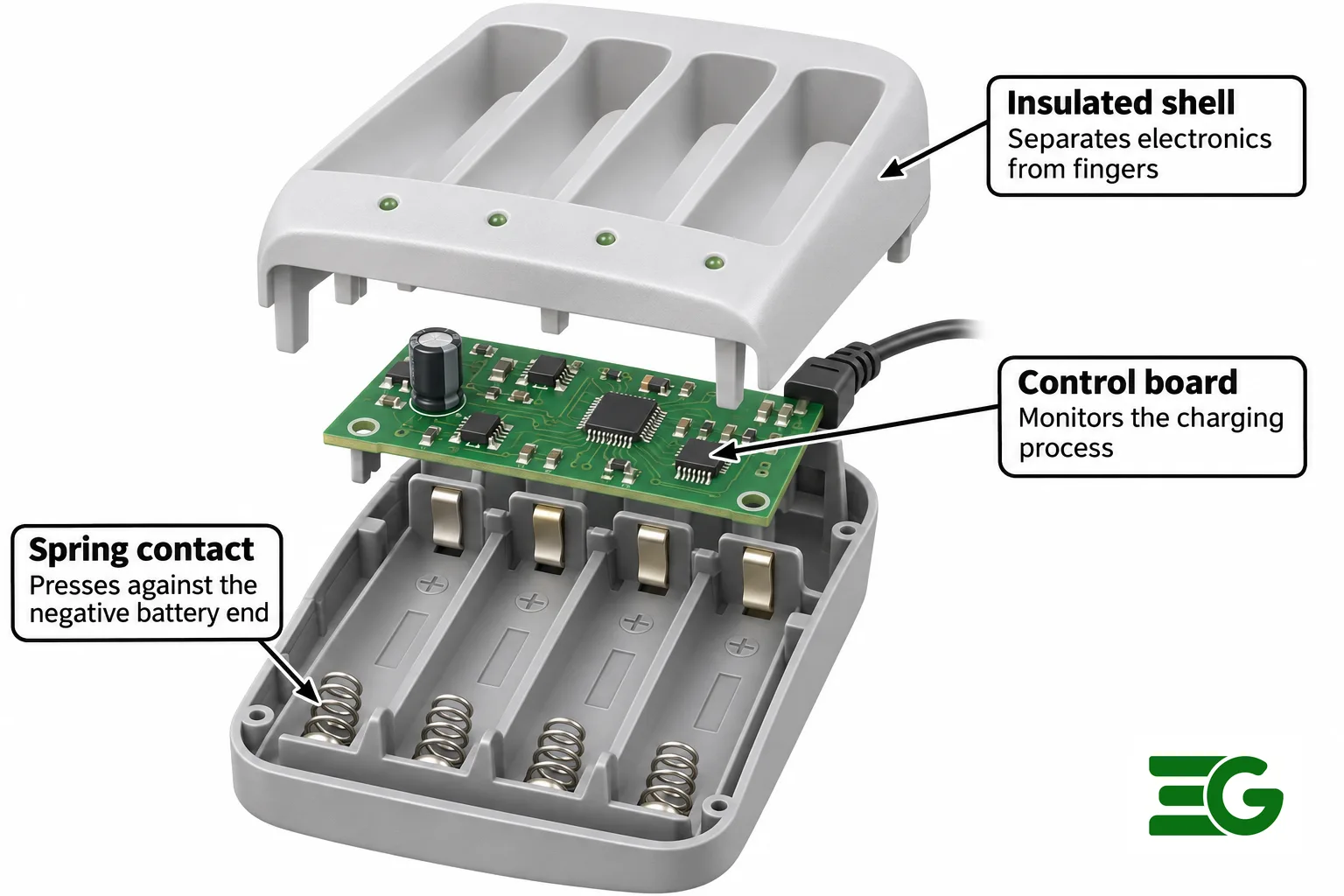
A rechargeable cell stores energy through reversible chemical reactions. The charger supplies current while monitoring conditions that indicate when to slow down or stop. A simple power adapter supplies voltage; it does not necessarily know whether a cell is full. That difference is why a USB cable and an improvised connector are poor substitutes for a charging controller.
For nickel-metal hydride (NiMH), full-charge detection often uses a small voltage change, temperature or a safety timer. Lithium-ion typically needs a controlled current phase followed by a voltage-limited phase. Lead-acid charging uses its own voltage stages and often a float stage for standby service. We would never choose a charger based on connector fit alone.
Cheap bundled chargers versus independent slots
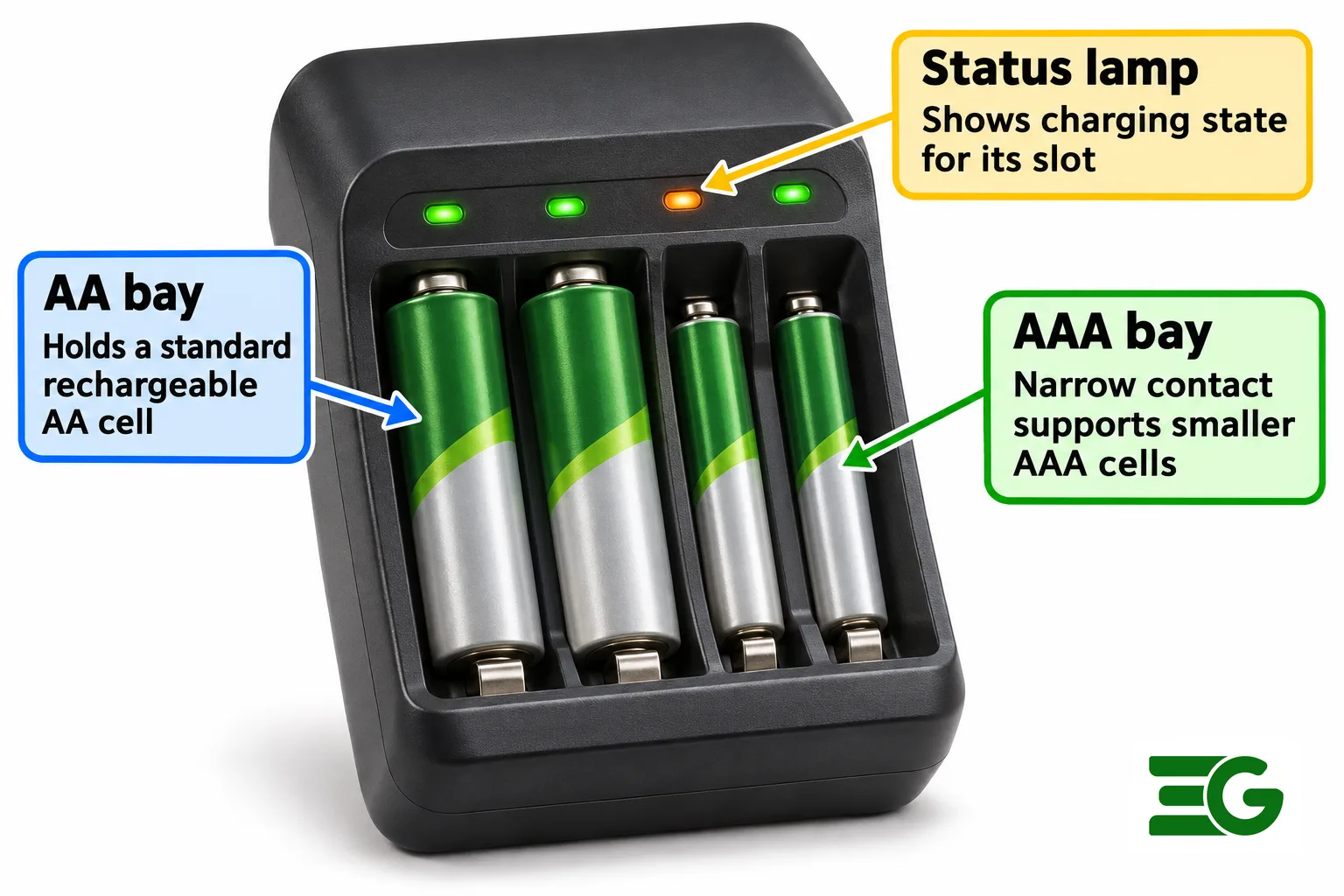
Some inexpensive chargers treat two cells as one charging pair. If one cell is older, the pair may finish unevenly. An independent-slot charger monitors each position, so a single AA cell can charge without a matching partner. Panasonic lists individual control and four indicators on its BQ-CC17N charger. That is a useful feature to compare, not a promise that every charger has it.
What a good indicator actually tells you
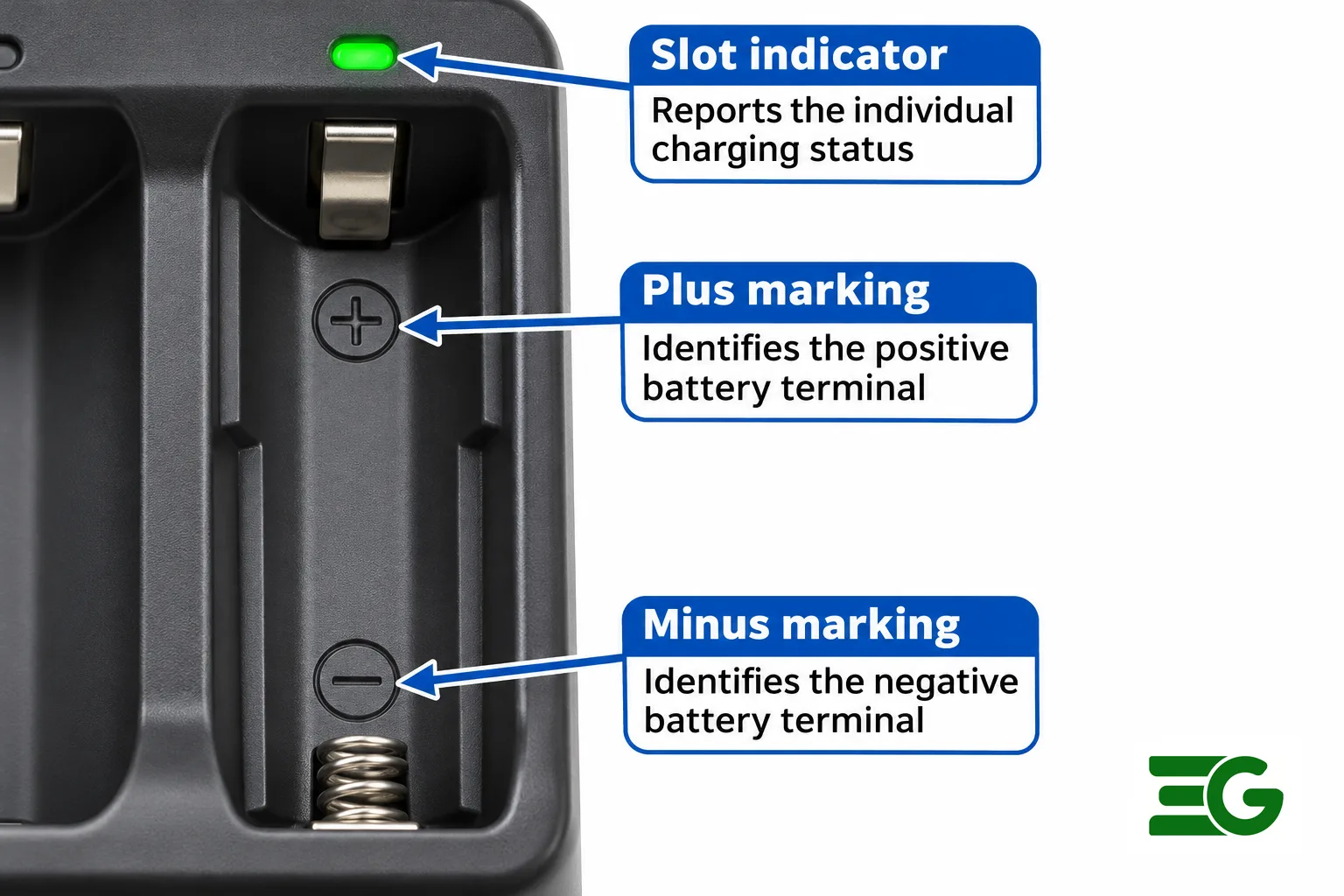
A lamp labelled charging is not a fuel gauge. On the Panasonic BQ-CC17, a solid green lamp means charging and the lamp goes out when the slot finishes; flashing can mean an invalid cell or incorrect insertion. Other models use red, amber or blinking codes differently. Read the manual for your model rather than assuming a blinking red light always means the same fault.
AA, AAA and 9V charger types compared
NiMH AA and AAA cells
Standard rechargeable AA and AAA cells are commonly 1.2 V NiMH. Their dimensions are different, but a charger may support both sizes with separate contacts. Check the markings beside each slot and the charger specification. Panasonic India lists the BQ-CC17 as accepting one to four AA or AAA cells, with approximate charge times of seven hours for a typical AA and six hours for a typical AAA.
Do not confuse a rechargeable 1.2 V NiMH AA with a disposable 1.5 V alkaline AA. They look alike. Charging a non-rechargeable alkaline cell can cause leakage or rupture. When we sort a mixed drawer of batteries, the first step is to separate anything without a clear rechargeable label.
Why a 9v battery needs its own charger
The rectangular 9v battery is not simply a larger AA. Rechargeable versions may contain NiMH or lithium-based cells with different internal arrangements. Their terminal shape can look identical even when the correct charge voltage is different. Use a charger explicitly approved for the specific rechargeable 9 V battery model. Never put a disposable 9 V alkaline battery on charge.
For a multimeter, smoke alarm or small circuit, verify the device manufacturer permits rechargeable 9 V batteries. Some rechargeable types have a different discharge curve or nominal voltage than alkaline units. Our 9 V battery listing is useful for checking the format, but its chemistry and rechargeability must be confirmed from the product label before selecting a charger.
A comparison you can use in the shop
| Battery | Typical chemistry | Charger requirement | Common use |
|---|---|---|---|
| AA | NiMH, 1.2 V | NiMH AA slot | Toys and cameras |
| AAA | NiMH, 1.2 V | NiMH AAA slot | Remotes and lights |
| 9 V format | NiMH or lithium | Exact 9 V chemistry | Meters and instruments |
| 12 V UPS | Sealed lead-acid | 12 V lead-acid profile | Backup power |
| 12 V lithium pack | Li-ion or LiFePO4 | Matching pack profile | Portable projects |
Can one rechargeable battery charger fit everything?
Check chemistry before voltage
No single basic charger safely handles every rechargeable battery. A NiMH termination circuit cannot be assumed to stop a lithium pack at its specified voltage. Similarly, a lead-acid float charger is not automatically suitable for LiFePO4. Some advanced multi-chemistry chargers genuinely support several types, but only when the manual names the chemistry and the correct operating mode.
Start with the exact words on the battery: NiMH, Li-ion, LiFePO4, SLA, AGM or flooded lead-acid. Then compare the charger manual, not just its marketing title. If either label is missing, we would postpone charging until the specifications are available. A damaged pack is not a good candidate for experimentation.
Voltage, current and polarity are separate checks
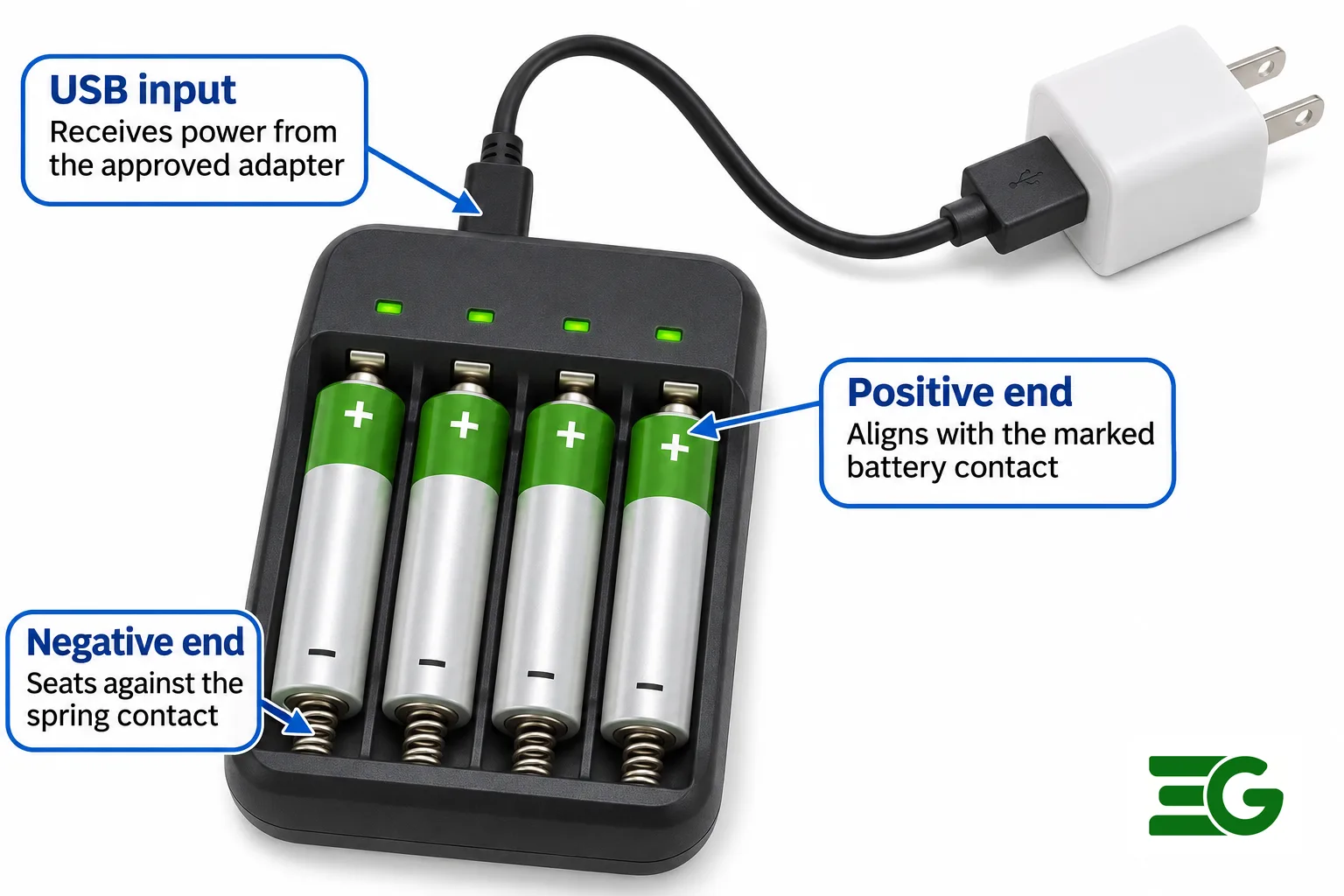
Voltage describes the charging profile; current controls how fast energy enters the battery. A 2000 mAh AA cell and a much larger home battery should not share the same current setting. Connector polarity also matters. On a cylindrical cell, the raised end is usually positive, but you must follow the charger markings. Reverse connection can damage electronics or trigger a protective shutdown.
Battery University explains that lithium-ion charging uses current and voltage limits and does not require lead-acid-style equalisation. See its lithium-ion charging guidance. This is why we reject the common advice to charge any battery from a spare 12 V adapter. The adapter rating does not establish safe charge termination.
The BMS is not the whole charger
Lithium battery packs may include a battery management system (BMS) that watches cells and disconnects them under fault conditions. That protection is valuable, but it does not replace a correctly matched charger. A BMS should be treated as a last line of protection, not as permission to feed a pack arbitrary voltage. The pack maker should state its recommended charging method.
Charging a 12v battery, UPS battery or inverter
Why home backup batteries are different
A home inverter and battery for home setup typically stores far more energy than handheld AA cells. Many UPS units use sealed lead-acid batteries; larger home systems may use tubular lead-acid or lithium packs. The inverter may contain a built-in charger, so adding an external charger without understanding the system can be unsafe. Always consult the inverter manual before changing battery type.
A nominal 12v battery is not necessarily charged at exactly 12 V. Battery University gives an example of 14.4 V for a six-cell lead-acid battery at 2.40 V per cell, while noting that voltage and current must be set for the battery. Read its lead-acid charging explanation for the reasoning. That figure is an example, not a universal setting.
UPS replacement is a matching exercise
If your UPS stops providing the expected runtime, the battery may be worn out. First check whether the UPS itself reports a battery fault and whether the replacement is the correct voltage, physical size and connector type. A 12 V 7 Ah sealed battery and a 12 V 9 Ah sealed battery may look similar, but enclosure clearance and charger limits still matter.
We would not replace a UPS battery with a random lithium pack just because it fits. A UPS designed for sealed lead-acid may not have the right lithium charge profile. Ask the manufacturer about supported replacements, and disconnect mains power before any service. If you are not trained to work around mains circuits, use a qualified technician.
Inverter charging and ventilation
Flooded lead-acid batteries can need water maintenance and ventilation. Sealed batteries have different care requirements and should not be opened. Lithium packs require the specified BMS and charging profile. Heat shortens the useful life of many battery systems, so a cramped cupboard beside a hot inverter is a poor location. Keep terminals protected from accidental metal contact.
For DIY 12 V electronics, a small pack such as our 12 V battery pack with DC connector belongs to a different category from a household inverter battery. A matching connector does not mean it can supply motor surge current or provide home backup. Check rated current, protection circuitry and the supplied charging instructions.
How to charge batteries without shortening their life
A simple charging routine
- Read the battery label and confirm that it is rechargeable. Identify chemistry, nominal voltage and capacity.
- Check the charger model and manual for that chemistry, cell size, permitted current and input voltage.
- Inspect for swelling, leakage, damaged insulation or hot terminals. Do not charge a damaged battery.
- Insert cells in the marked polarity or connect the approved battery connector with the power disconnected.
- Place the charger on a dry, open surface away from cloth and direct sun. Start charging and watch for normal indicator behaviour.
- When the charger signals completion, follow the manufacturer instructions for unplugging and removing the cells.
If a charger becomes unusually hot, smells odd or produces a fault indication that the manual cannot explain, disconnect power safely and stop using it. Do not leave improvised battery charging circuits unattended. For home backup equipment, follow the system installer and manufacturer rather than adapting this small-cell routine.
How long does a full charge take?
Charge time depends on cell capacity, charging current, termination method and temperature. For example, Panasonic quotes about seven hours for a 1900 to 2000 mAh AA on the BQ-CC17, and about six hours for a 750 to 800 mAh AAA. A higher current does not guarantee a healthier battery; excessive heat is a warning. Read the model-specific estimates instead of treating one hour as a universal target.
Should batteries stay in the charger?
For the BQ-CC17, Panasonic advises unplugging and removing batteries after the indicator signals completion. Other smart chargers may support a storage or maintenance mode. Follow the specific manual. Leaving batteries permanently in an unknown low-cost charger is not a sensible storage plan, especially in a warm Indian room.
Store cells away from heat and moisture, and keep loose batteries from touching metal objects. Do not mix old and new cells in devices that require matched sets. A cell that repeatedly heats up or loses charge unusually quickly may be nearing the end of its service life. Replacing it is often safer than repeatedly attempting to revive it.
Troubleshooting blinking lights and failed charging
Blinking red or green is model-specific
A flashing indicator can mean reverse insertion, an unsupported cell, poor contact, overheating or a defective battery. Panasonic describes flashing green on its BQ-CC17 when an invalid battery is detected or insertion is incorrect. Another manufacturer may use red for a similar warning. The LED colour alone is not a diagnosis. Check the printed model number and its indicator chart.
Unplug the charger before cleaning contacts. Use a dry cloth and inspect the springs for corrosion or damage. Then test a known-good, correctly labelled rechargeable cell in the same slot. If one slot fails with multiple healthy cells, the charger may be faulty. Do not bridge contacts with foil or metal tools to force charging.
When the charger does not start
Check the wall outlet, plug seating, USB power source if applicable, and whether the cell makes proper contact. A USB-powered charger may require more input current than an old low-output adapter can deliver. If the battery voltage has fallen below the charger acceptance threshold, the charger may refuse it for safety. We would not bypass that refusal with a bench supply unless following a qualified repair procedure.
When batteries finish but run out quickly
A charger indicating full does not guarantee the battery still has its original capacity. A worn NiMH cell may reach its termination point quickly and then power a toy for only a short time. Test it in another suitable device or with a charger that measures capacity. If performance remains poor, recycle the cell through an appropriate collection channel.
A rechargeable battery charger cannot repair physical damage or reverse every effect of age. Our preference is to replace a suspect cell rather than keep experimenting. This is especially true for lithium packs that are swollen, punctured or have suffered an unknown electrical fault.
Buying checklist for Indian homes and makers
Match your actual use before comparing price
If you mainly charge AA and AAA NiMH cells, buy a smart charger with individual channels, visible status and a published manual. If you need a 9v battery charger, confirm the exact 9 V chemistry. For a 12v battery or ups battery, the charger must explicitly support the battery type and its charge profile. A rechargeable battery charger advertised as universal deserves more scrutiny, not less.
What to check on the product page
- Supported chemistry and physical cell sizes, stated separately
- Independent slot control or paired charging behaviour
- Automatic charge termination and fault detection
- Input power specification suitable for Indian supply
- Warranty, model number and accessible instructions
- Battery capacity and charging time examples from the manufacturer
For small projects, browse battery parts and accessories only after deciding on chemistry and voltage. A holder, connector and protection board each solve a different problem. None is a substitute for a proper charger. If the seller lists only a voltage and a photograph, ask for the technical specification before ordering.
A practical final recommendation
For regular household NiMH use, a Panasonic-style independent AA/AAA charger is a clear reference design: the BQ-CC17N accepts one to four cells and uses individual control. We are not claiming it is the cheapest option in India or that it charges every rechargeable cell. For 9 V lithium or home inverter batteries, buy a separate chemistry-specific charger instead.
Conclusion: buy for chemistry, not the connector
A rechargeable battery charger is safe and useful only when it matches the battery chemistry, voltage and charging requirements. For AA and AAA NiMH, independent slots and automatic cutoff are worth paying attention to. For 9 V rechargeable formats and 12 V UPS or inverter batteries, check the exact model and charge profile before plugging anything in.
Start with the label on the battery you already own. Then compare the specifications in our battery selection and choose the charger that the battery manufacturer actually permits. That small check prevents a surprisingly expensive mistake.
Tagged