
Complete Guide to 12v Li Ion Battery Charger Requirements
Explore key 12v li ion battery charger requirements for 12v battery, 12v lithium ion battery & 12v rechargeable battery in embedded systems. Learn more now!
Alright, let’s clear the fog around 12v li ion battery charger requirements. If you’re tinkering with embedded systems or building your own solar or EV project, knowing your battery charging basics is non-negotiable. A 12V lithium ion battery isn’t as forgiving as old-school chemistries. You need the exact voltage, controlled current, and some solid safety logic. Miss one? You could cook your cells or halve your expensive battery’s life. Over half of project failures I’ve seen in India result from battery goof-ups—usually dodgy chargers or careless configuration.
Here at ElectroGlobal, we want you to nail your next 12v battery build. Whether you’re wiring up a scooter fleet or prototyping with a 12v battery and a microcontroller, matching your charger to your 12v lithium ion battery is the real hack for long battery life and peace of mind. Even a decent 12v rechargeable battery can get wrecked if you feed it just a little extra voltage. Meanwhile, the 12v 7ah battery price out there changes a lot, depending on the chemistry and protection circuits included.
Here’s what you’ll learn today, no jargon:
- What voltage, current, and charging logic your 12v li ion battery actually needs
- Why lithium ion and lead-acid are worlds apart when it comes to chargers
- How 12v 7Ah battery price swings based on build and features in India
- The safety bits you absolutely need—BMS, temp sensors, and chargers that know when to stop
- How to simulate and test your charger circuit in the cloud before you burn any silicon
Key Takeaways
- A 12v lithium ion battery pack is usually 3 or 4 cells in series.
- Charge at 12.6V (that’s 4.2V per cell for the 3-cell packs). Don’t go over, or you’ll risk damage.
- CC-CV charging is the way—constant current till full, then constant voltage.
- Set charging current to 0.5C–1C. For 7Ah cells, that’s 3.5A to 7A.
- Never use a lead-acid charger for a lithium ion battery. You’ll kill the battery or worse.
- Smart chargers with BMS and temp sensors keep your battery safe and living long.
Essential 12v li ion battery charger Requirements
Understanding Voltage and Current Specifications
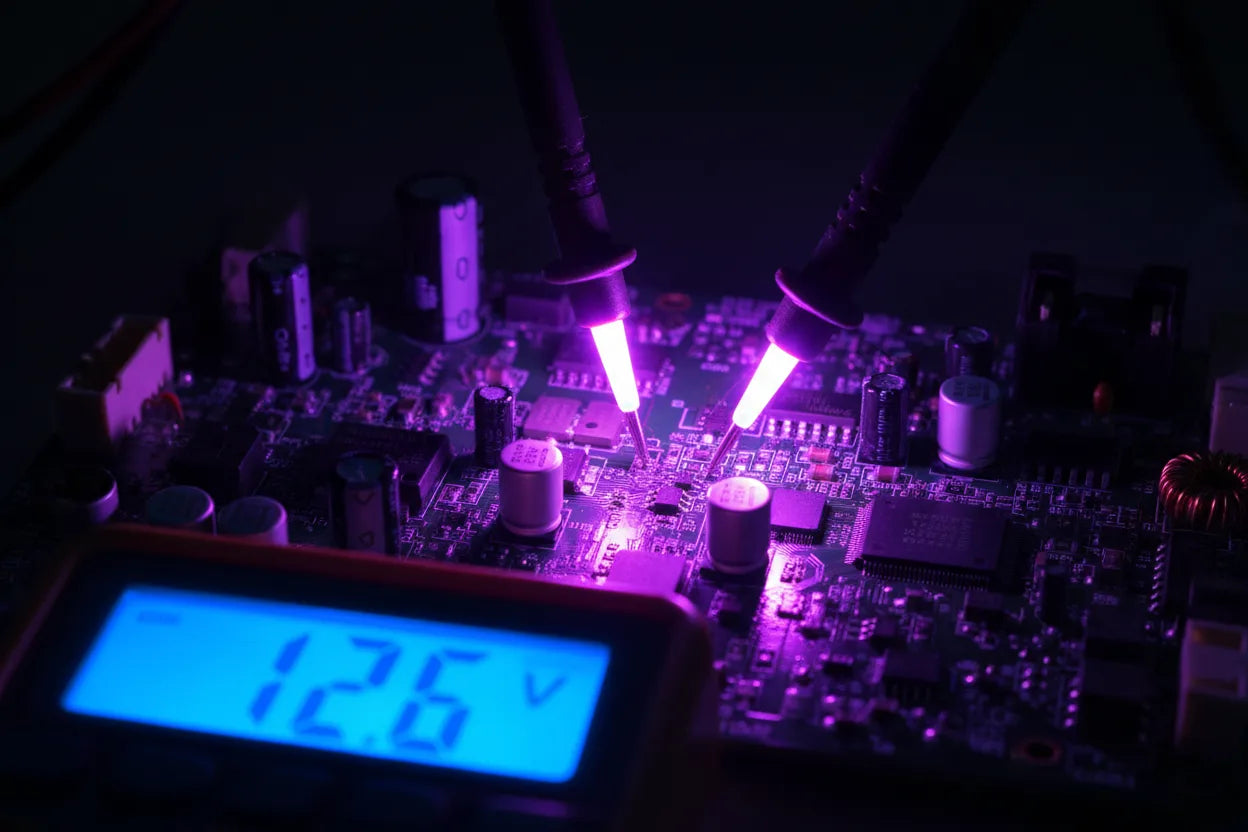
Your basic 12v lithium ion battery is just three cells wired up in series—each cell gives you 3.7V nominal. That adds up to 11.1V nominal, and it’s fully charged at 12.6V (because each cell maxes out at 4.2V). When picking or making a charger, set your output bang on 12.6V. Even a tiny overshoot can stress or overheat the battery and slash its lifespan.
Current is just as critical. Stick to 0.5C–1C charging. For a 7Ah battery, that’s between 3.5A and 7A. Slower charging (closer to 0.5C) is gentle but slow. Fast charging near 1C works if your BMS is solid and you’re monitoring temperature closely. Don’t rush it if you care about long-term results.
12V Li Ion Battery Charger Selection Checklist
- Output must be exactly 12.6V DC
- Current range adjustable between 0.5C–1C of battery rating
- CC–CV charging routine supported
- Good connectors to prevent accidental reverse wiring
- Built-in short circuit, overvoltage, and overcurrent protections
Implementing the CC-CV Charging Algorithm
Most 12v li ion battery charger circuits out there use the CC-CV method. Here’s the deal:
- You start with constant current (up to 1C) until the battery hits 12.6V.
- When you reach 12.6V, switch to constant voltage, holding it steady while the battery draws less and less current.
- Charging is done once current drops below 0.05C–0.1C.
Got an embedded design and want to test the charging profile before building real hardware? Use simulation platforms like ElectroGlobal’s RapidChip. This way, you’re sure the CC-CV logic works as expected before you grab the soldering iron. For anyone designing large-scale scooter batteries or just optimizing a UPS, simulating charge profiles is a game changer.
Bottom line: Get your voltage and current right, and follow CC-CV. This is non-negotiable for lithium ion packs.
Comparing 12V rechargeable battery Types and 12V 7ah battery price Factors
Lead-Acid Vs Lithium Ion: Charging Implications
Lead-acid and lithium ion aren’t just different inside—they need totally different chargers. A lead-acid charger can go up to 14.4V. If you hook that to a 12v lithium ion battery, you’ll almost guarantee damage or a safety mess.
Lithium ion batteries give you 2–3x more energy density and weigh less than lead-acids. They last longer too—over 1000 cycles is common (compared to 300–400 for lead-acid). If you’re building for embedded, portable, or e-mobility stuff, lithium ion is usually the better bet. Always match your charger to your battery chemistry. Don’t just swap them and hope it’ll work.
Worth remembering: Wrong charger = ruined battery or worse. Double-check your setup before you power on.
Pricing Trends for 12v 7ah Batteries in India
The 12v 7ah battery price in India covers a big range. Lead-acid batteries start at ₹1,500, while good lithium ion versions with BMS and sensors will cost ₹2,200 to ₹3,000 or more. What’s with the price swing? You’re paying for better cells, built-in protection, and in some cases, a much longer service life.
Let’s say you’re a hobbyist building a solar UPS. Lead-acid looks cheaper at first, but weigh in charger costs, maintenance, and lifespan. Lithium ion usually justifies the spend if you want something compact and reliable over years.
| Battery Type | Full Charge Voltage | Cycle Life | Typical 7Ah Price (INR) | Energy Density (Wh/kg) |
|---|---|---|---|---|
| Lead Acid | 14.4V | 300–400 | ₹1,500–2,000 | 30–50 |
| Lithium Ion (3S) | 12.6V | 1,000+ | ₹2,200–3,000 | 120–180 |
Bottom line: You really do get what you pay for. Higher upfront price for lithium ion pays off in lower maintenance and more cycles in the long run.
Implementing Safety Features in 12v lithium ion battery Chargers
Role of Battery Management Systems (BMS)
The BMS is your safety net. It watches voltages, cuts off charging if things go too high (above 4.25V per cell, or 12.75V for a 3-cell pack), and it stops discharge if you’re running too low. If a short happens, BMS shuts things down. All this keeps your pack healthy and you out of trouble.
Most 12v rechargeable battery packs now ship with BMS built-in—especially those for UPS, solar, or EVs. If your project is for an Indian e-scooter, you need a BMS by law. Steer clear of “cheap” packs missing this. They aren’t worth the liability or fire risk.
Incorporating Temperature Sensors for Smart Charging
Don’t ignore temperature sensors. Cells heat up during charging—especially if you’re charging fast. If a temp sensor sees things climbing past 55°C, the charger must slow down or stop. That’s how you avoid thermal runaway and boost battery life.
For embedded engineers, you can use NTC thermistors for hardware sensing or code up smart logic on your charger’s MCU. Indian EV and solar manufacturers now expect this as a basic safety feature. Put both BMS and temp sensors in your design and you’ll dodge most of the “my battery died suddenly” drama.
Bottom line: BMS and temperature protection aren’t extras—they’re must-haves for every modern 12v lithium ion battery charger project.

Design and Simulation Tools for 12v lithium ion battery Charger Development
Using ElectroGlobal RapidChip for Charger Circuit Simulation
Why risk real batteries or waste PCBs when you can test your 12v li ion battery charger circuit in the cloud? The ElectroGlobal RapidChip platform lets you draw your schematic, run the CC-CV algorithm, and even simulate BMS actions—all online. You can throw real-world scenarios at it, like cell imbalance or hot weather, and see how your design holds up.
Say you’re building a solar-powered UPS for the Indian market. Validate charger logic, protection, and timing on RapidChip first. It’s faster and way cheaper than burning through real batteries or making lots of hardware fixes.
Benefits of Cloud-Based Testing for Embedded Battery Management
Cloud simulation saves time, money, and headaches. You can tweak your code, try out different CC-CV logic, stress-test your BMS, and simulate failures—without ever plugging in a real 12v rechargeable battery. Tools like EGPT on RapidChip make it simple to compare charger designs or spot problems before they cost you.
This is especially handy if you’re working with new battery packs or higher capacity builds (like custom 12v 14Ah projects). You can be sure your charger is up for the job before you ever buy parts or spin a PCB.
Worth remembering: Cloud testing closes the gap between first sketch and working hardware. It’s the fastest way to confidence for any embedded battery project.
Powering Innovation With Safe Charging
Getting your charging voltage and current right is the secret sauce for long-lasting, safe 12v lithium ion batteries. Whether you’re driving an e-scooter, running a solar inverter, or tinkering with a microcontroller project, smart charger selection will make or break it. Add in proper BMS and heat sensors—now you’re playing to win.
Need to test before you buy parts? Electro Global has you covered. With RapidChip and EGPT, you can simulate, test, and finalize your 12v li ion battery charger circuit risk-free, before you ever touch hardware. Don’t gamble on something as core as your battery—simulate, verify, and launch with confidence.
Frequently Asked Questions
What is a 12v li ion battery charger and why is it different from ordinary battery chargers?
A 12v li ion battery charger is made for lithium ion batteries wired for 12V output, usually 3 cells in series. It’s not like old-school chargers. The output is locked at 12.6V and follows the CC-CV method. Use a random charger—even a lead-acid one—and you risk frying your battery the first time itself.
How does a CC-CV charger protect my 12v lithium ion battery from damage?
CC-CV chargers start with constant current to quickly fill up the battery until it hits 12.6V. Once it gets there, the charger switches to constant voltage and lets the current drop off naturally. This means you never overcharge or stress your cells. Charging ends at just the right spot—safe and simple.
Can I use the same charger for a 12v battery whether its lead-acid or lithium ion?
No way. A 12v battery can be either lead-acid or lithium ion, but the charging needs are different. Lead-acid can take higher voltages—lithium ion cannot! Using a charger for the wrong chemistry can ruin the battery or even cause a fire. Stick to the right charger for what you have.
What determines the 12v 7ah battery price in the Indian market?
Lots of things. The 12v 7ah battery price depends on chemistry (lead-acid is cheaper, lithium ion costs more), built-in BMS, sensors, brand, and quality. Lithium ion with good protection usually costs more, but you get a longer lasting and safer battery. Upfront price vs long-term value—it’s your call.
How do I know if my 12v rechargeable battery has a built-in BMS?
Most newer lithium ion packs, especially ones for UPS, solar, or e-mobility, mention BMS or “balancing” on their datasheet. If you’re unsure, check with your supplier. You can often spot a small PCB inside the pack under the wrapping—that’s your BMS right there.
Whats the main benefit of using a smart charger for a 12v lithium ion battery?
Smart chargers watch battery temperature, cell voltage, and sometimes even the number of charge cycles. They adjust how fast they charge based on all that info. That means your 12v lithium ion battery charges faster when it’s safe, but never overheats or gets damaged. You get longer battery life, fewer worries—especially in India’s hot weather.
What is the safest charge current for a 12v li ion battery?
Stick to 0.5C–1C of your battery’s Ah rating. For a 7Ah battery, that’s 3.5A–7A. Slower charging is safer and extends battery life. Fast charging works, but only if you monitor heat and use a BMS. Don’t rush unless you really need speed.
How can I test my charger design before building physical hardware?
Easy—use cloud simulation tools like RapidChip or EGPT. You can run your full charger circuit virtually, test the CC-CV logic, see how it handles heat or faults, and debug before you lay out a PCB. Saves time, money, and headaches. Do this first!
Is there any regulation around lithium ion battery charging in India?
Yep. India now requires BMS, proper short circuit and overcharge protection, and sometimes temp sensors for EV batteries. Check BIS or local rules before you try to sell or deploy anything. Getting this wrong can get you in trouble or banned from the market.
What’s the most common application for 12v li ion battery chargers in India today?
You’ll find these in solar UPS systems, e-bikes and scooter batteries, portable gadgets, and IoT devices. The affordable 12v 7ah battery price alongside long cycle life is a big reason why both rural and urban projects use them everywhere.
Can I upgrade my old lead-acid system to a 12v lithium ion battery?
Yes, but you’ll need to swap your old charger for a proper 12v li ion battery charger. Check that your BMS fits your application and never use the old lead-acid charger, or you’ll ruin your new battery. Also, check if your system’s low-voltage disconnect matches lithium ion specs.
How do ambient temperature and seasons affect 12v lithium ion battery charging?
High temperatures (like Indian summers) can make batteries heat up faster while charging. Always monitor battery temp and use chargers with auto cutoff or derating. In winter, charging may slow down, but overheating risk is lower.
Tagged
Related Content
Related Products
From the Blog
- Where to Use 7Ah Battery with 12v 7ah Battery Price Insights
- Comprehensive Guide to 12v Battery Types and Their Advantages
- Choosing the Right 6000 mAh Lithium Ion Battery for Your Device
- Comprehensive Guide to Choosing and Using 12v Lithium Ion Batteries
- Optimizing 12v Rechargeable Battery Runtime in Electronics Projects